CURRENT AFFAIRS | 23 JULY 2026
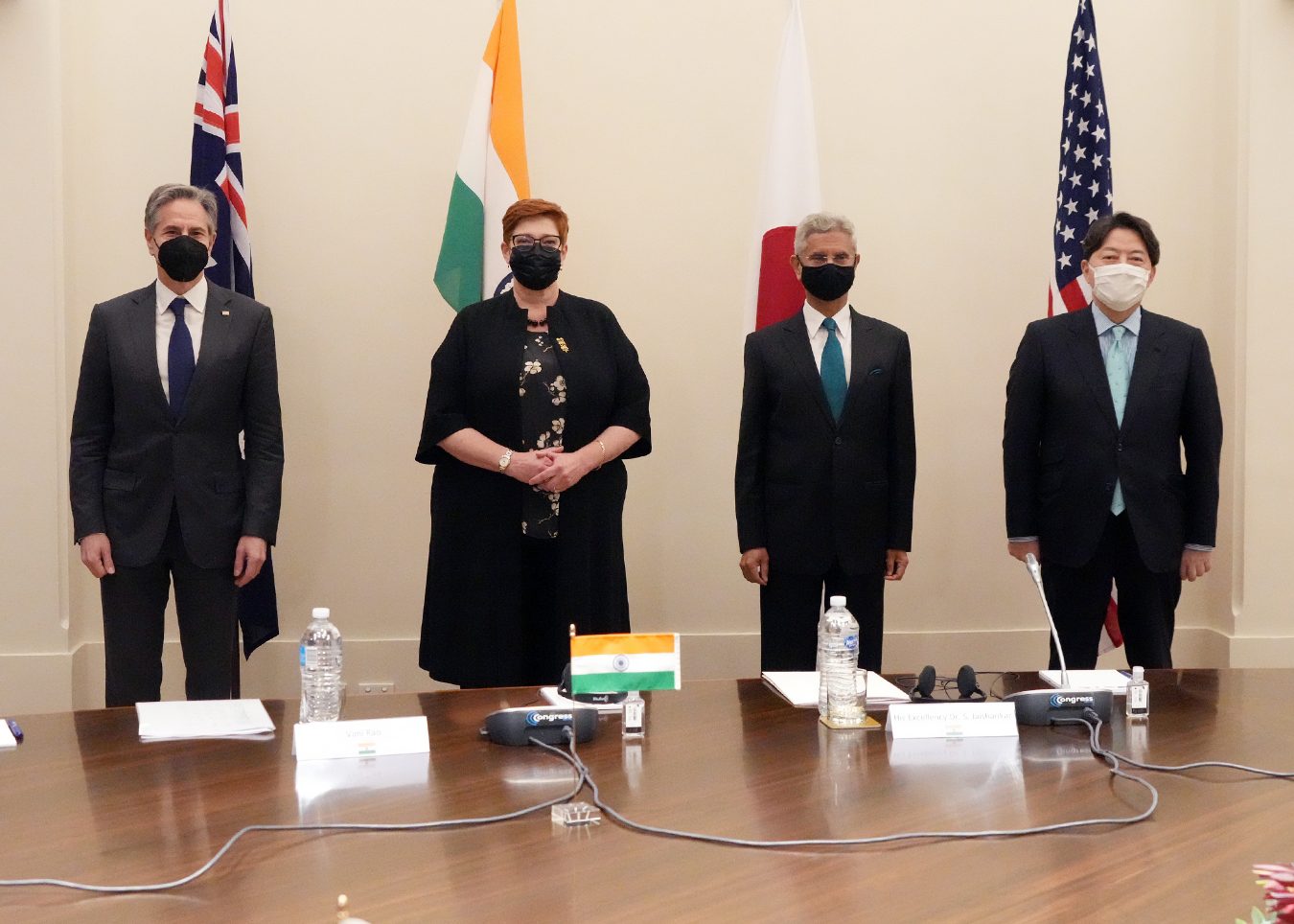
The Foreign Ministers of the Quad — India, the United States, Japan and Australia — met in Manila on the sidelines of the ASEAN Foreign Ministers’ Meeting and recommitted to a “Free and Open Indo-Pacific“. Their joint statement reaffirmed ASEAN centrality, maritime security and a rules-based order, with an unmistakable eye on China’s assertiveness in the region. For CLAT aspirants, this is prime international-relations GK: plurilateral groupings, ASEAN, and the law of the sea are all high-frequency themes.
The Quad (Quadrilateral Security Dialogue) is an informal, consultative strategic grouping — not a treaty-based military alliance like NATO. Its guiding idea is the Free and Open Indo-Pacific (FOIP), resting on ASEAN centrality (the ten-member Association of Southeast Asian Nations as the hub of regional architecture) and freedom of navigation. The legal bedrock for maritime claims and navigation is the United Nations Convention on the Law of the Sea (UNCLOS), 1982, which defines territorial seas, Exclusive Economic Zones (EEZs) and the freedom of the high seas. The Manila statement also referenced the goal of complete denuclearisation of North Korea.
The CLAT GK section leans heavily on India’s foreign-policy architecture. The Quad lets a passage test whether you can distinguish a plurilateral consultative grouping from a formal alliance, name the four members and their ministers, and connect FOIP to UNCLOS. Expect factual MCQs on the host city, the summit on whose sidelines it was held (ASEAN FMM), and the meaning of “ASEAN centrality”. A common trap: assuming the Quad is a military bloc with mutual-defence obligations — it is not. Lock in the members with a mnemonic and you have several easy marks.
| Grouping | Quad — India, US, Japan, Australia |
| Venue | Manila, Philippines (sidelines of ASEAN FMM) |
| Ministers | S Jaishankar (India), Marco Rubio (US), Penny Wong (Australia), Toshimitsu Motegi (Japan) |
| Reaffirmed | ASEAN centrality, maritime security, rule of law, concrete cooperation |
| Legal anchor | UNCLOS 1982 (freedom of navigation) |
| Also flagged | Complete denuclearisation of North Korea |
Members = “JAWA” or picture “I-USA-J-A”: India, USA, Japan, Australia. Think of four democracies drawing a “diamond” around the Indo-Pacific — the Quad was once literally called the “Democratic Security Diamond”. And FOIP floats on UNCLOS.
What was decided in Manila
The ministers used the meeting to signal continuity and resolve. They reaffirmed their shared vision of a Free and Open Indo-Pacific where sovereignty and international law are respected, disputes are resolved peacefully, and sea lanes remain open to trade. The statement stressed “concrete cooperation” — moving beyond declarations towards deliverables in areas such as maritime domain awareness, critical technology, supply-chain resilience and infrastructure. Importantly, the Quad reiterated ASEAN centrality, acknowledging that Southeast Asian nations, not outside powers, should sit at the heart of regional decision-making.
Understanding ASEAN centrality
ASEAN — the Association of Southeast Asian Nations — is a ten-member regional bloc. “ASEAN centrality” is the principle that ASEAN-led platforms (like the East Asia Summit and the ASEAN Regional Forum) should remain the primary venues for shaping the region’s security and economic architecture. By repeatedly affirming this, the Quad seeks to reassure smaller states that it is not a great-power club imposing its will, but a partner working within existing structures. For CLAT, remember the pairing: the Quad supports ASEAN centrality; it does not replace it.
Why UNCLOS matters here
The phrase “freedom of navigation” is not rhetoric — it is grounded in UNCLOS 1982, often called the “constitution of the oceans”. UNCLOS lays out the rights of coastal states over their territorial sea (12 nautical miles) and Exclusive Economic Zone (200 nautical miles), while preserving freedom of navigation and overflight in international waters. Tensions in the South China Sea, where expansive claims collide with UNCLOS, are the backdrop to the Quad’s maritime emphasis. The Quad’s insistence on a “rules-based maritime order” is essentially a call to uphold UNCLOS and settle disputes through law rather than force.
The Quad in India’s strategic map
For India, the Quad complements a wider web of partnerships without compromising its tradition of strategic autonomy. It is not a formal alliance, so India retains freedom to pursue other relationships, including within BRICS and the SCO. The grouping’s value lies in coordination — pooling capabilities on vaccines, climate, technology and maritime security. As global uncertainty grows, the Quad’s Manila meeting reinforced a simple message: like-minded democracies intend to keep the Indo-Pacific free, open and governed by rules. For the exam, the essentials are the four members, the host city, the ASEAN link and the UNCLOS foundation.
Practice Quiz — 10 CLAT-Style Questions
Click an option to reveal the answer and explanation.