CURRENT AFFAIRS | 28 APRIL 2026
CLAT GK + INDIAN POLITY & CONSTITUTIONAL LAW
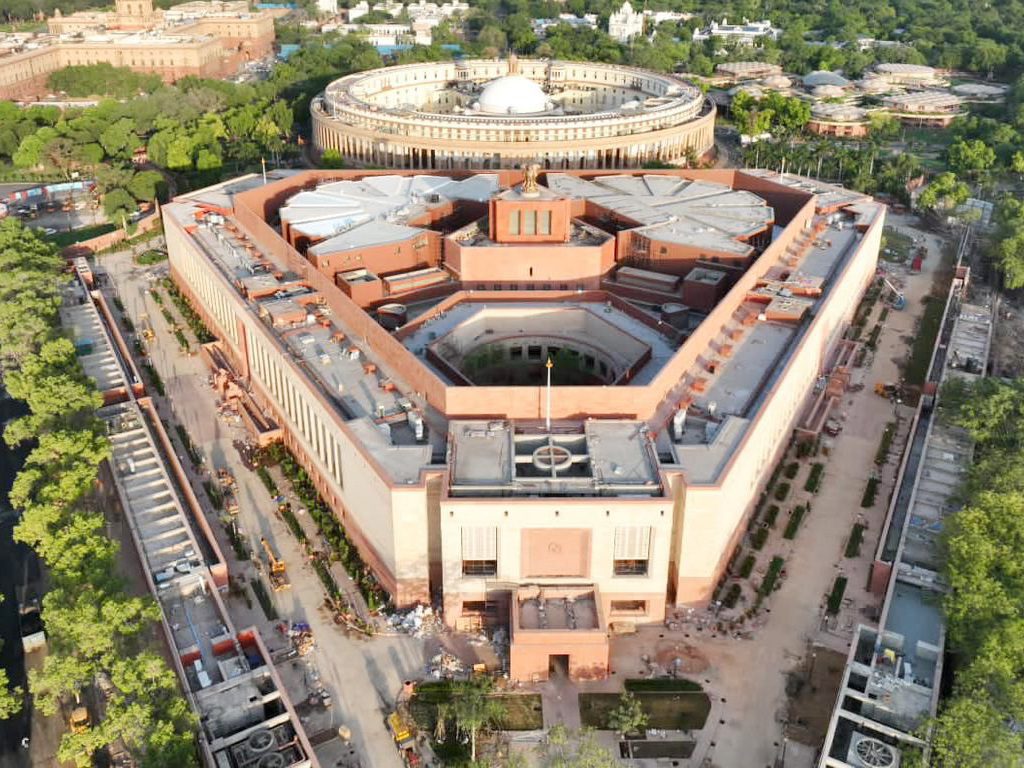
The Constitution (131st Amendment) Bill, 2026, introduced in Parliament on 16 April 2026, proposes one of the most consequential rewrites of India’s electoral architecture since 1976: it would increase the maximum strength of the Lok Sabha from 543 to 850, amend Articles 81, 82 and 170, allow Parliament to decide by simple majority when delimitation will occur and on which census, and bundle the operationalisation of women’s reservation (the Nari Shakti Vandan Adhiniyam, 106th Amendment, 2023) into the same package. The Bill was defeated in Lok Sabha on 17 April 2026 — 298 votes for, 230 against — falling short of the two-thirds majority required under Article 368.
In a sharply argued Indian Express op-ed today (28 April 2026), Congress Rajya Sabha MP Randeep Singh Surjewala contends that Clause 8 on women’s reservation is being used as rhetorical cover for the real intent: undoing the freeze on delimitation that has, since the 42nd and 84th Amendments, protected the parliamentary share of southern and smaller states which embraced family planning. He argues the women’s reservation provision should be brought back as a standalone amendment, in force by 2029, decoupled from any expansion of seats.
⚖️ Constitutional & Legal Framework
- Article 81 — composition of the House of the People; current ceiling 530 from States + 20 from UTs (= 550, of which 543 are filled).
- Article 82 — readjustment of LS constituencies after every census; suspended by the 42nd Amendment (1976), extended to 2026 by the 84th Amendment (2001).
- Article 170 — parallel provision for State Legislative Assemblies; the 131st Bill amends this too.
- Article 368 — amendment procedure: majority of total membership of each House plus 2/3 of members present and voting. The 131st Bill failed this second test.
- 106th Constitutional Amendment Act, 2023 — Nari Shakti Vandan Adhiniyam, inserted Articles 330A, 332A and 239AA(2)(b); passed Lok Sabha 454-2 and Rajya Sabha 214-0 (unanimous). Section 5 makes commencement contingent on the first census after enactment and subsequent delimitation.
- 73rd Amendment (Article 243D) and 74th Amendment (Article 243T), 1992 — one-third reservation for women in PRIs and Municipalities (already operational since 1993).
- 84th Amendment (2001) and 87th Amendment (2003) — froze inter-state allocation till after 2026 census; shifted intra-state delimitation base to 2001 census.
📚 Why This Matters for CLAT 2027
This is a five-marks-easy topic. Expect a passage giving the bill text and asking which Article is amended (Art 81/82/170 — not Art 330 unless the 106th Amendment angle is also tested). Watch for a Legal Reasoning trap on Article 368: the principle that ordinary majority cannot amend the Constitution even on a ‘procedural’ bill — the 131st Bill failed precisely because the qualified-majority test was not met. Surjewala’s argument also opens a clean question on doctrine of severability (whether women’s reservation can be carved out of a composite amendment) and on basic structure (federalism + free and fair elections — see Kesavananda Bharati, S.R. Bommai, Indira Sawhney). Cross-reference with the 73rd/74th Amendments since CLAT loves the gap between Panchayat-level reservation (already in force) and Parliament-level reservation (still pending).
📊 Key Facts at a Glance
| Element | Detail |
|---|---|
| Bill | Constitution (131st Amendment) Bill, 2026, introduced 16 April 2026 |
| Outcome | Defeated in Lok Sabha on 17 April 2026 (298 for, 230 against) |
| LS strength change | 543 (current filled) → 850 maximum (815 States + 35 UTs) |
| Articles amended | 81, 82, 170 (and consequential changes to 106th Amendment trigger) |
| Vote requirement (Art 368) | Majority of total membership + 2/3 of those present and voting |
| 106th Amendment, 2023 | Nari Shakti Vandan Adhiniyam — inserted Arts 330A, 332A, 239AA(2)(b) |
| Women in PRIs | 73rd Amendment (Art 243D), 1992 — already operational |
| Op-ed author | Randeep Singh Surjewala, Indian Express, 28 April 2026 |
🧠 Memory Hook
’81-82-170-368′ — the four-Article quartet of any LS expansion bill: 81 (composition) + 82 (readjustment) + 170 (state assemblies) + 368 (the gateway every Constitutional Amendment must pass).
‘NARI-2023, FREEZE-2026’ — Nari Shakti Vandan Adhiniyam was 2023’s headline amendment but its operation waits till the post-2026 delimitation; the 131st Bill tried to merge that wait with seat expansion and failed the Art 368 test.
The Road Ahead
With the 131st Bill defeated, three pathways remain on the table: (i) a fresh standalone Bill for women’s reservation alone, decoupled from delimitation — the route Surjewala urges, modelled on the 1996/2008/2010 standalone attempts; (ii) the Centre’s preferred composite approach reintroduced after the 2026 census is notified; or (iii) status quo, in which the 106th Amendment’s commencement awaits the post-2026 census-and-delimitation cycle, pushing real implementation to the early 2030s. For CLAT aspirants, the takeaway is that India’s electoral architecture is in genuine constitutional motion — and Articles 81, 82 and 368 are now active exam territory, not historical curiosities.
Practice Quiz — 10 CLAT-Style Questions
Click an option to reveal the answer and explanation.