CURRENT AFFAIRS | 21 SEPTEMBER 2026
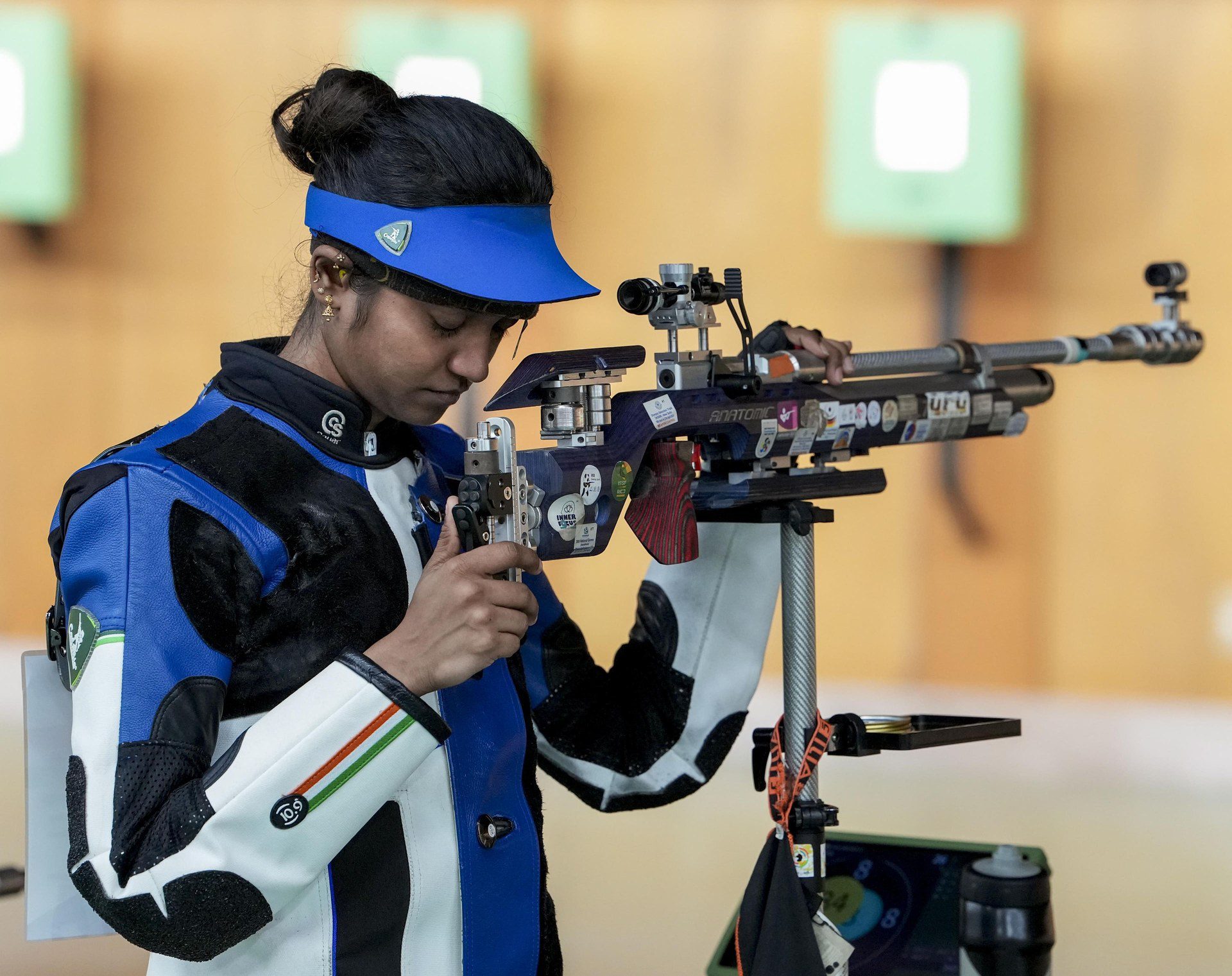
India opened its medal account at the 20th Asian Games, Aichi-Nagoya 2026, on Sunday, 20 September 2026, with two silver medals from the shooting range. In the morning, the trio of Elavenil Valarivan, Sonam Maskar and Vidarsa K Vinod combined for 1898.0 points to finish second in the women’s 10m air rifle team event — India’s first medal of the Games. Later the same day, Elavenil added an individual silver in the women’s 10m air rifle final, shooting 252.4 to finish just 0.6 points behind Japan’s Hinata Taichi (253.0). South Korea’s Ban Hyo-jin took bronze. The results were reported on 20 September by wire agencies and by China Daily, and in detail by The Indian Express on 21 September.
The team event was won by China (Wang Zifei, Han Jiayu and Du Yuchen) with 1904.2 points, which China Daily reported as a new world record, bettering the previous mark of 1902.0. Hosts Japan took bronze with 1897.1 — just 0.9 behind India. According to The Indian Express, Sonam led the Indian effort in qualification with 634.1, while Elavenil, the senior member of the team, contributed 633.5.
The Games at a glance
The 2026 Asian Games are hosted by Aichi Prefecture and the city of Nagoya in Japan. The opening ceremony was held on 19 September and the closing ceremony is scheduled for 4 October 2026, although some team sports such as football and basketball began earlier, on 10 September. According to ESPN’s official-schedule guide, 469 medal events across 43 sports will be contested at 54 venues. New additions to the programme include freestyle BMX, mixed martial arts, padel, surfing, teqball and virtual taekwondo. The shooting competition is being held at the Aichi Prefectural General Shooting Gallery near Toyota City, which The Indian Express reports is up to a two-hour bus ride from Nagoya — its correspondent described Indian shooters using neck pillows and avoiding phone screens to stay fresh on the winding road.
India sent a contingent of nearly 500 athletes. Its benchmark is the previous edition: at Hangzhou 2022 (postponed and held in 2023 because of the pandemic), India won 107 medals — 28 gold, 38 silver and 41 bronze, according to All India Radio at the close of those Games. It was the first time India crossed 100 medals at any of the three major multi-sport Games (Olympics, Commonwealth Games, Asian Games); the previous best had been 70 at Jakarta-Palembang 2018. Olympic javelin champion Neeraj Chopra is missing the 2026 Games because of an ankle ligament injury.
Background & Framework
History. The first Asian Games were held in New Delhi in 1951, making India the founding host. The Games are held every four years and are today governed by the Olympic Council of Asia (OCA), headquartered in Kuwait City. The motto is “Ever Onward”. Japan has hosted twice before — Tokyo 1958 and Hiroshima 1994 — so Aichi-Nagoya is its third edition. The next two Games are awarded to Doha (2030) and Riyadh (2034).
The sport. Shooting is governed internationally by the ISSF (International Shooting Sport Federation) and in India by the National Rifle Association of India (NRAI). In 10m air rifle, athletes shoot from a standing position at a target 10 metres away. Qualification scores (such as 634.1) decide the eight finalists; the final is shot afresh with decimal scoring, where the best single shot is 10.9. In the team event, the qualification totals of the three shooters are added — which is how India reached 1898.0.
The support system. Two Union Sports Ministry schemes underpin elite preparation: the Target Olympic Podium Scheme (TOPS), launched in 2014, which funds top athletes’ training and equipment, and Khelo India, the grassroots-to-elite programme. The Indian Express notes that Vidarsa’s career steadied after she joined a SAI National Centre of Excellence, where equipment, nutrition and training support eased financial pressure.
How the individual final was decided
The Indian Express published a stage-by-stage breakdown of Elavenil’s final. She opened with 106.0 from her first ten shots and led the eight-woman field for all but the last two shots. After twenty shots she was on 211.1, narrowly ahead of Hinata. In the closing series her lead slipped — a 10.1 on her 18th shot, fired after she held the trigger a moment too long, opened the door — and Hinata pipped her at the finish, 253.0 to 252.4. The paper described the margin as the width of the edge of a coin. Elavenil said there was “a bit of disappointment” at losing a good lead but that she saw scope to learn from it. Sonam, the other Indian finalist, finished sixth.
For Elavenil, 27 and a two-time Olympian, it was her first medal at a major multi-sport Games, at her second Asian Games. The Indian Express recounts that she was world No. 1 going into the Tokyo Olympics but finished 16th in qualification there; she was not in the team for Hangzhou; and she finished 10th in qualification at Paris. Born in Cuddalore and raised in Ahmedabad, she is mentored by Gagan Narang, who himself won team and individual silvers at his first Asian Games in 2010.
Three routes to one podium
The team medal is also a story of how Indian sport produces depth. Sonam Maskar took up shooting as a college hobby in Mumbai in 2018; when the pandemic hit the family business, her father sold a plot and a shop to buy her rifle and kit. Vidarsa K Vinod, from Kozhikode, picked up a rifle through the NCC, trained on borrowed equipment until her family took a loan in 2021, and moved to Delhi’s Dr Karni Singh Shooting Range. Rifle coach Deepali Deshpande told the paper before the Games that India’s depth in rifle and pistol events is why it can hope for team medals in most shooting events.
The CLAT Angle
Sports questions in CLAT’s Current Affairs section are typically set around a passage that mixes the news with static facts. From this story, the high-probability recall points are: the edition (20th), host (Aichi-Nagoya, Japan), dates (19 September–4 October 2026), India’s first medal (women’s 10m air rifle team silver) and its members, the individual silver and the gold medallist’s nationality, the governing body (OCA, Kuwait City) and the first Games (New Delhi, 1951).
For Quantitative Techniques, the scores are a ready data set: China’s 1904.2 minus India’s 1898.0 is a 6.2-point gap; India beat Japan by 0.9. For Reading Comprehension, the Express profiles lend themselves to an inference question: does the team medal reflect individual talent or an ecosystem of coaches, centres and family sacrifice? A good answer notes that the passage presents both, and that “depth” — several shooters of similar standard — is precisely what team events reward.
Other Indian results on Day 2
The Indian Express Day 2 capsule also recorded: the women’s badminton team of PV Sindhu, Unnati Hooda and Tanvi Sharma beating Kazakhstan 3-0 to reach the team quarter-finals; the men’s hockey team opening with a 13-1 win over Indonesia; and the women’s hockey team beating Uzbekistan 19-0. On the same page, the paper reported that IOC President Kirsty Coventry, a former Olympic swimming champion, praised the athletes’ accommodation in Japan.
Key Facts
- Games: 20th Asian Games, Aichi-Nagoya, Japan; 19 September–4 October 2026.
- Scale: 469 events, 43 sports, 54 venues.
- India’s first medal: women’s 10m air rifle team silver, 20 September 2026.
- Team: Elavenil Valarivan, Sonam Maskar, Vidarsa K Vinod — 1898.0.
- Team podium: China 1904.2 (reported world record), India 1898.0, Japan 1897.1.
- Individual final: Hinata Taichi (Japan) 253.0 gold; Elavenil 252.4 silver; Ban Hyo-jin (South Korea) bronze.
- Margin: 0.6 points; Sonam Maskar finished sixth.
- Venue: Aichi Prefectural General Shooting Gallery, near Toyota City.
- Benchmark: Hangzhou 2022 (held 2023) — 107 medals, 28 gold.
- First Asian Games: New Delhi, 1951; governing body OCA, Kuwait City.
- Japan’s earlier editions: Tokyo 1958, Hiroshima 1994.
- Next hosts: Doha 2030, Riyadh 2034.
Reading the result
An opening-day double silver does not decide a campaign that runs to 4 October, but it sets a tone. Shooting has become one of India’s most reliable medal sources at multi-sport events, and the team-event structure rewards exactly the kind of depth the Express reporting describes. The individual final, meanwhile, is a reminder of how fine the margins are in decimal-scored sport: over 24 shots, the difference between gold and silver was a single shot a few tenths lower. For aspirants, the useful discipline is to separate the verifiable facts (scores, names, dates, bodies) from the narrative (sacrifice, resilience) — both appear in passages, but only the first can be tested as a single correct option.
Memory Hook / Mnemonic
“ESV opened India’s tally” — Elavenil, Sonam, Vidarsa: team silver, 1898.
“Point-six to the Rising Sun” — Elavenil lost gold by 0.6 to Japan’s Hinata (252.4 vs 253.0).
“Delhi began it, Kuwait runs it, Nagoya hosts it” — first Games 1951 New Delhi; OCA in Kuwait City; 20th edition in Aichi-Nagoya.
Practice Quiz — 10 CLAT-Style Questions
Click an option to reveal the answer and explanation.