
CURRENT AFFAIRS | 21 SEPTEMBER 2026
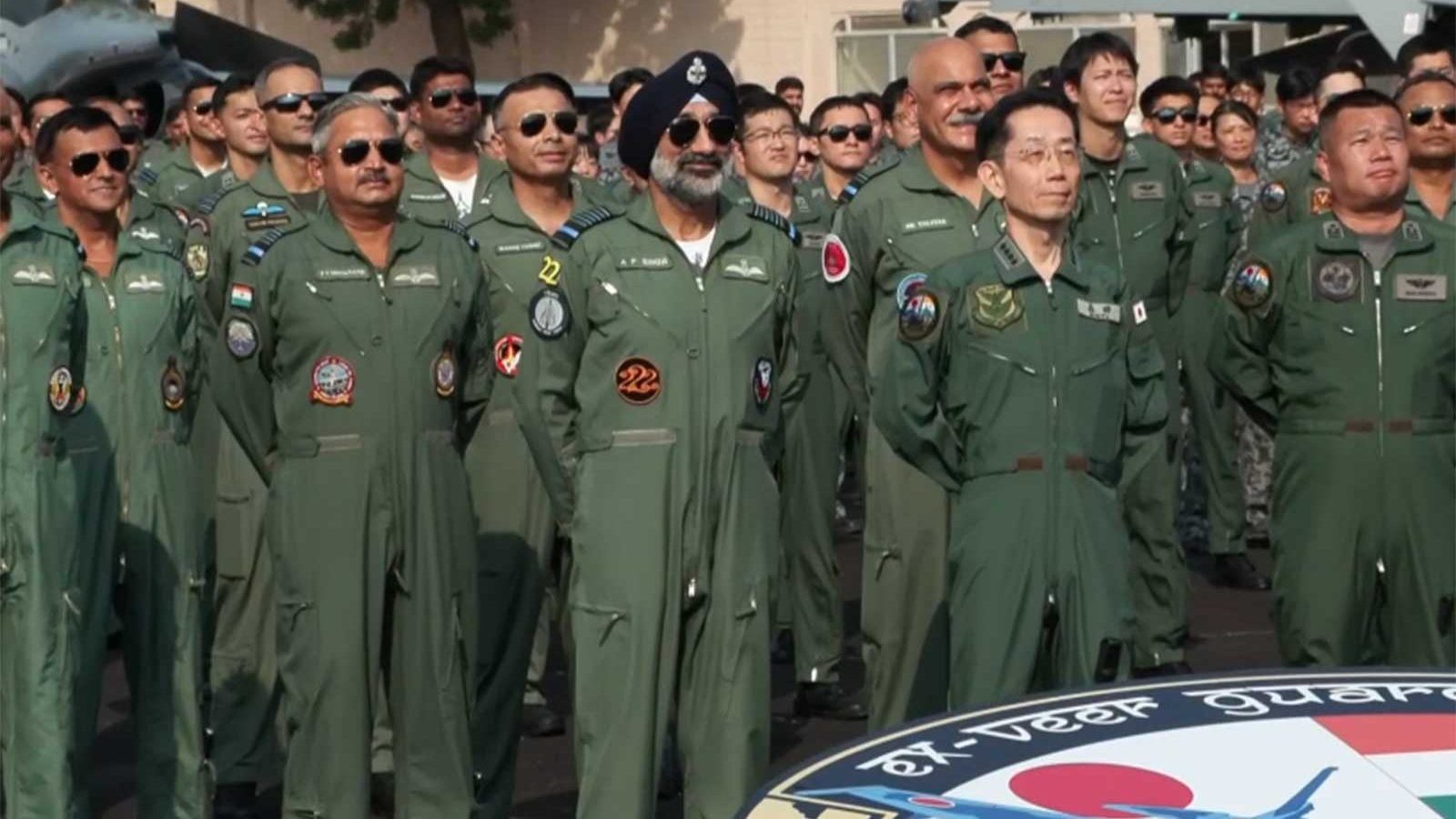
On Sunday, 20 September 2026, the Chief of the Air Staff, Air Chief Marshal Amar Preet (A P) Singh, and the Chief of Staff of the Japan Air Self-Defense Force (JASDF), General Takehiro Morita, flew in separate LCA Tejas jets as part of a formation sortie at Air Force Station Jodhpur. The sortie was the showpiece moment of Exercise Veer Guardian-2026, a 14-day bilateral air exercise between the Indian Air Force (IAF) and the JASDF that runs from 9 to 22 September 2026. As reported by ANI and PTI on 20 September and carried by The Indian Express on 21 September under the photo caption “Sky-high exercise”, the IAF is fielding a mix of frontline combat aircraft — the indigenous LCA Tejas, the Su-30 MKI and the Rafale — while the JASDF is participating with its F-2A fighter aircraft.
The headline significance lies in geography. According to the Ministry of Defence and the IAF, this is the first time JASDF fighter aircraft are operating from Indian soil as part of a bilateral exercise. Defence Minister Rajnath Singh described Tokyo’s decision to send its fighters as a “significant milestone” for the India–Japan defence partnership, saying the maiden visit of JASDF fighter aircraft to India reflects growing trust and a shared commitment to peace and stability in the Indo-Pacific. For a country whose post-war Constitution renounces war as a sovereign right, sending combat jets to train in a partner’s airspace is a meaningful signal.
What the exercise involves
The exercise was announced by the Ministry of Defence on 8 September 2026 (reported the same day by DD News). According to that statement, the two air forces are undertaking advanced operational missions and extensive professional interaction: mission planning conferences, subject-matter-expert exchanges, and discussions on engineering practices and aerospace safety. The stated aim is to enhance interoperability — the ability of two forces to plan, communicate and fly together without friction — and to strengthen “tactical proficiency and aerospace operational synergy”. The Ministry described the exercise as reflecting the deepening strategic partnership between India and Japan.
The choice of aircraft is itself a talking point. The Tejas, built by Hindustan Aeronautics Limited (HAL), is India’s homegrown light combat aircraft and a flagship of the Atmanirbhar Bharat push in defence manufacturing; putting a foreign air chief in its cockpit is also a showcase. The Su-30 MKI is the backbone of the IAF’s fighter fleet, and the Rafale is its most modern multirole jet. On the Japanese side, the F-2 is a multirole fighter that Japan co-developed with the United States, derived from the F-16 design.
Veer Guardian-2026 is the second edition of the exercise. The first edition, Veer Guardian-23, was held in January 2023 at Hyakuri Air Base in Japan, north-west of Tokyo. It was the first-ever bilateral fighter exercise between the two air forces; the IAF then sent Su-30 MKI fighters supported by IL-78 mid-air refuellers, while the JASDF flew F-2 and F-15 fighters. The 2026 edition thus reverses the direction of travel: in 2023 Indian jets went to Japan; in 2026 Japanese jets came to India.
Background & Framework
The partnership. India and Japan upgraded their relationship to a “Special Strategic and Global Partnership” in 2014. Defence is now one of its most active pillars. The two countries hold a 2+2 Ministerial Dialogue (foreign and defence ministers of both sides), the first of which met in New Delhi in 2019. In September 2020 they signed the Acquisition and Cross-Servicing Agreement (ACSA), which allows the armed forces of each country to obtain supplies and services such as fuel, food and spare parts from the other on a reciprocal basis — the kind of logistics arrangement that makes exercises like Veer Guardian easier to host.
The exercise family. Each service now has a bilateral exercise with Japan: JIMEX (Japan–India Maritime Exercise, navies), Dharma Guardian (armies), Shinyuu Maitri (an earlier IAF–JASDF exercise involving transport aircraft) and now Veer Guardian (fighters). Both countries also take part in the multilateral naval exercise Malabar and are members of the Quad with the United States and Australia.
The Japanese constitutional context. Article 9 of Japan’s 1947 Constitution renounces war as a sovereign right of the nation. Japan therefore maintains “Self-Defense Forces” rather than an army, navy and air force in name — which is why the JASDF is called what it is.
Why a fighter exercise in Jodhpur matters
Three strands of analysis follow from the news. First, strategic signalling. Joint fighter drills are the most demanding form of air-force cooperation because they involve combat tactics, communications procedures and airspace management. Hosting them in India — rather than only sending Indian jets abroad — indicates a relationship moving from goodwill visits towards operational familiarity. Rajnath Singh’s explicit reference to the Indo-Pacific places the exercise within the broader effort of like-minded democracies to keep that region open and rules-based.
Second, reciprocity and logistics. Deploying fighters thousands of kilometres from home requires transport aircraft, spares, fuel and ground support. Frameworks such as the ACSA exist precisely to make such deployments smoother, and the successful staging of Japanese jets in Rajasthan is a practical test of that architecture.
Third, indigenous capability on display. The image of two air chiefs flying Tejas jets side by side was widely circulated on 20 September. For India, it serves an export and prestige purpose; for Japan, it is a chance to observe an Indian-built platform at close quarters.
The CLAT Angle
CLAT’s Current Affairs section is passage-based, so expect a 400-word extract on the exercise followed by questions that test precise recall and inference: Which edition is this? (second). Where was the first held? (Hyakuri, Japan, 2023). Which aircraft did each side field? What is “first” about 2026? (JASDF fighters operating from Indian soil in a bilateral exercise). A well-set question may also ask you to match exercises to services — JIMEX to the navy, Dharma Guardian to the army, Veer Guardian to the air force — a classic distractor trap.
In Legal Reasoning and Logical Reasoning, the Japanese angle offers a ready premise: a constitution that renounces war (Article 9) yet permits self-defence forces. A passage could ask whether training with a foreign air force is consistent with a self-defence-only mandate — the answer depends on how the passage defines “self-defence”, so read the principle, not your prior knowledge. Also note the distinction between an agreement (ACSA, a binding logistics arrangement) and a partnership label (“Special Strategic and Global Partnership”, a diplomatic framing) — examiners like to test whether you can tell a legal instrument from a political description.
Sidebar: the Army’s AASHVAST labs
The same edition of The Indian Express (21 September, pages 1 and 2) carried a separate defence-technology story that belongs in the same revision file. According to that report, the Indian Army will soon operate six AASHVAST labs across the country, where all its drones — and eventually CCTV cameras — will undergo mandatory inspection to identify and eliminate firmware-level vulnerabilities. AASHVAST stands for Assessment and Analysis of Electronic Systems Hardware for Vulnerabilities and Security Threats. One lab has been inaugurated in Delhi, with at least five more planned in the coming months. The labs work under the Directorate General of Electronics and Mechanical Engineering (DG EME) and, per the report, will also check drones for Chinese or other foreign-origin active components, hidden passwords, embedded keys and remote-access tools — addressing the problem that an invoice shows where a part was bought, not where it was made. The report notes that the Army’s public-information directorate had announced the facility on X on 14 August; the new element in the 21 September report is the plan to scale up to six labs.
Key Facts
- Exercise: Veer Guardian-2026, bilateral air exercise, IAF and JASDF.
- Venue: Air Force Station Jodhpur.
- Duration: 14 days, 9–22 September 2026; announced by the Ministry of Defence on 8 September.
- Edition: Second; first edition Veer Guardian-23 at Hyakuri Air Base, Japan, January 2023.
- IAF aircraft: LCA Tejas, Su-30 MKI, Rafale.
- JASDF aircraft: F-2A fighters.
- First: JASDF fighter aircraft operating from Indian soil in a bilateral exercise.
- 20 September sortie: Air Chief Marshal A P Singh and General Takehiro Morita flew in separate Tejas jets.
- Rajnath Singh: called it a “significant milestone” for the defence partnership.
- Framework: Special Strategic and Global Partnership (2014); 2+2 dialogue (first 2019); ACSA (2020).
- Sister exercises: JIMEX (navy), Dharma Guardian (army), Shinyuu Maitri (air force).
- Sidebar: AASHVAST — Army drone-firmware labs; one in Delhi, six planned (IE report, 21 Sep).
How to read this for the exam
Defence exercises are a staple of current-affairs sections, and the risk is rote memorisation of names without context. The better approach is to build a small matrix for each strategic partner: the relationship label, the institutional dialogue, the key agreement, and one exercise per service. For Japan, that matrix reads: Special Strategic and Global Partnership; 2+2; ACSA; JIMEX, Dharma Guardian, Veer Guardian. Once the grid exists, a news item like this one simply updates a cell — “Veer Guardian: second edition, India, 2026” — rather than becoming a stray fact.
Examiners also like the word “first”. Be precise about what is first here. It is not the first India–Japan air exercise (that was in 2023), and it is not the first time the two air forces have trained together in any form. It is the first time JASDF fighter aircraft have operated from Indian soil in a bilateral exercise. Options that blur these distinctions are the likeliest wrong answers.
Finally, keep the two stories of the day in their proper boxes. Veer Guardian is about partnership and interoperability abroad; AASHVAST is about supply-chain security at home. Together they sketch the two faces of modern defence policy — working more closely with trusted partners while scrutinising more carefully what goes inside one’s own equipment.
Memory Hook / Mnemonic
“VEER flies, DHARMA marches, JIMEX sails.” Veer Guardian = air force, Dharma Guardian = army, JIMEX = navy.
For the two editions: “23 went East, 26 came West” — 2023 at Hyakuri in Japan, 2026 at Jodhpur in India.
For the aircraft: “TSR vs F-2” — Tejas, Su-30 MKI, Rafale against Japan’s F-2A. And for AASHVAST: “the invoice lies, the silicon tells”.
Practice Quiz — 10 CLAT-Style Questions
Click an option to reveal the answer and explanation.