CURRENT AFFAIRS | 24 SEPTEMBER 2026
Day 6 of the Aichi–Nagoya Asian Games, Thursday 24 September 2026, was India’s busiest day of the Games so far: five medals — two silver and three bronze, spread across wushu, athletics, rowing and shooting. The Indian Express of 25 September carried the day’s capsule and the medal table; the individual results are confirmed by the Games coverage of the same evening. This article is written as of the close of Day 6. Day 7 results were not available at the time of writing and nothing here should be read as reporting them.
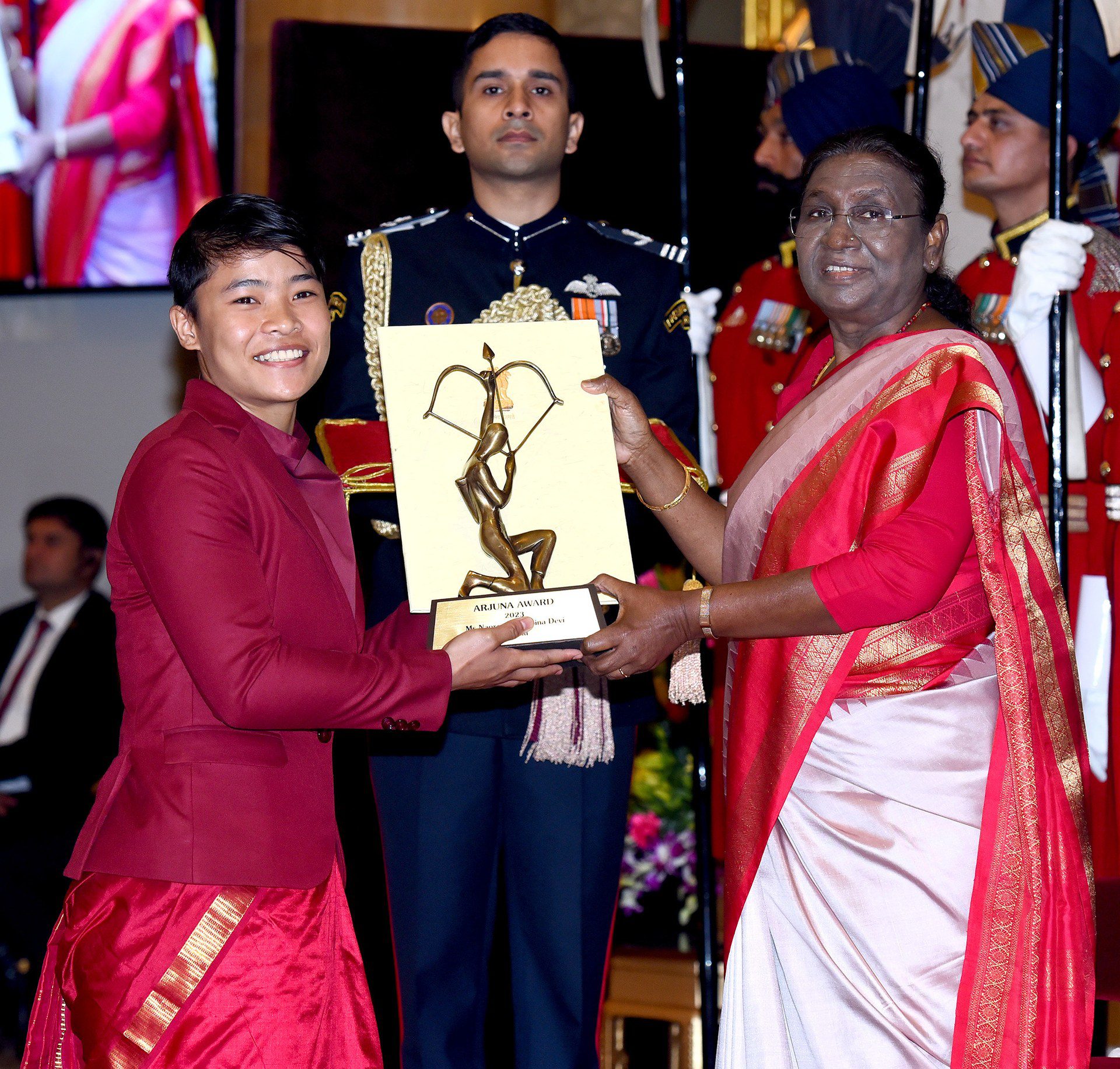
The headline performance belonged to Naorem Roshibina Devi, who won silver in the women’s 60 kg sanda event in wushu. She beat Macao’s Chu Man Sin in the quarter-final and Indonesia’s Thania Kusumaningtyas in the semi-final before losing the final to China’s Zhang Xiaoyu. It was her third consecutive Asian Games medal — bronze at Jakarta–Palembang 2018, silver at Hangzhou, and silver again now — a sequence no other Indian wushu athlete has managed.
The day’s medals, event by event
On the track, the mixed 4×400 metres relay quartet took silver in 3:14.46, retaining the colour India won in the previous edition. Bahrain took gold in a Games-record 3:12.87. The reported Indian quartet was Machettira Poovamma, Vishal Thennarasu, Ramraj Vithya and Thekkinalil Manu; spellings and the running order vary slightly between reports, so treat the names as reported rather than official until the result sheet is published.
The most emotionally resonant result of the day came in the women’s 10,000 metres, where Seema took bronze in 32:50.05 — India’s first Asian Games medal in that event since 2010. The race, as the Indian Express reported it, was tactically slow: the field passed 1,000 m in 3:18 and 5,000 m in 16:52, unhurried for athletes of that calibre, because nobody wanted the responsibility of leading. Seema sat in, moved up with three laps to go, passed two established distance runners and held third as the leaders pulled clear. Bahrain’s Winfred Yavi took gold in 32:39.18, with Japan’s Nozomi Tanaka second in 32:41.54. Her winning time was close to 48 seconds slower than the personal best she had run in March — a useful reminder for students that a championship race is a contest against people, not against the clock.
In rowing, Satnam Singh and Salman Khan won bronze in the men’s double sculls, clocking 6:13.25 in the final. In shooting, Anantjeet Singh Naruka and Parinaaz Dhaliwal — both already medallists in their respective team events — paired up in the mixed team skeet and took bronze.
Background & Framework
The Asian Games are the continent’s multi-sport championship, held every four years. The first edition was staged in New Delhi in 1951, and India hosted again in 1982. The Games are governed by the Olympic Council of Asia (OCA), the continental body recognised by the International Olympic Committee; India’s participation is routed through the Indian Olympic Association (IOA), the National Olympic Committee. The four-year cycle was disturbed once in recent memory: the edition awarded to Hangzhou, formally titled the 2022 Asian Games, was postponed because of the COVID-19 pandemic and actually held from 23 September to 8 October 2023 — which is why the same Games are referred to sometimes as “Hangzhou 2022” and sometimes as “2023”. At Hangzhou, India crossed 100 medals for the first time in Asian Games history and finished fourth in the overall medal tally, its best-ever performance. On the domestic side, athlete support runs through the Khelo India programme, which builds grassroots and academy-level competition, and the Target Olympic Podium Scheme (TOPS), which funds a small identified pool of elite athletes. Anti-doping is administered by the National Anti-Doping Agency (NADA) under the National Anti-Doping Act, 2022, within the framework of the World Anti-Doping Agency (WADA) Code.
Where India stood at the end of Day 6
As of the close of Day 6, per the medal table published by the Indian Express on 25 September, India had 17 medals — 1 gold, 7 silver and 9 bronze. The same table showed China far ahead on 130 medals (80 gold), Japan second on 91 (20 gold), South Korea third on 50 (10 gold), followed by Kazakhstan and Uzbekistan. A medal tally is a snapshot that changes within hours, so the figures above should always be read with the date attached: they are the end-of-Day-6 position, not the final standings.
India’s single gold at that point had come from the women’s cricket final. The imbalance in the Indian column — one gold against sixteen silver and bronze medals — is itself the story worth noticing. It suggests a contingent that is consistently reaching finals and podiums but not converting at the top, and with rowing, shooting, athletics and the combat sports still in progress the shape of the tally was always liable to change. Comparisons with Hangzhou at this stage are also misleading, because the event schedule differs between editions and India’s traditionally strong disciplines do not fall on the same days.
The CLAT Angle
Sports questions in CLAT are rarely pure trivia. The typical passage sets up a results report and then tests three things. First, careful reading: who won what colour, in which event, in what time. The commonest error is upgrading a silver to a gold or attaching a time to the wrong athlete — exactly the mistakes a hurried reader makes. Second, the static scaffolding around the story: the year and city of the first Asian Games, the governing body, the reason the Hangzhou edition carries two different years. Third, inference: a passage may state that India led the tally in silver medals but trailed in gold and ask which conclusion follows — a question about what the data supports, not about sport. A further tip: when a passage gives a tally, check whether it is dated. Questions are sometimes built precisely on the difference between “India has 17 medals” and “India had 17 medals at the end of Day 6”, and only the second is a defensible statement.
Wushu, sanda, and why the terms matter
Wushu is the modern, codified form of Chinese martial arts, and it is contested in two broad branches. Taolu is the routine or forms branch, judged on execution and difficulty, closer in structure to gymnastics. Sanda — also written sanshou — is the full-contact combat branch, fought on a raised platform, in which points are scored for strikes and for throws that put an opponent off the platform or onto the floor. Bouts are decided over rounds, and a fighter who wins two rounds wins the bout, which is why sanda results are often reported in the form “2–0” rather than by a single score. Roshibina Devi competes in the 60 kg women’s weight class.
Roshibina Devi is from Manipur, a state that has produced a disproportionate share of India’s combat-sport medallists, and she is a recipient of the Arjuna Award, India’s honour for outstanding performance in sport. Her run of three Asian Games medals across three successive editions is the kind of consistency that is harder than a single breakthrough: it requires holding form, weight class and fitness across roughly eight years of competition.
Key Facts
- Event: Asian Games 2026, hosted at Aichi–Nagoya, Japan; the facts below are as of Day 6, 24 September 2026.
- India’s Day 6 haul: five medals — 2 silver, 3 bronze.
- Naorem Roshibina Devi — silver, women’s 60 kg sanda (wushu); lost the final to China’s Zhang Xiaoyu.
- That was her third successive Asian Games medal: bronze 2018, silver at Hangzhou, silver 2026.
- Mixed 4×400 m relay — silver in 3:14.46; Bahrain took gold in a Games-record 3:12.87.
- Seema — bronze, women’s 10,000 m, in 32:50.05; India’s first medal in the event since 2010.
- Gold in that race went to Bahrain’s Winfred Yavi (32:39.18), silver to Japan’s Nozomi Tanaka (32:41.54).
- Satnam Singh and Salman Khan — bronze, men’s double sculls, rowing, in 6:13.25.
- Anantjeet Singh Naruka and Parinaaz Dhaliwal — bronze, mixed team skeet, shooting.
- India’s tally at the end of Day 6: 17 medals — 1 gold, 7 silver, 9 bronze; the sole gold came in the women’s cricket final.
- Leaders at that point: China 130 (80 gold), Japan 91 (20 gold), South Korea 50 (10 gold).
- Static anchors: first Asian Games — New Delhi, 1951; governing body — Olympic Council of Asia; Hangzhou’s “2022” Games were held in 2023 after a COVID-19 postponement, and India finished fourth there with its first 100-plus medal haul.
What to take away
Two lessons sit inside this day’s results, and both are transferable well beyond sport. The first is about reading a tally honestly. Seventeen medals sounds strong; one gold in seventeen tells a different story; and neither number means anything without the date and the stage of the Games attached to it. Learning to ask “as of when?” before repeating a figure is a genuine exam skill, and it is the same discipline that legal reasoning demands when a passage gives you a rule and a set of dated facts.
The second is about what these results represent in individual terms. Seema, from a village in Himachal Pradesh, ran a tactically intelligent race to end a sixteen-year drought in her event. Roshibina Devi came back for a third Asian Games podium in a discipline that most Indians could not describe. Behind each is a long public-funding chain — Khelo India at the base, TOPS at the top — and a much longer private one. When a general-knowledge passage on Indian sport asks what explains improved performance at continental level, the honest answer is layered: sustained funding, foreign coaching, wider participation, and individual persistence. That layered answer is worth more in an interview than a recited medal count.
Memory Hook / Mnemonic
For Day 6, remember “WARS” — Wushu (Roshibina, silver), Athletics (relay silver, Seema bronze), Rowing (double sculls bronze), Shooting (mixed skeet bronze). Two silver, three bronze, five in all. For the Games themselves, use “51 in Delhi, OCA in charge, Hangzhou’s 22 ran in 23” — first edition New Delhi 1951, governed by the Olympic Council of Asia, and the “2022” Hangzhou Games actually held in 2023. And for wushu’s two branches: “Taolu is a performance, Sanda is a fight.”
Practice Quiz — 10 CLAT-Style Questions
Click an option to reveal the answer and explanation.