CURRENT AFFAIRS | 24 SEPTEMBER 2026
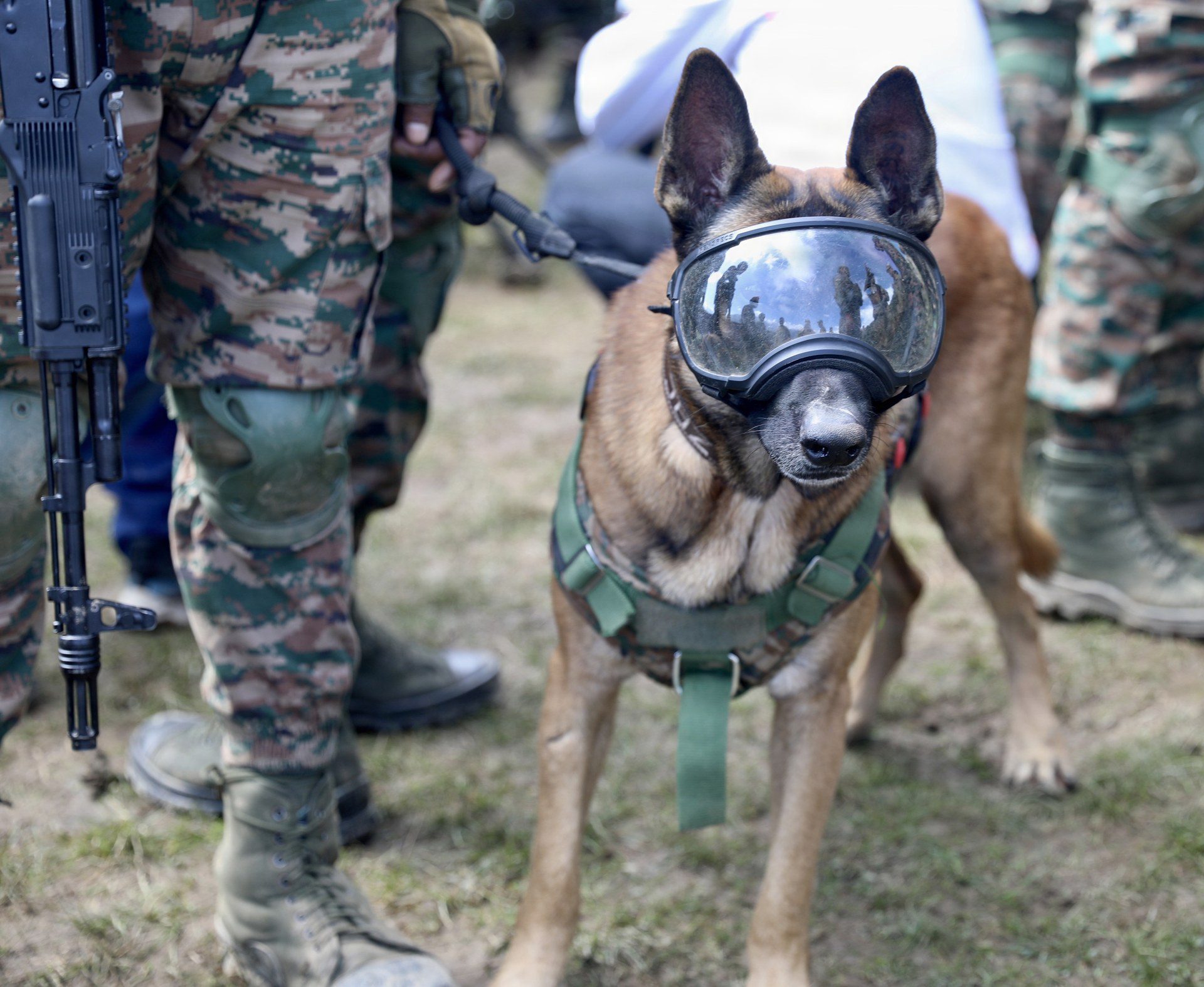
On 24 September 2026 the United States Ambassador to India, Sergio Gor, travelled to the Mahajan Field Firing Range in Rajasthan’s Bikaner district to watch Indian and American soldiers train together in Exercise Yudh Abhyas 2026, the 22nd edition of the two armies’ bilateral exercise. Prasar Bharati’s News on Air reported the visit the same day, and the Indian Express of 25 September carried a PTI photograph of the Ambassador standing with personnel of the Indian Army and the US Army at the range. Ambassador Gor described the exercise as a reflection of “trust, readiness, interoperability, and shared purpose” between the two armies.
The exercise itself began earlier in the month. According to the Press Information Bureau release of 15 September 2026 (Release ID 2310476), Yudh Abhyas 2026 commenced simultaneously at two widely separated nodes — the Auli Foreign Training Node in Uttarakhand, set in high-altitude Himalayan terrain, and the Mahajan Field Firing Range in Rajasthan, set in arid desert. Roughly 600 personnel from each side are taking part. The US Army’s own account of the opening places the exercise window at 15–28 September 2026. For an aspirant, this is a clean, dateable, checkable news item of exactly the kind CLAT’s current-affairs section rewards.
Who is training, and what they are training for
The Indian contingent is drawn from the 14 Infantry Division, and the PIB release names Major General Amaresh Gunjan as the officer leading it. On the American side the contingent comes from the 1st Brigade Combat Team of the 11th Airborne Division — the US Army’s Alaska-based formation nicknamed the “Arctic Angels” — under Colonel Benjamin Jackman. That pairing is not accidental: the 11th Airborne is the American army’s Arctic and cold-weather formation, and the Auli node exists to train troops for mountain warfare.
The stated aim, in the PIB’s own words, is to enhance the joint military capability of both armies for the employment of Integrated Battle Groups in mountainous and semi-mountainous terrain, with emphasis on infantry-dominated operations. An Integrated Battle Group is a self-contained, brigade-sized combined-arms formation — infantry, armour, artillery, engineers, signals and logistics under one commander — designed to be mobilised quickly as a single unit. Training two armies to slot such a package together is a demanding test of interoperability: shared battle procedures, compatible communications, common map references and mutually intelligible staff work.
Background & Framework
Defence is squarely a Union subject. Under Article 246 read with the Seventh Schedule, Entry 1 of the Union List covers the defence of India and every part of it, and Entry 2 covers the naval, military and air forces of the Union. Entry 14 of the Union List covers entering into treaties and agreements with foreign countries and implementing them — which, read with Article 73 (the executive power of the Union extends to matters on which Parliament may legislate), is why the Union executive can conclude defence agreements and arrange joint exercises without a separate statute for each. Article 53(2) vests the supreme command of the Defence Forces of the Union in the President, to be exercised in accordance with law; the President acts on the aid and advice of the Council of Ministers under Article 74, so operational control in practice runs through the Union Government. Article 352 permits a Proclamation of Emergency where the security of India is threatened by war or external aggression. Administratively, the Chief of Defence Staff post and the Department of Military Affairs within the Ministry of Defence were created in 2019, with the first CDS assuming office on 1 January 2020; the CDS heads the DMA and is the principal military adviser to the Defence Minister on tri-service matters.
Two terrains, one exercise
The most distinctive feature of the 2026 edition is that it is running at two nodes at once rather than at a single station. Reports of the opening describe drills conducted simultaneously across the high-altitude ecology of Auli and the desert conditions at Mahajan, so that the same formations must adapt tactics, logistics and equipment settings to radically different environments inside one exercise cycle. Terrain is not a backdrop in military training — it dictates weapon ranges, casualty evacuation timelines, acclimatisation schedules, vehicle mobility and even how long a radio battery lasts.
At Mahajan, the artillery component has been prominent. Press reports of the live-firing phase list the M777 ultra-light howitzer, the indigenous Dhanush gun and the Pinaka multi-barrel rocket launcher on the Indian side, with the American contingent bringing systems including the High Mobility Artillery Rocket System (HIMARS), Stinger air-defence missiles and a mobile counter-drone system. Both contingents have also trained on drones and autonomous systems for surveillance and reconnaissance, and on countering small unmanned aircraft — the single fastest-moving area of land warfare anywhere in the world today. A brigade-level command post exercise has run alongside the field training, which is where the genuinely hard interoperability work happens: two staffs, two doctrines, one plan.
The CLAT Angle
Current Affairs and GK in CLAT is passage-based, so a story like this is likely to appear as a short report followed by questions that test whether you read carefully and whether you brought outside knowledge. Expect three layers. One, direct recall from the passage — the edition number, the two venues, the troop strength, the participating divisions. Two, static links the passage assumes — which service does Yudh Abhyas belong to, which exercise is the naval one, what LEMOA and BECA stand for. Three, the confusion traps, which is where most marks are lost: pairing an exercise with the wrong service, or with the wrong partner country. Note also the constitutional hook. A legal-reasoning or polity question can ask who holds supreme command of the Defence Forces (the President, under Article 53(2)), whether that makes the President the operational commander (no — the power is exercised in accordance with law and on ministerial advice), or which List defence falls under (the Union List). Learn the vocabulary the reports use: interoperability, combined-arms, bilateral versus multilateral, and foundational agreements.
The exercise sits inside a larger defence relationship
Yudh Abhyas is the army-to-army exercise, and it is only one strand of a wider India–US military relationship. Vajra Prahar is the special-forces exercise; Cope India is the air-force exercise; Malabar is the naval exercise, which began as an India–US drill and now also includes Japan and Australia; and Tiger Triumph is the tri-service exercise built around humanitarian assistance and disaster relief. Students routinely mix these up, and examiners know it.
Underpinning the exercises is a set of enabling arrangements usually called the foundational agreements. The Logistics Exchange Memorandum of Agreement (LEMOA), signed in 2016, allows each military to use the other’s facilities for refuelling and replenishment on a reciprocal, reimbursable basis. The Communications Compatibility and Security Agreement (COMCASA), signed in 2018, permits the transfer of secure, encrypted communications equipment so that Indian and American platforms can talk to each other. The Basic Exchange and Cooperation Agreement (BECA), signed in 2020, enables the sharing of geospatial intelligence — maps, charts and precise navigational data. An Industrial Security Annex extends similar protections to private defence industry. Separately, the United States designated India a Major Defence Partner in 2016 and granted it Strategic Trade Authorisation Tier 1 status in 2018, easing licence requirements for the export of sensitive technology. Political direction comes from the 2+2 Ministerial Dialogue, which brings the foreign and defence ministers of both countries to the same table.
Two cautions are worth carrying into an exam hall. First, none of this is an alliance. India is not a treaty ally of the United States, maintains strategic autonomy as declared policy, and simultaneously conducts exercises with Russia, France, Japan, the United Kingdom and its neighbours. Second, a joint exercise is training, not a deployment; it creates familiarity and shared procedure, not an obligation to fight alongside anyone. Passages sometimes invite you to over-read a drill as a commitment — do not take the bait.
Key Facts
- Exercise: Yudh Abhyas 2026 — the 22nd edition of the India–US joint army exercise.
- Venues: Auli Foreign Training Node, Uttarakhand, and Mahajan Field Firing Range, Bikaner district, Rajasthan — run simultaneously.
- Window: commenced 15 September 2026; the US Army’s account gives the dates as 15–28 September 2026.
- Strength: about 600 personnel from each army.
- Indian contingent: 14 Infantry Division, led by Major General Amaresh Gunjan (PIB, Release ID 2310476).
- US contingent: 1st Brigade Combat Team, 11th Airborne Division, under Colonel Benjamin Jackman.
- Stated aim: joint capability for employing Integrated Battle Groups in mountainous and semi-mountainous terrain, emphasising infantry-dominated operations.
- Equipment on display: M777 ultra-light howitzer, Dhanush, Pinaka; HIMARS, Stinger, a mobile counter-drone system; drones and autonomous systems.
- Visit: US Ambassador Sergio Gor witnessed the drills at Mahajan on 24 September 2026.
- Other India–US exercises: Vajra Prahar (special forces), Cope India (air), Malabar (naval, with Japan and Australia), Tiger Triumph (tri-service HADR).
- Foundational agreements: LEMOA (2016), COMCASA (2018), BECA (2020), plus an Industrial Security Annex.
- Constitutional anchor: Article 53(2) — supreme command of the Defence Forces vests in the President; defence is Entry 1, Union List.
Why the exercise matters beyond the photographs
It is easy to read a joint exercise as ceremony. The substance lies elsewhere. Armies that have never trained together cannot simply be combined in a crisis; radios do not interconnect, map references do not match, and even a shared word like “objective” can carry different doctrinal weight. Repeated exercises build a stock of procedural familiarity that can be drawn on later — for disaster relief, an evacuation of civilians from a conflict zone, or a coalition mission under a United Nations mandate. That is also why the mundane-sounding foundational agreements matter more than the hardware: logistics, communications and geospatial data are the plumbing on which any joint operation runs.
For India specifically, the terrain choice is telling. A training node at Auli exists because the Indian Army must be able to fight and sustain itself at altitude. Pairing that with desert live-firing at Mahajan in one exercise cycle tests the quality no single-terrain drill can measure: the ability to switch. That is the analytical point to make in an essay or an interview — not the size of the contingent, but the adaptability the design is trying to produce.
Memory Hook / Mnemonic
For the India–US exercise family, remember “Your Army, Very Special, Cope Air, Malabar Sea, Tiger for Trouble” — Yudh Abhyas (Army), Vajra Prahar (Special Forces), Cope India (Air), Malabar (Navy), Tiger Triumph (Tri-service, disaster relief). For the foundational agreements in order, use “L-C-B: 16, 18, 20” — LEMOA logistics 2016, COMCASA communications 2018, BECA geospatial 2020, which conveniently runs alphabetically and chronologically at once. And for the venues of the 2026 edition: “A for Auli, altitude; M for Mahajan, marusthal” — mountain and desert in one exercise.
Practice Quiz — 10 CLAT-Style Questions
Click an option to reveal the answer and explanation.