CURRENT AFFAIRS | 24 SEPTEMBER 2026
On 24 September 2026, Union Minister of State (Independent Charge) for Science and Technology Dr Jitendra Singh formalised the commercial launch of bio-based biodegradable PLA (Polylactic Acid) plastic produced at a facility of Balrampur Chini Mills Limited (BCML) at Kumbhi, Uttar Pradesh, under the Government’s BioE3 — Biotechnology for Economy, Environment and Employment framework. The event was reported the same day by newsonair.gov.in, the news service of Prasar Bharati.
The description of the facility deserves careful reading, because it carries a qualification that a hurried summary would lose. The report calls it a pilot-scale facility at BCML’s integrated manufacturing complex, set up to develop specialised PLA grades and advanced PLA co-polymers for high-value applications, to generate techno-economic data, to support product development and customer validation, to facilitate technology indigenisation, and to enable scale-up towards commercial production. In other words, what was launched is the commercial use of material from a pilot-scale research and development plant — a step on the way to full commercial-scale manufacture, not the arrival of it. A careful aspirant records both halves of that sentence.
Dr Singh described the initiative, in words carried by the official report, as “a significant milestone in India’s bioeconomy journey, where biotechnology is moving beyond laboratory research towards commercial products, sustainable manufacturing and employment generation”. The same report notes that India’s bioeconomy has grown from about US$10 billion in 2014 to nearly US$195 billion.
The money and the capacity
The financial architecture was reported separately by PTI on 24 September 2026. BCML has been awarded ₹75 crore in grant assistance by the Biotechnology Industry Research Assistance Council (BIRAC), under the Department of Biotechnology (DBT), for a 100 tonnes-per-annum PLA co-polymer R&D facility whose total project cost is put at ₹110 crore. That is the pilot. At the same Kumbhi complex the company is separately establishing a much larger integrated commercial PLA manufacturing facility with a capacity of 80,000 tonnes per annum and a reported investment of about ₹3,000 crore.
Holding those two numbers side by side — 100 tonnes against 80,000 tonnes — is the quickest way to see what “pilot-scale” means. A pilot plant exists to answer engineering questions: which catalyst, which grade, which co-polymer blend, at what cost per kilogram, with what impurity profile. The techno-economic data it produces is the evidence on which the far larger investment is justified. It is not a small version of the commercial plant so much as the laboratory that tells you how to build one.
Background & Framework
PLA (polylactic acid, also called polylactide) is an aliphatic polyester built from lactic acid. The lactic acid is obtained by the fermentation of sugar or starch feedstock — sugarcane, sugar-beet, maize or cassava — which is why a sugar company is the natural manufacturer here. The lactic acid is then converted into the cyclic dimer lactide and polymerised, most commonly by ring-opening polymerisation, into long chains. The result is a thermoplastic that can be moulded, extruded and spun like a conventional plastic. BioE3 is the policy umbrella: it was approved by the Union Cabinet on 24 August 2024 on the proposal of the Department of Biotechnology, to foster high-performance biomanufacturing, and it identifies six thematic sectors — bio-based chemicals, biopolymers and enzymes; smart proteins and functional foods; precision biotherapeutics; climate-resilient agriculture; carbon capture and utilisation; and marine and space research. Implementation runs through the Department of Biotechnology, under the Ministry of Science and Technology, and BIRAC, the public sector enterprise set up by DBT to fund and mentor biotech enterprise. India’s domestic plastics regime sits under the Plastic Waste Management Rules, 2016, framed under the Environment (Protection) Act, 1986, whose 2021 amendment prohibited identified single-use plastic items from 1 July 2022, and whose Extended Producer Responsibility (EPR) guidelines make producers, importers and brand owners accountable for the end-of-life management of plastic packaging.
Bio-based, biodegradable, compostable: three different words
This is the part of the story most worth learning properly, because the three terms are routinely used as synonyms and they are not.
Bio-based describes the origin of the carbon in a polymer. A bio-based plastic is made wholly or partly from renewable biological feedstock rather than from petroleum. It says nothing at all about what happens to the material at the end of its life. Bio-based polyethylene made from sugarcane ethanol is chemically identical to petroleum-derived polyethylene and lasts just as long.
Biodegradable describes the fate of the material: whether micro-organisms can break its polymer chains down into carbon dioxide, water and biomass. But biodegradability is meaningless as a bare adjective, because it is always relative to conditions and to time. A material that fully degrades in twelve weeks in a hot industrial vessel may persist for years in cold soil or in seawater.
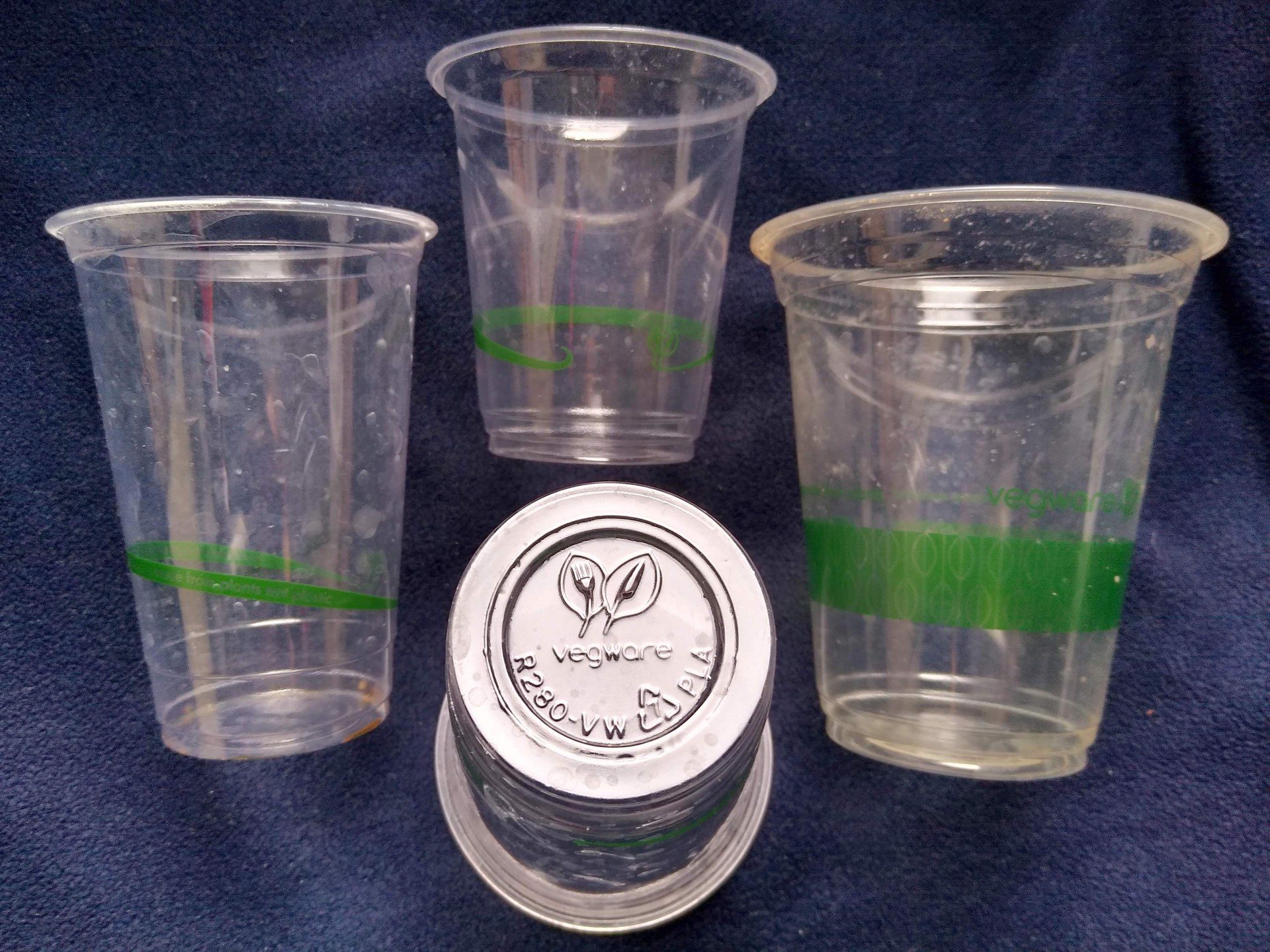
Compostable is the stricter and more useful term: it means the material degrades within a defined period under defined conditions and leaves no toxic residue, certified against a standard. In India the relevant standard for compostable plastics is IS 17088; internationally the comparable standards are EN 13432 in Europe and ASTM D6400 in the United States. And here is the honest caveat about PLA: it is bio-based and it is biodegradable, but in practice it usually requires industrial composting conditions — sustained elevated temperature of roughly 58–60°C with controlled humidity and active microbial populations — to break down at a useful rate. Dropped in a landfill, a river or the sea, a PLA cup does not vanish quickly. This is not a criticism of the technology; it is a statement about the infrastructure the technology assumes. A compostable plastic without a collection-and-composting system behind it is simply a plastic with a better story.
The CLAT Angle
For Current Affairs / GK, the matchable pairs are clean: BioE3 with the Department of Biotechnology and the Cabinet approval of 24 August 2024; BIRAC with the ₹75 crore grant; Kumbhi in Uttar Pradesh with Balrampur Chini Mills; PLA with lactic acid and fermented sugar feedstock. For Reading Comprehension in the English section, a passage on bioplastics is very likely to turn on precisely the distinction drawn above, and the classic trap is an inference question that treats “bio-based” and “biodegradable” as interchangeable — the correct answer will be the one that keeps them apart. For Legal Reasoning, the Plastic Waste Management Rules, 2016 are a strong source: Extended Producer Responsibility is a rule allocating a duty to a producer for the post-consumer stage of a product, and a passage can give you the rule and then ask whether an importer, a brand owner or a waste aggregator bears the obligation on given facts. The single-use plastic prohibition of 1 July 2022 supports questions on the difference between a ban on an item and a duty to manage the waste from it. For Logical Reasoning, the pilot-versus-commercial gap is an excellent weaken question: a conclusion that India has achieved commercial-scale biodegradable plastic manufacture is weakened by the fact that the plant launched is a 100 TPA pilot.
Why a sugar company
The industrial logic is worth a sentence, because it explains the choice of location. A sugar mill already sits on top of the feedstock: it crushes cane, produces sugar, and generates molasses and other sugar streams that are a direct input to fermentation. Integrating a PLA line into an existing sugar complex removes transport cost, removes a separate procurement chain, and converts a commodity with volatile prices into a higher-value specialty polymer. That is exactly the kind of value addition the BioE3 framework, with biopolymers among its thematic sectors, is designed to pull forward. It also connects the story to a familiar theme in Indian policy discussion — diversification of the sugar sector beyond sugar and ethanol.
Key Facts
- Event: Commercial launch of bio-based biodegradable PLA plastic formalised on 24 September 2026 by Dr Jitendra Singh, Union Minister of State (I/C) for Science and Technology.
- Producer and place: Balrampur Chini Mills Limited (BCML), integrated manufacturing complex at Kumbhi, Uttar Pradesh.
- Nature of the plant: pilot-scale facility for specialised PLA grades and advanced PLA co-polymers, generating techno-economic data for scale-up.
- Grant: ₹75 crore from BIRAC, under the Department of Biotechnology (reported by PTI, 24 September 2026).
- Pilot capacity and cost: 100 tonnes per annum; total project cost ₹110 crore.
- Separate commercial plant: 80,000 tonnes per annum at the same complex, investment of about ₹3,000 crore.
- Policy: BioE3 (Biotechnology for Economy, Environment and Employment), approved by the Union Cabinet on 24 August 2024; six thematic sectors.
- Bioeconomy: grown from about US$10 billion in 2014 to nearly US$195 billion.
- Chemistry: PLA is an aliphatic polyester of lactic acid, fermented from sugar or starch feedstock and polymerised via lactide.
- Caveat: PLA generally needs industrial composting conditions (about 58–60°C) to degrade at a useful rate.
- Standards: IS 17088 in India; EN 13432 and ASTM D6400 internationally.
- Domestic regime: Plastic Waste Management Rules, 2016 under the Environment (Protection) Act, 1986; single-use plastic prohibition from 1 July 2022; EPR obligations on producers, importers and brand owners.
What to watch, and what not to overclaim
Two cautions make this a better answer in an interview or an essay. The first is scale. Even the larger 80,000-tonne plant, once built, is modest against India’s total plastic consumption; bioplastics are a substitution strategy for specific applications — food-service ware, packaging films, certain fibres — not a replacement for the whole polymer economy. The second is end-of-life. The environmental benefit of a compostable polymer is realised only where segregated collection and industrial composting exist. Framed accurately, the announcement is a genuine and useful step: a domestic, feedstock-integrated route to a specialty biopolymer, publicly co-funded, with the explicit aim of indigenising technology and generating the data needed to justify a much larger plant. Framed loosely — as India solving plastic pollution — it becomes an overclaim that a well-set comprehension passage would punish.
Memory Hook / Mnemonic
For the three words, remember “SOURCE – FATE – PROOF”: bio-based is about the source of the carbon, biodegradable is about the fate of the material, compostable is the proof — a certified fate under defined conditions. For the numbers, use the ladder “75 – 100 – 110 – 80,000 – 3,000”: a ₹75 crore BIRAC grant, a 100-tonne pilot, a ₹110 crore project, an 80,000-tonne commercial plant, ₹3,000 crore of investment. For the policy, expand BioE3 as the three E’s — Economy, Environment, Employment. And for the chemistry, one line: “Sugar ferments to lactic acid; lactic acid rings into lactide; lactide opens into PLA.”
Practice Quiz — 10 CLAT-Style Questions
Click an option to reveal the answer and explanation.