CURRENT AFFAIRS | 08 OCTOBER 2026
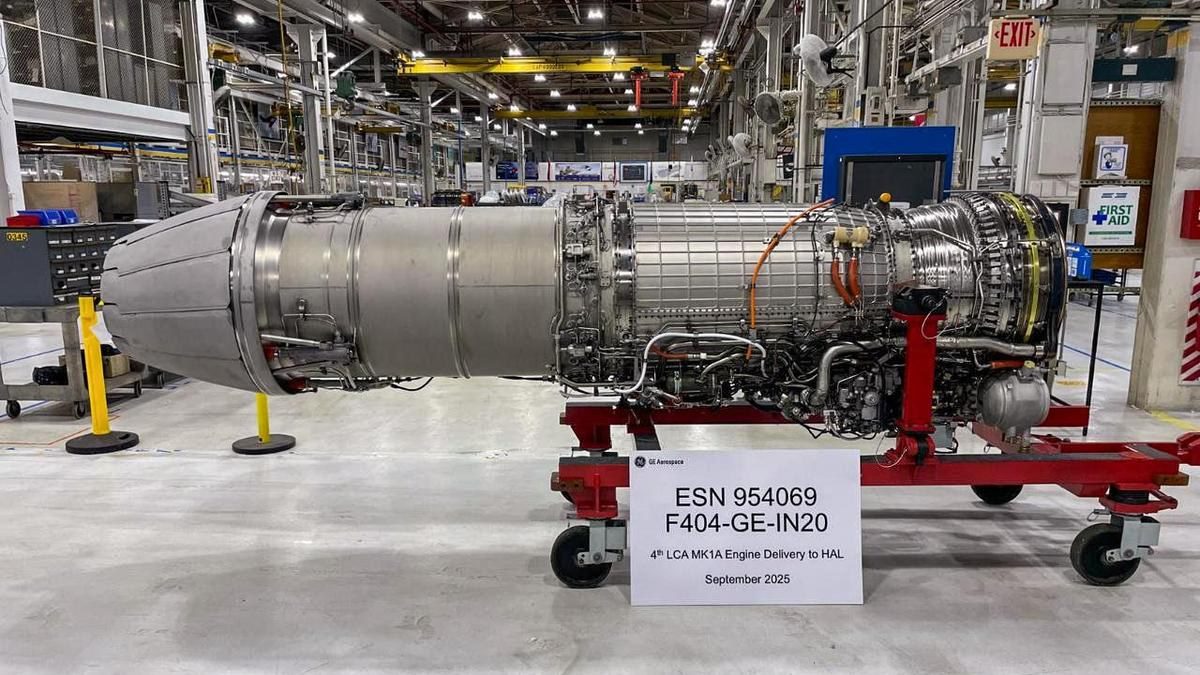
On Wednesday, 7 October 2026, the American engine maker GE Aerospace announced that it had shipped four more F404-IN20 engines to Hindustan Aeronautics Limited (HAL) for the Tejas Light Combat Aircraft (LCA) Mk 1A. According to The Hindu, which carried the company’s statement, a GE Aerospace spokesperson said the four engines were shipped in September 2026, and that the company remained focused on delivering the engines needed to power India’s indigenous fighter. With this batch, GE has sent seven F404-IN20 engines in the last two months; it is contracted to deliver 99 such engines in all, and HAL had received 10 engines before the latest shipment.
The announcement came a day before 8 October, observed every year as Indian Air Force Day — the IAF was established on 8 October 1932. The timing is a reminder of why a few engines matter so much: the Tejas Mk 1A is meant to replace ageing fighters in a force whose squadron strength has been falling, and the programme has been held up largely because engines have not arrived on time.
What the shipment does and does not solve
The Hindu’s report sets out the bottleneck plainly. At least 25 Tejas airframes are ready, and HAL is waiting for engines from the U.S. company. The delay in the engine delivery schedule has in turn delayed aircraft deliveries from HAL to the IAF — so far, the report notes, HAL has not delivered a single LCA Tejas Mk 1A fighter to the Air Force. The previous batch, of three engines shipped in August 2026, was reported in early September by The Week and All India Radio’s News on AIR; the four-engine September batch announced on 7 October is the latest step.
The pressure from the user is explicit. The Hindu reports that, in the week before the announcement, the Chief of Air Staff, Air Chief Marshal A.P. Singh, said the delay in inducting the Tejas Mk 1A was hurting the Air Force, citing its depleting fighter squadron strength. In September, Defence Minister Rajnath Singh, speaking at a HAL handover ceremony in Bengaluru, called for realistic project timelines, warning that delays can create gaps in critical defence requirements, cause cost escalation and raise the risk of technology obsolescence.
The two Mk 1A contracts
India has placed two large orders for the Mk 1A. In February 2021, the Defence Ministry signed a ₹48,000-crore deal with HAL for 83 Tejas Mk 1A jets for the IAF. Under that contract, HAL is to build 73 LCA Tejas Mk 1A fighters and 10 LCA Tejas Mk 1 trainers, and all 83 aircraft were to be delivered within eight years of signing — three aircraft in the third year and 16 a year for the following five years, as the Ministry announced in 2021.
The second order followed on 25 September 2025. According to the PIB release of that date, the Ministry of Defence signed a contract with HAL for 97 LCA Mk 1A aircraft — 68 fighters and 29 twin-seaters — at a cost of ₹62,370 crore (excluding taxes). Deliveries are to begin in 2027–28 and run over six years. The release said the aircraft would carry over 64% indigenous content, integrating home-grown systems such as the UTTAM Active Electronically Scanned Array (AESA) radar and the Swayam Raksha Kavach self-protection suite, with nearly 105 Indian companies making components. The purchase was made under the ‘Buy (India-IDDM)’ category of the Defence Acquisition Procedure (DAP) 2020 — IDDM standing for Indigenously Designed, Developed and Manufactured.
Taken together, the two orders total 180 Mk 1A aircraft. Every one of them needs an engine, which is why the supply line from GE is the single most watched variable in India’s fighter programme.
Background & Framework
The Tejas is India’s indigenous light combat aircraft. It was designed by the Aeronautical Development Agency (ADA), which functions under the Department of Defence Research and Development, and is manufactured by HAL, the Bengaluru-headquartered defence public sector undertaking under the Ministry of Defence. The aircraft was named “Tejas” in 2003 by Prime Minister Atal Bihari Vajpayee, and the first IAF squadron to fly it, No. 45 Squadron (“Flying Daggers”), was formed in 2016. The Mk 1A is an upgraded version of the Mk 1 with an AESA radar, electronic-warfare suite and improved maintainability. The engine is the American GE F404 family; India’s own Kaveri engine, developed by DRDO’s Gas Turbine Research Establishment (GTRE), did not reach the thrust needed for the fighter. For the larger Tejas Mk 2, HAL and GE signed an agreement in 2023 for the co-production in India of the more powerful F414 engine. Procurement itself follows the Defence Acquisition Procedure 2020, whose highest-preference category, Buy (Indian-IDDM), favours platforms designed and made in India.
Why engines are the hard part
An airframe can be built in a hangar in Bengaluru; a modern jet engine is the product of decades of metallurgy, high-temperature materials and testing that only a handful of countries have mastered. That is the strategic lesson inside a routine shipment notice. India’s fighter fleet depends on a foreign supplier’s production line, so disruptions in that line — reported as supply-chain problems at GE — translate directly into empty IAF hangars. It explains both the Kaveri effort and the push for co-production of the F414: the long-term policy aim is to move the engine, not just the airframe, onto Indian soil.
There is also a contractual dimension. A defence contract specifies delivery schedules, and delays raise the question of penalties and of who bears the cost — the manufacturer, the integrator or the user. For the IAF, the cost is operational: every year of delay is a year in which older aircraft must be kept flying or retired without replacement. For HAL, as the Defence Minister’s remarks show, it is a question of credibility in setting timelines it can meet.
The CLAT Angle
Defence procurement appears in CLAT current-affairs passages through numbers, names and institutions. Expect direct questions such as: which company makes the F404 engine (GE Aerospace); which firm builds the Tejas (HAL); which agency designed it (ADA); how many Mk 1A jets the 2021 deal covered (83) and the 2025 deal covered (97); and when Air Force Day is observed (8 October). A passage could also test reasoning: if 25 airframes are ready but none has been delivered, what is the binding constraint? The answer — engines, not airframes — is an inference from the facts, the kind of step CLAT rewards. Watch the distractors: the F414 is the Mk 2 engine, the Kaveri is the indigenous engine, and the F404 powers the Mk 1A. Mixing these up is the most common error.
Reading the numbers carefully
Three figures recur in coverage and are easy to confuse. 99 is the number of F404-IN20 engines GE must supply to HAL for the Mk 1A. 83 is the number of aircraft in the 2021 contract and 97 the number in the 2025 contract. The running delivery count is the figure most likely to change: The Hindu reports that HAL had received 10 engines before the latest four, and that GE has sent seven in the last two months. Cumulative totals quoted in different reports do not always match, so for an exam answer it is safest to rely on the figures tied to a named source and date.
Key Facts
- 7 October 2026: GE Aerospace announced shipment of four F404-IN20 engines to HAL (shipped in September 2026).
- GE has sent seven F404-IN20 engines in the last two months; three were shipped in August 2026.
- GE must deliver 99 F404-IN20 engines to HAL; HAL had received 10 before the latest batch.
- At least 25 Tejas airframes are ready and awaiting engines; no Mk 1A fighter has yet been delivered to the IAF.
- February 2021: ₹48,000-crore deal for 83 Tejas Mk 1A (73 Mk 1A fighters + 10 Mk 1 trainers).
- 25 September 2025: ₹62,370-crore contract for 97 LCA Mk 1A (68 fighters + 29 twin-seaters), deliveries from 2027–28.
- 2025 contract: over 64% indigenous content; Buy (India-IDDM) category of DAP 2020.
- Tejas designed by ADA, built by HAL (HQ Bengaluru).
- Indigenous engine: Kaveri (GTRE, DRDO); Tejas Mk 2 engine: GE F414.
- Indian Air Force Day: 8 October (IAF established 8 October 1932).
- Chief of Air Staff: Air Chief Marshal A.P. Singh.
The bigger picture
The Tejas story is, in miniature, the story of Aatmanirbharta in defence. India has succeeded in designing and assembling a fighter, in raising its indigenous content, and in building a domestic supplier base of over a hundred firms. What it has not yet done is make the engine. Until it does, the pace of the programme will be set partly in another country. The September shipment — and the seven engines in two months — suggest the supply line is picking up; whether it is fast enough to turn ready airframes into operational squadrons is the question the IAF has now asked in public.
Memory Hook / Mnemonic
“4-0-4 powers the 1A; 4-1-4 powers the 2.” F404 → Tejas Mk 1A; F414 → Tejas Mk 2; Kaveri → India’s own engine. For the orders, remember “83 in ’21, 97 in ’25, 99 engines to arrive” — and the designer-builder pair “ADA draws, HAL builds.”
Practice Quiz — 10 CLAT-Style Questions
Click an option to reveal the answer and explanation.