CURRENT AFFAIRS | 08 OCTOBER 2026
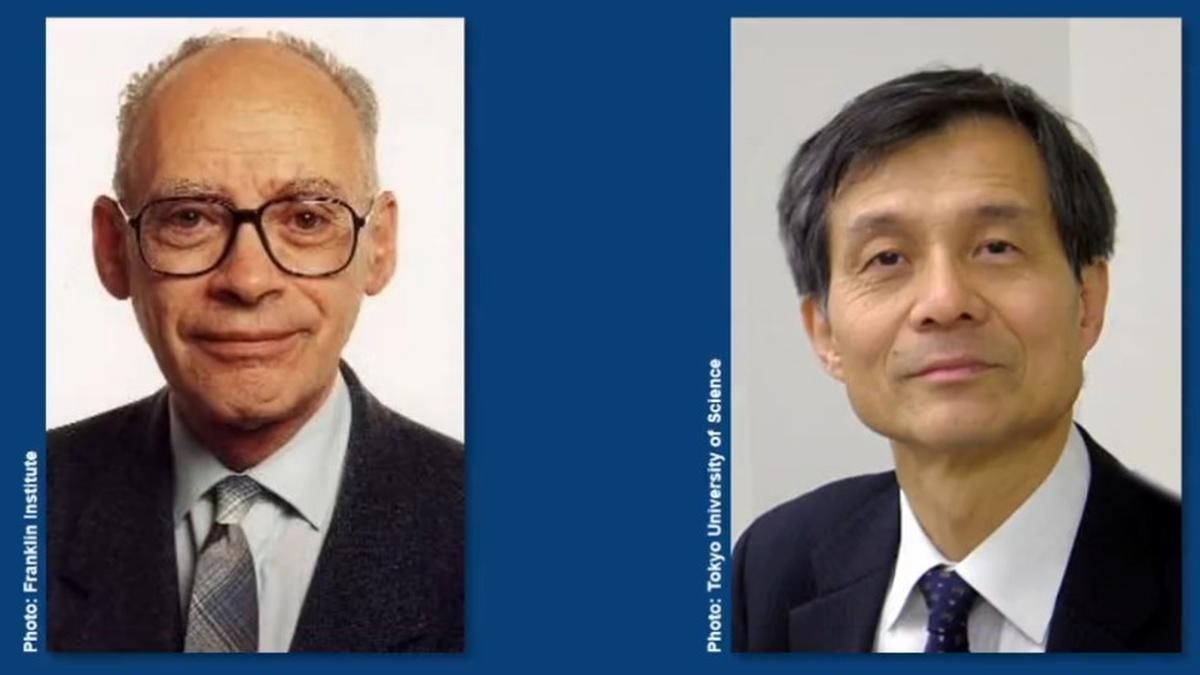
On Wednesday, 7 October 2026, the Royal Swedish Academy of Sciences in Stockholm awarded the Nobel Prize in Chemistry 2026 to Henri B. Kagan of France and Kenso Soai of Japan “for the discovery of non-linear effects and autocatalysis in asymmetric organic synthesis”. According to the official press release on nobelprize.org, Kagan is affiliated with the Université Paris-Sud, France (he is Professor Emeritus at the then Université Paris-Sud) and Soai with the Tokyo University of Science, Japan. The prize amount is 12 million Swedish kronor, to be shared equally between the two laureates.
The Academy summed up their work in one line: they made chemistry choose a mirror image. Many molecules exist in two forms that are mirror images of each other, like a left and a right hand. Ordinary laboratory reactions produce both forms in equal amounts, yet living organisms use only one. How that one-handedness could arise on its own was, in the words of the Nobel Committee’s chair Heiner Linke, “a chemical mystery that is over a century old”. Kagan and Soai showed how it can happen.
The science in plain words: chirality
A molecule is called chiral (from the Greek for “hand”) when it cannot be superimposed on its own mirror image — just as your left glove will not fit your right hand. The two mirror-image versions are called enantiomers. A 50:50 mixture of the two is a racemic mixture. Life’s chemistry, the press release explains, is homochiral — from the Greek words for “same” and “hand”: all amino acids exist in two mirrored variants, but only one of them is found in the proteins in our cells.
This matters far beyond theory. Enzymes and receptors in the body are themselves chiral, so the two enantiomers of a drug can behave very differently inside the body — one may heal while the other is useless or harmful. As the Academy notes, in pharmaceuticals “only one mirror image will have the desired effect”. Making only the right enantiomer — asymmetric synthesis — is therefore one of the central challenges of modern chemistry.
What each laureate discovered
Henri Kagan (1986): the non-linear effect. Chemists use catalysts to speed up reactions, and a chiral catalyst can push a reaction to favour one enantiomer. The usual assumption was that the purity of the product would simply mirror the purity of the catalyst. According to The Hindu’s account, Kagan’s team found that the chiral parts of a catalyst could combine in pairs, and that opposite-handed pairs could behave differently from same-handed ones. If the mixed pairs reacted poorly, they effectively removed the minority form from play, leaving the active catalyst more one-handed — and the product disproportionately one-handed. The Academy says this allowed him to create a greater excess of one mirror image “than had previously been thought possible”. This is the non-linear effect: output purity is not a straight-line function of input purity.
Kenso Soai (1995 and 2003): autocatalysis. Soai took the next step. In 1995 he described a reaction in which a chiral product speeds up the formation of more molecules of its own handedness — a process called asymmetric autocatalysis, now known as the Soai reaction. The Hindu reports that even when only 0.00005% more right-handed than left-handed molecules entered the reaction, after just three rounds 99.75% of the molecules could be right-handed. According to the press release, in 2003 Soai presented a reaction in which only one of the two possible mirror images was formed — a feat that, other than life itself, no one had previously achieved.
Background & Framework
The Nobel Prizes were established by the will of the Swedish chemist and inventor Alfred Nobel and were first awarded in 1901. Different bodies choose different prizes: the Royal Swedish Academy of Sciences (founded in 1739) selects the Physics and Chemistry laureates (and the Prize in Economic Sciences); the Karolinska Institutet selects Physiology or Medicine; the Swedish Academy selects Literature; and the Norwegian Nobel Committee awards the Peace Prize in Oslo. The 2026 announcements run from 5 to 12 October.
Chirality has been honoured before. The 2001 Chemistry Nobel went to William Knowles, Ryoji Noyori and K. Barry Sharpless for chirally catalysed reactions — the tools that made one-handed drug manufacture practical. The 2026 prize explains a deeper puzzle: how a tiny imbalance can amplify itself until one hand dominates.
The cautionary tale. The thalidomide tragedy of the late 1950s and early 1960s, in which a drug given to pregnant women was linked to severe birth defects, is the textbook example used to teach why the handedness of drug molecules must be studied carefully.
Why it matters: from medicine cabinets to the origin of life
The two discoveries have had different kinds of impact. According to The Hindu, chemists today use Kagan’s findings to optimise reactions that produce specific enantiomers of drugs, agrochemicals and fragrances — and to work backwards from a reaction’s products to its hidden mechanism. The Academy says the discoveries “have been decisive for chemists who design reactions for the manufacture of pharmaceuticals”.
Soai’s work speaks to one of the oldest questions in science: why is life one-handed? His reaction shows that a small, random imbalance can be amplified into near-total dominance by chemistry alone. That keeps open the possibility that some tiny imbalance billions of years ago grew into the overwhelming handedness we see in biological molecules today. A prize-winning idea in a test tube thus becomes a contribution to the study of the origin of life.
For the record, the 2026 season had already honoured Francis Halzen in Physics and work on optogenetics in Physiology or Medicine earlier in the week (covered in our 7 October notes).
The CLAT Angle
Direct GK: winners and nationality (Kagan — France; Soai — Japan), the motivation (non-linear effects and autocatalysis in asymmetric organic synthesis), the awarding body (Royal Swedish Academy of Sciences), the prize amount (12 million Swedish kronor, shared equally) and the key years (Kagan 1986; Soai 1995 and 2003). A matching question could pair each Nobel category with its selecting institution.
Reading comprehension: science-explainer passages on chirality are ideal RC material. Watch for vocabulary questions on enantiomer, racemic, homochiral and catalyst, and for inference questions such as why a drug company would prefer one enantiomer.
Critical reasoning: the Soai reaction is a neat example of amplification — a small initial cause producing a disproportionate effect. An argument that “because the starting imbalance was tiny, the outcome must be balanced” commits exactly the linear-thinking error that Kagan’s non-linear effect disproves.
Key Facts
- Prize: Nobel Prize in Chemistry 2026, announced 7 October 2026.
- Laureates: Henri B. Kagan (France) and Kenso Soai (Japan).
- Motivation: “for the discovery of non-linear effects and autocatalysis in asymmetric organic synthesis”.
- Affiliations: Université Paris-Sud (Kagan); Tokyo University of Science (Soai).
- Born: Kagan 1930, Boulogne-Billancourt; Soai 1950, Hiroshima.
- Awarding body: Royal Swedish Academy of Sciences (founded 1739).
- Prize money: 12 million Swedish kronor, shared equally.
- Kagan’s step: 1986 — non-linear effect in asymmetric catalysis.
- Soai’s step: 1995 publication on asymmetric autocatalysis; 2003 — reaction forming only one mirror image.
- Key term: homochiral = “same hand”; life’s amino acids use only one mirror form.
- Earlier chirality Nobel: 2001 — Knowles, Noyori, Sharpless.
Memory Hook / Mnemonic
“K before S, 86 before 95.” Kagan came first (1986, non-linear effect), Soai followed (1995, Self-copying = autocatalysis; 2003, one hand only). Picture a pair of gloves: France drops the odd glove, Japan photocopies the right glove until only right gloves remain. And the prize purse: 12 million kronor, split two ways.
Practice Quiz — 10 CLAT-Style Questions
Click an option to reveal the answer and explanation.