

CURRENT AFFAIRS | 01 OCTOBER 2026
India Climbs to 38th in WIPO Global Innovation Index 2026
The World Intellectual Property Organization (WIPO) released the Global Innovation Index (GII) 2026 on September 29, 2026, and India secured the 38th position — an improvement of one rank from 39th in GII 2025. More significantly, India retained its title as the highest-ranked country in South Asia and South-East Asia, and extended its remarkable streak as a consistent overperformer relative to its GDP and income group to 16 consecutive years since 2011.
This story is important for CLAT 2027 because it tests multiple domains simultaneously: international organisations (WIPO), India’s intellectual property law framework, government policy on innovation, and constitutional provisions supporting economic and scientific progress.
WIPO (World Intellectual Property Organization) became a specialised agency of the United Nations in 1974, though it was founded in 1967. It is headquartered in Geneva, Switzerland and has 193 member states. WIPO administers key international IP agreements including: the Patent Cooperation Treaty (PCT) — enabling patent protection in multiple countries via a single application; the Madrid System — for international trademark registration; the Hague System — for industrial designs; and the WIPO Copyright Treaty 1996. India is a member and signatory to the PCT.
Top Countries and India’s Clusters
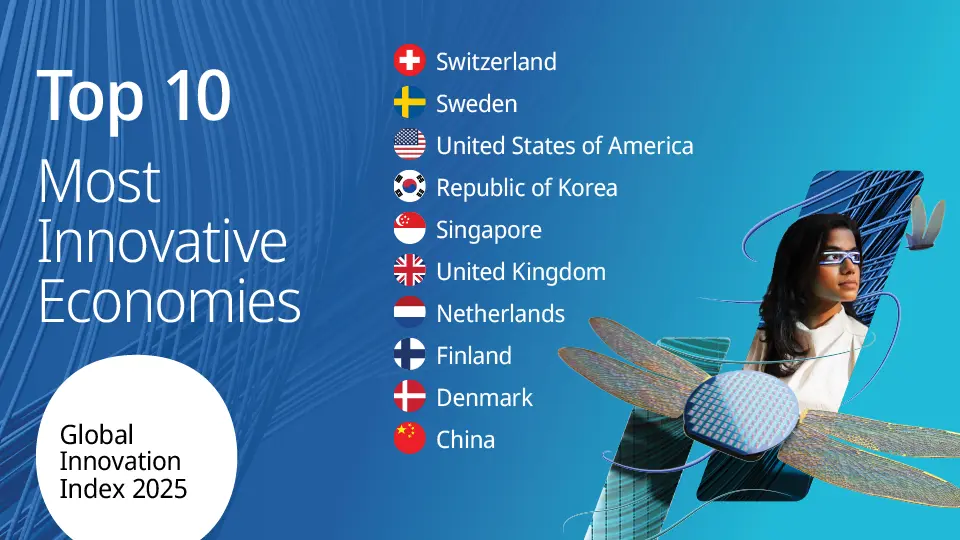
The GII 2026 top five countries were: Switzerland (#1), Sweden (#2), USA (#3), Singapore (#4), and Netherlands (#5). China ranked 11th, Pakistan 139th. India’s position at 38th places it ahead of all other South Asian and South-East Asian economies.
Four Indian innovation clusters made it into the GII 2026 top 100:
- Bengaluru — 91st (India’s highest-ranked cluster, driven by IT and biotechnology)
- Chennai — ranked for automotive and manufacturing innovation
- Mumbai — financial services and pharmaceutical innovation
- Delhi — government research institutions and startups
The GII measures innovation across 80 indicators organised under 7 pillars: (1) Institutions — political stability, regulatory quality, rule of law; (2) Human Capital and Research — tertiary education, R&D expenditure; (3) Infrastructure — ICT, general infrastructure; (4) Market Sophistication — credit access, investment, trade; (5) Business Sophistication — knowledge workers, innovation linkages; (6) Knowledge and Technology Outputs — patents, IP receipts, scientific publications; (7) Creative Outputs — intangible assets, creative goods and services, online creativity. India’s strengths lie in software exports, human capital quality, and market sophistication.
The AI Megatrend: 53% of Global VC
A headline finding of GII 2026 was that Artificial Intelligence attracted 53% of global venture capital funding in the index period — an unprecedented concentration reflecting the post-ChatGPT investment surge. India’s startup ecosystem, particularly Bengaluru and Hyderabad, has seen significant AI investment, though the absolute scale still trails the USA and China.
India’s IP Legal Framework
Patents Act 1970 (amended 2005): The 2005 amendment brought India into compliance with the TRIPS Agreement. India retained Section 3(d) — preventing “evergreening” of pharmaceutical patents. This provision was upheld in Novartis AG v. Union of India (2013), rejecting the Gleevec (imatinib mesylate) patent.
Trade Marks Act 1999 — aligned with the Madrid Protocol. Copyright Act 1957 — amended 2012 for digital rights. GI Act 1999 — protects Darjeeling Tea, Kangra Tea, Kolhapuri Chappals. National IPR Policy 2016 — motto: “Creative India; Innovative India.”
Article 51(c) directs India to foster respect for international law and treaty obligations — the basis for India’s participation in WIPO agreements. Article 19(1)(g) guarantees the right to practise any profession or carry on any trade or business. Entry 49 of List I (Union List) grants Parliament power to make laws regarding patents, inventions, and designs. Article 39(e) and 39(f) under Directive Principles require the State to protect children’s right to develop in a healthy manner — related to education and human capital formation.
The TRIPS Connection and India’s Section 3(d)
The TRIPS Agreement (1994), administered by the WTO, sets minimum standards for IP protection. India amended its Patents Act in 2005 to comply but inserted Section 3(d) — preventing patent protection for known substances with mere new forms or uses unless they show enhanced efficacy. The Novartis v. Union of India case upheld this provision, setting India apart from high-income countries and celebrated by public health advocates globally.
1. India = 38th in GII 2026 (up from 39th). 2. WIPO = UN specialised agency, Geneva, 193 members, since 1974. 3. GII top countries: Switzerland, Sweden, USA, Singapore, Netherlands. 4. AI = 53% of global VC (GII 2026 headline). 5. Bengaluru = India’s top cluster, 91st globally. 6. Patents Act 1970 amended 2005 for TRIPS compliance; Section 3(d) prevents evergreening. 7. Novartis v. Union of India (2013) — upheld Section 3(d), rejected Gleevec patent. 8. National IPR Policy 2016 — “Creative India; Innovative India.”
Practice Quiz — 10 CLAT-Style Questions
Click an option to reveal the answer and explanation.