VIDEO EXPLAINER | 12 OCTOBER 2026
Between 5 and 12 October 2026, the six Nobel announcements came one a day, from Physiology or Medicine on 5 October to the Sveriges Riksbank Prize in Economic Sciences in Memory of Alfred Nobel on 12 October. This explainer lists every 2026 laureate with the official citation, and then goes back to where it all began: the will that Alfred Nobel, the inventor of dynamite, signed in Paris on 27 November 1895. All facts here come from the official NobelPrize.org press releases and fact pages.
The 2026 Nobel Prizes at a glance
Physiology or Medicine (5 October): the Nobel Assembly at Karolinska Institutet awarded the prize jointly to Karl Deisseroth (Howard Hughes Medical Institute and Stanford University, USA), Peter Hegemann (Humboldt University of Berlin, Germany) and Georg Nagel (University of Würzburg, Germany) “for their discoveries concerning light-gated ion channels and optogenetics”. Hegemann and Nagel discovered the protein channelrhodopsin in a single-celled alga; Deisseroth turned it into a light-controlled switch for nerve cells, which lets scientists study how nerve cells shape memories, feelings and behaviour in the living brain.
Physics (6 October): the Royal Swedish Academy of Sciences awarded the prize to Francis Halzen (University of Wisconsin–Madison, USA) “for decisive contributions to the IceCube Neutrino Observatory and the discovery of high-energy neutrinos of astrophysical origin”. IceCube is a cubic kilometre of ice at the South Pole fitted with light sensors; Halzen first presented the idea in 1988.
Chemistry (7 October): the Royal Swedish Academy of Sciences awarded Henri B. Kagan (Université Paris-Sud, France) and Kenso Soai (Tokyo University of Science, Japan) “for the discovery of non-linear effects and autocatalysis in asymmetric organic synthesis”. Many molecules, such as amino acids, exist as two mirror images, but living things use only one. The laureates showed how chemistry can come to “choose” one mirror image, a property called homochirality.
Literature (8 October): the Swedish Academy awarded the prize to the Canadian author Anne Carson “for her bold and inventive oeuvre that, in playful dialogue with the classical tradition, has created new forms for contemporary literature”.
Peace (9 October): the Norwegian Nobel Committee awarded the prize to Navanethem “Navi” Pillay “for her efforts to promote peace and international law”. Born into a family of Indian Tamil origin in Durban, South Africa, she has served as a judge on the High Court in South Africa, the International Criminal Tribunal for Rwanda and the International Criminal Court, and was the United Nations High Commissioner for Human Rights.
Economic Sciences (12 October): the Royal Swedish Academy of Sciences awarded Robert E. Hall (Stanford University, USA) and Michael Woodford (Columbia University, USA) “for microeconomic foundations of macroeconomic stabilisation”. Their models help governments and central banks time fiscal and monetary policy to smooth out the economy’s peaks and troughs.
Each 2026 prize carries 12 million Swedish kronor, shared equally where there is more than one laureate.
How it all started: Alfred Nobel and his will
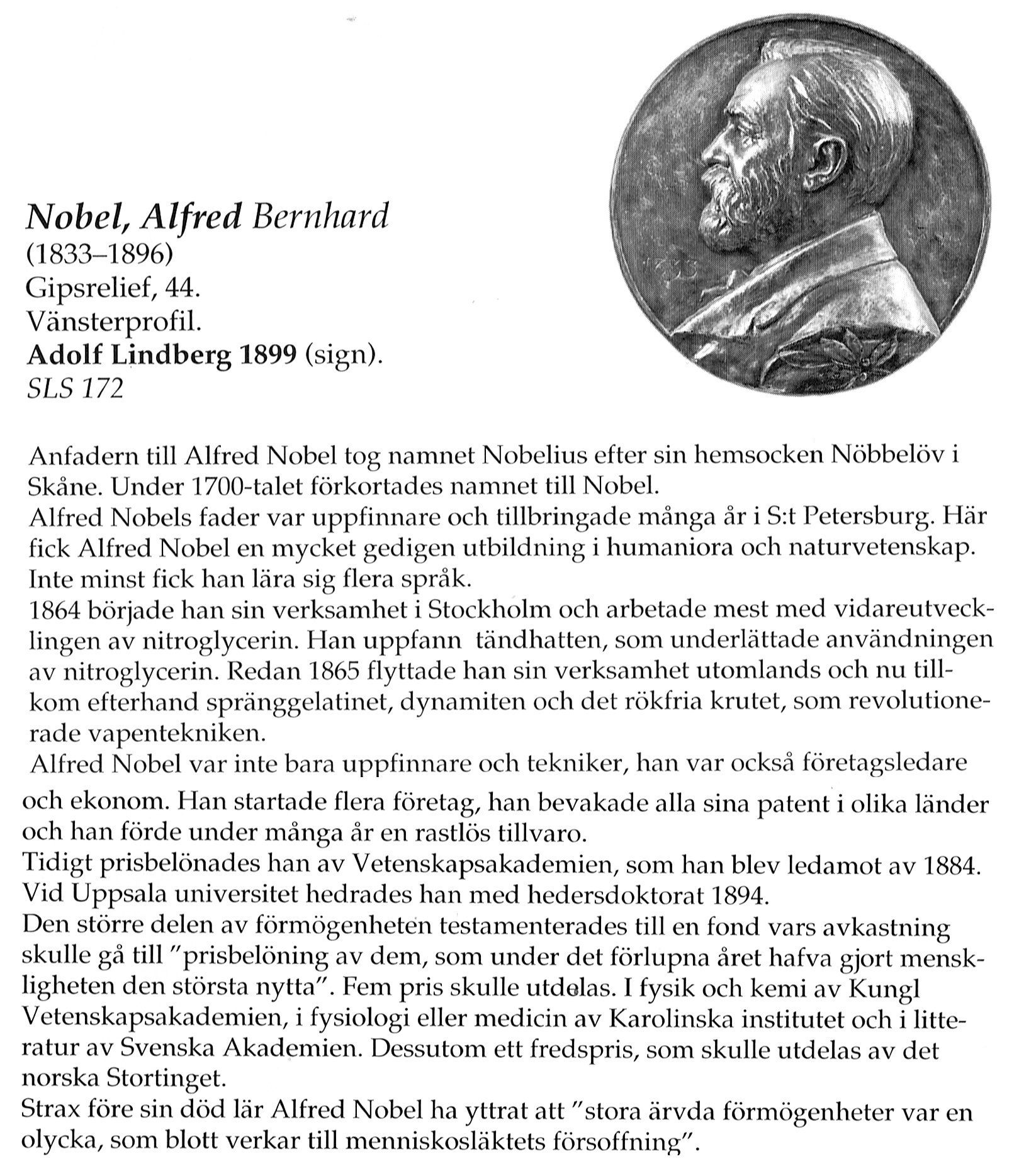
Alfred Nobel was born in Stockholm on 21 October 1833. A chemist, inventor and businessman, he is known for inventing dynamite (patented in Sweden in 1867) and held 355 patents. On 27 November 1895, at the Swedish-Norwegian Club in Paris, he signed his third and last will, leaving most of his fortune to fund prizes in physics, chemistry, physiology or medicine, literature and peace. He died in Sanremo, Italy, on 10 December 1896.
The will named the judges: physics and chemistry by the Swedish Academy of Sciences, physiology or medicine by the Karolinska Institute, literature by the Academy in Stockholm, and peace by a committee of five persons selected by the Norwegian Storting (parliament). It also said that nationality should not be considered. The first prizes were awarded on 10 December 1901, the anniversary of his death, which is why the ceremonies are still held on 10 December: the Peace Prize in Oslo (at Oslo City Hall since 1990) and the others in Stockholm (at the Stockholm Concert Hall since 1926).
The economics prize is different
Economics was not in Nobel’s will. In 1968, Sveriges Riksbank, Sweden’s central bank, established the Sveriges Riksbank Prize in Economic Sciences in Memory of Alfred Nobel on its 300th anniversary. It was first awarded in 1969 to Ragnar Frisch and Jan Tinbergen. It is awarded by the Royal Swedish Academy of Sciences on the same principles and with the same prize amount as the Nobel Prizes, paid by the Riksbank.
India and the Nobel Prize
Rabindranath Tagore won the Nobel Prize in Literature in 1913, the first Indian laureate. Sir C.V. Raman won the Nobel Prize in Physics in 1930 “for his work on the scattering of light and for the discovery of the effect named after him”, the Raman effect; he was then at Calcutta University. In 2026, the Peace laureate Navi Pillay comes from a family of Indian Tamil origin.
Institutional framework
- Nobel Assembly at Karolinska Institutet (Stockholm): Physiology or Medicine.
- Royal Swedish Academy of Sciences: Physics, Chemistry and the economics prize.
- Swedish Academy: Literature.
- Norwegian Nobel Committee (five members chosen by the Norwegian Storting): Peace, awarded in Oslo.
- Sveriges Riksbank: established the economics prize in 1968 and pays its prize amount.
CLAT angle
- GK: match the 2026 laureate to the prize (especially Peace: Navi Pillay; Literature: Anne Carson).
- GK: Nobel’s will (27 Nov 1895), his death (10 Dec 1896) and the first prizes (1901).
- GK: which body awards which prize, and why Peace is the one given in Oslo.
- Trap: the economics prize is not one of Nobel’s original five; Sveriges Riksbank set it up in 1968 (first awarded 1969).
- India: Tagore (Literature 1913), C.V. Raman (Physics 1930).
Key facts
| Fact | Detail |
|---|---|
| Medicine 2026 | Karl Deisseroth, Peter Hegemann, Georg Nagel: optogenetics |
| Physics 2026 | Francis Halzen: IceCube, high-energy neutrinos |
| Chemistry 2026 | Henri B. Kagan, Kenso Soai: asymmetric organic synthesis |
| Literature 2026 | Anne Carson (Canada) |
| Peace 2026 | Navi Pillay: peace and international law |
| Economics 2026 | Robert E. Hall, Michael Woodford: macroeconomic stabilisation |
| Prize amount 2026 | 12 million Swedish kronor per prize |
| Nobel’s will | 27 November 1895, Paris |
| First prizes | 10 December 1901 |
| Economics prize | Established 1968 by Sveriges Riksbank; first awarded 1969 |
Memory hook: “5 in the will, 1 from the bank, 1 in Oslo”
Five prizes came from Nobel’s 1895 will; the sixth (economics) came from the Riksbank in 1968; and only one, Peace, is awarded in Oslo.
Sources
NobelPrize.org: the 2026 press releases for Physiology or Medicine, Physics, Chemistry, Literature, Peace and Economic Sciences; “Alfred Nobel – biographical information”; “Alfred Nobel’s will”; “Nobel Prize facts”; the economic sciences prize page; and the fact pages for Rabindranath Tagore (1913) and C.V. Raman (1930).
Free in the CLAT Gurukul app
These notes (as a PDF lesson) and the 10-question CBT are in the app under Current Affairs → 12 Oct 2026. Get the app on Google Play or open app.clatgurukul.com.
Practice Quiz — 10 CLAT-Style Questions
Click an option to reveal the answer and explanation.