CURRENT AFFAIRS | 10 JUNE 2026
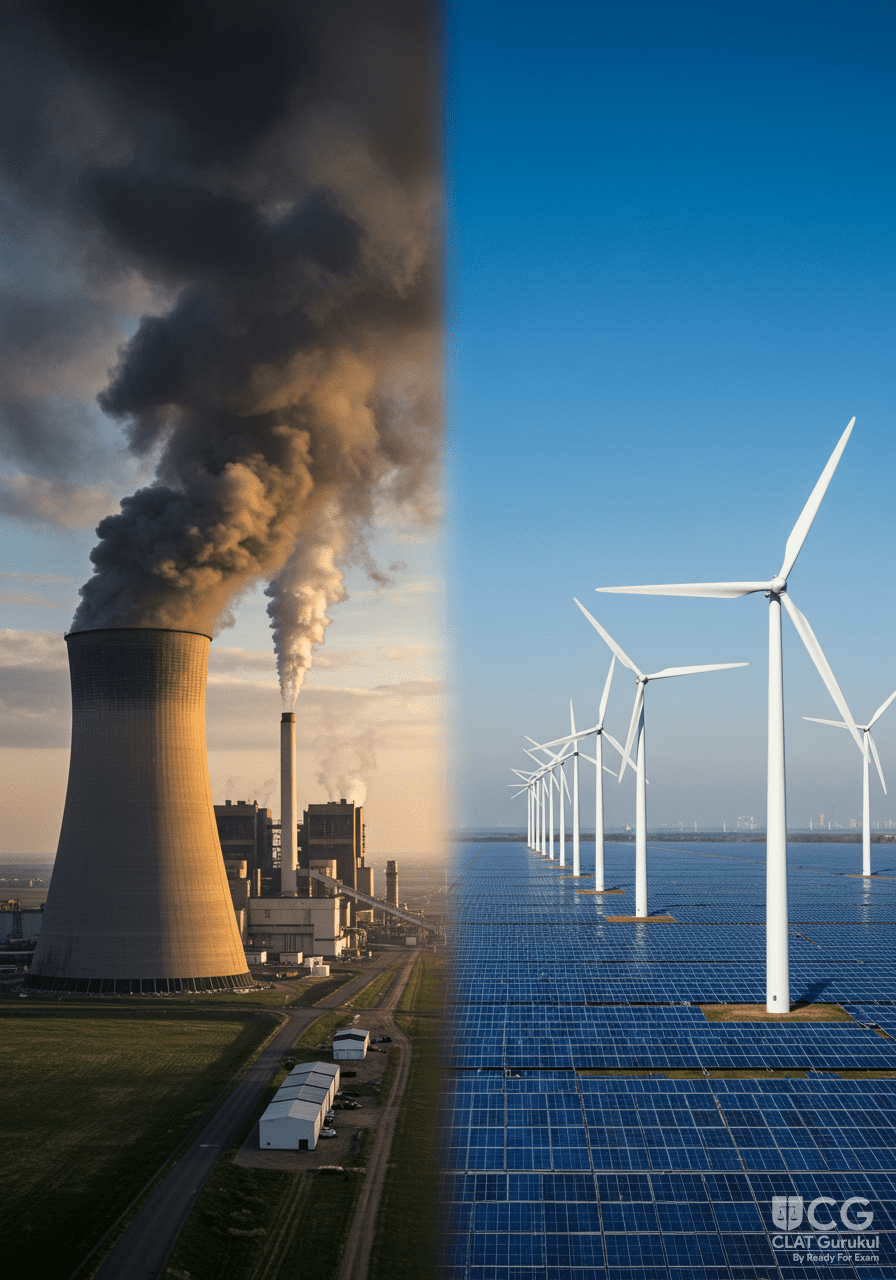
In a notable convergence of defence and climate policy, Defence Minister Rajnath Singh has approved the establishment of a 250 MW Solar Power Project with a Battery Energy Storage System (BESS) in Sitapur, Uttar Pradesh. The project will rise on a vacant parcel of defence land measuring about 850 acres, and is being billed as the first-of-its-kind solar project undertaken by the Ministry of Defence in India.
The plant will be implemented by NTPC Ltd through a competitive bidding process. Beyond its symbolic value, the project is designed to deliver hard savings: by generating clean power on idle land, it is expected to cut the Ministry’s procurement of conventional grid electricity and yield significant savings for the government exchequer, while providing dependable energy security for defence establishments.
Constitutional & Statutory Framework
- Article 48A (DPSP) — State duty to protect and improve the environment
- Article 51A(g) — Fundamental Duty of citizens to protect the natural environment
- Panchamrit pledge (COP26, 2021) — India’s five-point climate commitment
- Net-Zero by 2070 — India’s long-term emissions target
- Ministry of Defence green-energy initiative on unused land
The ‘first-of-its-kind’ tag matters. India’s armed forces hold vast tracts of land, much of it vacant, scattered across cantonments and ranges. Converting such idle parcels into solar farms turns a dormant asset into a revenue-and-resilience generator without competing with agriculture or housing. The Sitapur plant is conceived as a template — the government has flagged several planned projects to harness idle defence land for green energy across the country.
The addition of a Battery Energy Storage System (BESS) is technically significant. Solar generation is intermittent — it peaks at midday and vanishes at night. A BESS stores surplus daytime power and discharges it when generation falls, smoothing supply and making the plant capable of meeting defence-establishment loads around the clock. This is precisely the firming technology India needs to scale as it pushes deeper into variable renewable energy.
The constitutional and policy framing is clean. Article 48A of the Directive Principles directs the State to protect and improve the environment, and Article 51A(g) makes environmental protection a Fundamental Duty of citizens. At the international level, the project advances India’s Panchamrit pledge made at COP26 in Glasgow (2021) and its long-term commitment to net-zero emissions by 2070, alongside the near-term goal of 500 GW of non-fossil capacity by 2030.
For CLAT 2027 aspirants, this is a fresh cross-cutting GK item linking three exam-favourite threads: defence, renewable-energy targets and India’s climate pledges. Expect questions on the Panchamrit commitments, the 2070 net-zero date, the 500 GW-by-2030 target, and the DPSP-Fundamental Duty environmental framework under Articles 48A and 51A(g).
Why This Matters for CLAT
This story stitches together defence, renewable energy and climate law. CLAT 2027 may test the Panchamrit five-point pledge from COP26, the net-zero-by-2070 target, the 500 GW non-fossil by 2030 goal, and the environmental duties under Article 48A (DPSP) and Article 51A(g) (Fundamental Duty). The BESS angle is a useful S&T hook on energy firming and storage.
Key Facts
| Project | 250 MW Solar + BESS |
| Location | Sitapur, Uttar Pradesh |
| Land used | ~850 acres (vacant defence land) |
| Implementing PSU | NTPC Ltd |
| Significance | 1st-of-its-kind by Ministry of Defence |
| Approved by | Defence Minister Rajnath Singh |
| Net-zero target | 2070 (Panchamrit, COP26) |
| Non-fossil target | 500 GW by 2030 |
| Constitutional basis | Article 48A / 51A(g) |
Mnemonic / One-liner
Energy targets to lock in: ‘500 by 30, net-zero by 70’ — 500 GW non-fossil by 2030, net-zero by 2070 (Panchamrit, COP26). Environmental duo: ’48A (State) + 51A(g) (Citizen)’. Project tag: first Ministry of Defence solar plant, at Sitapur, by NTPC.
Test Your Knowledge
Practice Quiz — 10 CLAT-Style Questions
Click an option to reveal the answer and explanation.