CURRENT AFFAIRS | 10 JUNE 2026
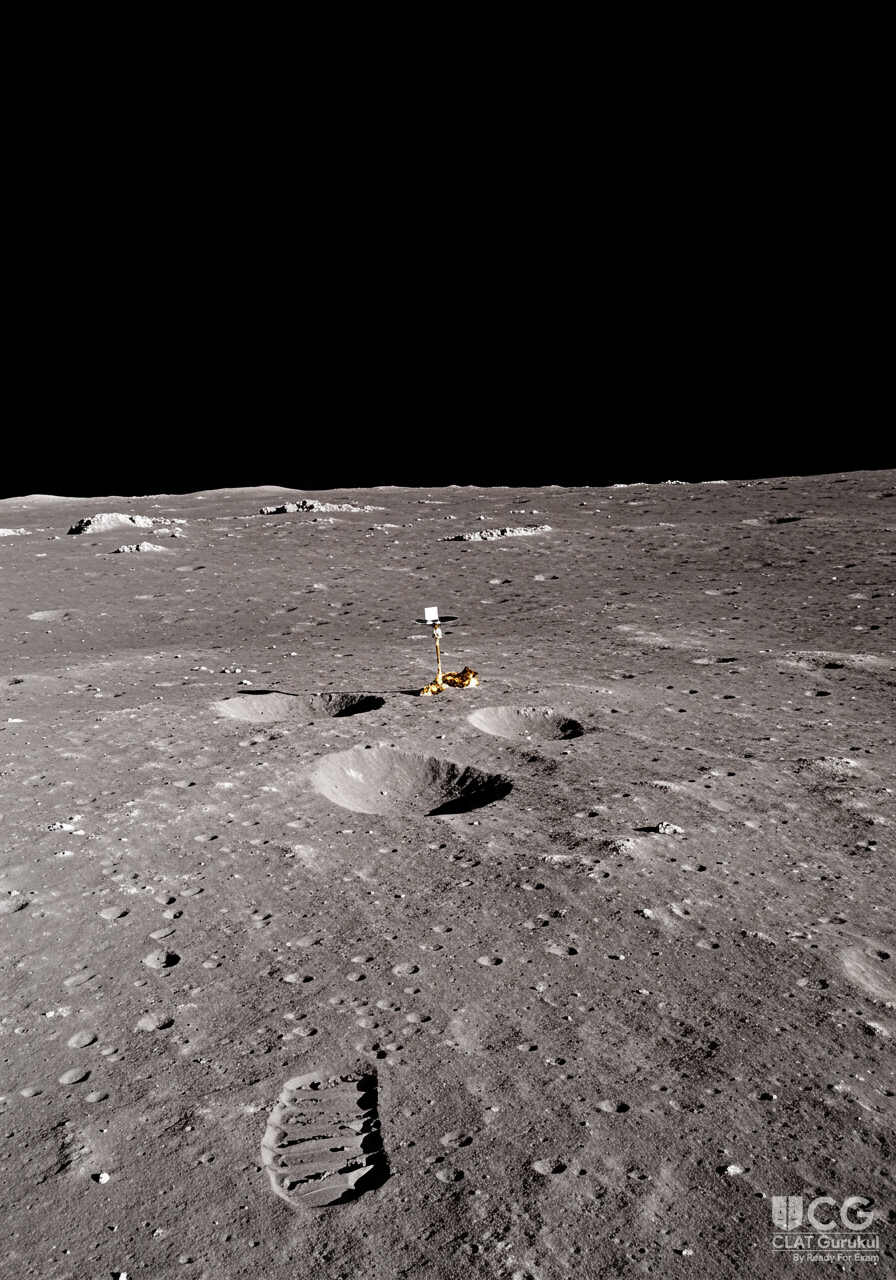
Nearly three years after India made history at the Moon’s south pole, Chandrayaan-3 is still yielding scientific gold. New data from the mission shows that the soil near Shiv Shakti Point — the official name of the Vikram lander’s landing site — is chemically close to a lunar meteorite, ALHA 81005, that crashed into Antarctica’s Allan Hills about a million years ago. A study led by the Physical Research Laboratory (PRL), Ahmedabad, with Dwijesh Ray as lead author, has been published in the prestigious journal Nature.
The link between a freshly-sampled patch of the lunar south pole and a meteorite that sat in Antarctic ice for a million years is striking. Both share an iron- and magnesium-rich, aluminium-deficient signature that resembles ferroan anorthosite and Mg-suite lithologies — the ancient rock families that make up the lunar highlands. The match tells scientists that the highlands are more compositionally diverse than older Apollo-era samples alone suggested.
Constitutional & Statutory Framework
- ISRO (Indian Space Research Organisation) — under the Department of Space
- Chandrayaan programme — India’s lunar exploration series
- National Space Day — 23 August, marking the Chandrayaan-3 landing
- Alpha Particle X-ray Spectrometer (APXS) — instrument that gathered the data
- Outer Space Treaty 1967 — international legal framework for space activity
The data was gathered by the Alpha Particle X-ray Spectrometer (APXS) onboard the Pragyan rover, which trundled across the lunar surface after the Vikram lander touched down on 23 August 2023. That landing made India the first nation to land near the lunar south pole and the fourth — after the United States, the erstwhile Soviet Union and China — to achieve a soft landing on the Moon. To commemorate it, 23 August is now observed as National Space Day.
Why does the meteorite comparison matter? Lunar meteorites are random chunks knocked off the Moon’s surface by impacts and scattered to Earth; they sample regions that no mission has visited. When in-situ Chandrayaan-3 readings line up with a meteorite’s chemistry, scientists gain an independent cross-check on the geological story of the south-polar highlands — and on how micrometeorite bombardment has reworked the top layer of regolith over billions of years, while deeper lava and mineral layers occasionally mix in.
The scientific significance is twofold. First, it validates the quality of Chandrayaan-3’s in-situ measurements against an independent sample. Second, it strengthens the case that the south-polar region — a prime target for future crewed missions because of suspected water-ice in permanently shadowed craters — has a varied and scientifically rich geology worth deeper exploration through the planned Chandrayaan-4 sample-return and the Gaganyaan-adjacent roadmap.
For CLAT 2027 aspirants, Chandrayaan-3 is marquee science-and-technology GK. The ‘first near the south pole, fourth to soft-land’ fact, the Shiv Shakti Point name, the Nature publication and National Space Day are all exam-frequent. Pair them with the broader legal frame of space — the Outer Space Treaty 1967 — for a complete answer.
Why This Matters for CLAT
Chandrayaan-3 is a high-yield S&T-GK anchor. CLAT 2027 may test the ‘first near the lunar south pole, fourth to soft-land’ fact, the name Shiv Shakti Point, the PRL Ahmedabad + Nature publication, the APXS instrument, and National Space Day (23 August). The legal hook is the Outer Space Treaty 1967, which governs the peaceful use and non-appropriation of celestial bodies.
Key Facts
| Mission | Chandrayaan-3 (Vikram lander + Pragyan rover) |
| Landing site | Shiv Shakti Point (lunar south pole) |
| Meteorite match | ALHA 81005 (Allan Hills, Antarctica) |
| Study led by | PRL Ahmedabad (Dwijesh Ray) |
| Published in | Nature |
| Instrument | Alpha Particle X-ray Spectrometer (APXS) |
| Landing date | 23 August 2023 |
| India’s milestone | 1st near south pole, 4th to soft-land |
| Commemoration | National Space Day (23 August) |
Mnemonic / One-liner
Remember ‘1-4’ — India is 1st near the south pole and the 4th to soft-land. Landing site = Shiv Shakti Point; meteorite twin = ALHA 81005; journal = Nature; instrument = APXS; date = 23 Aug = National Space Day.
Test Your Knowledge
Practice Quiz — 10 CLAT-Style Questions
Click an option to reveal the answer and explanation.