CURRENT AFFAIRS | 10 JUNE 2026
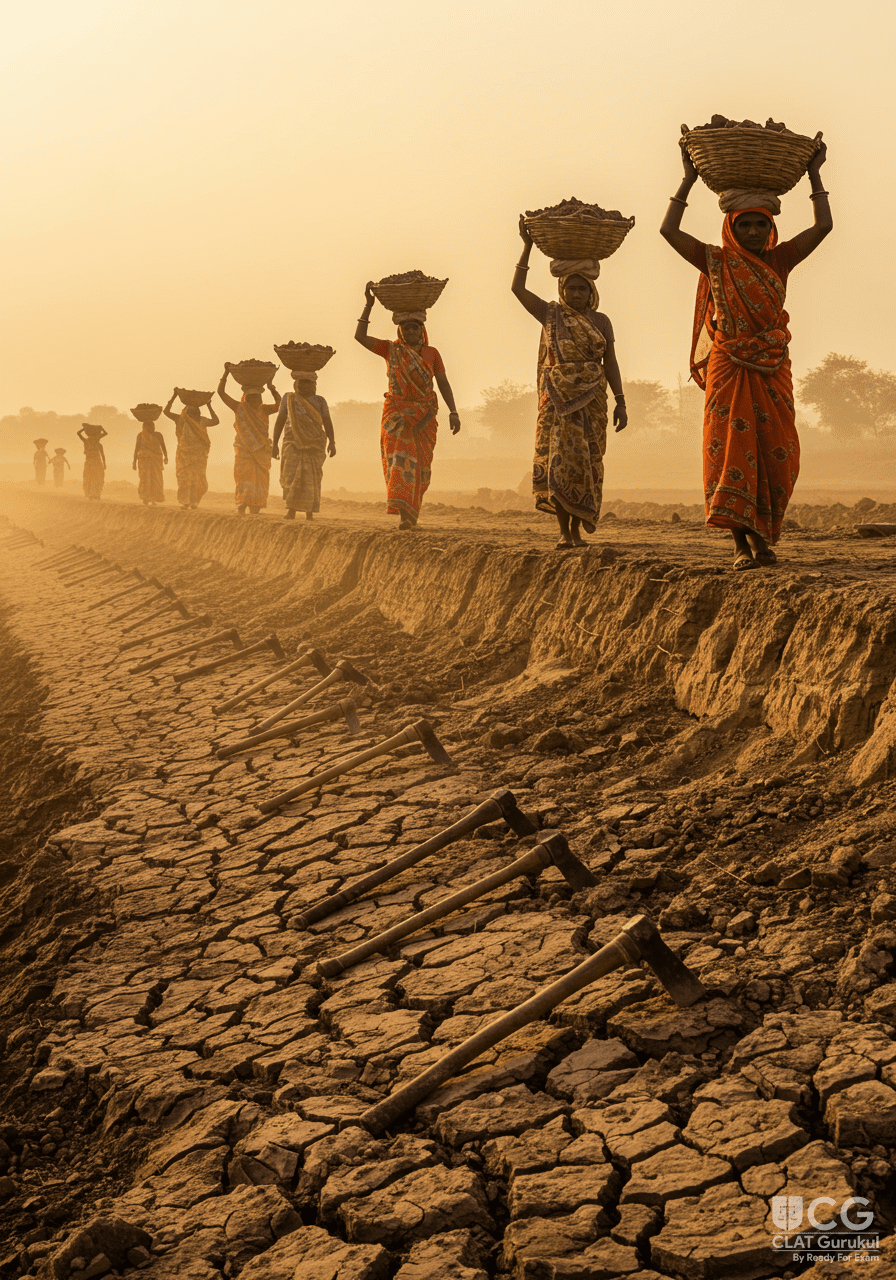
India’s flagship rural jobs programme is being rebranded and restructured. From 1 July 2026, the Centre will replace the Mahatma Gandhi National Rural Employment Guarantee Act (MGNREGA), 2005 with the Viksit Bharat-Guarantee for Employment and Livelihood Mission (Rural) — abbreviated VB-G RAM G. The headline change is generous: the new framework guarantees 125 days of wage employment a year to every rural household, up from the 100 days promised under MGNREGA.
On Tuesday, the Centre announced an interim allocation of Rs 95,692 crore to states for FY 2026-27 under the new mission. Uttar Pradesh tops the list with Rs 9,721.48 crore, followed by West Bengal (Rs 8,508 crore) and Andhra Pradesh (Rs 7,707.21 crore). To ensure work continues uninterrupted through the transition, over 45 crore persondays have been approved for June 2026, and incomplete MGNREGA works will continue until 1 July.
Constitutional & Statutory Framework
- Article 41 (DPSP) — State to secure the right to work within its economic capacity
- Article 21 — right to livelihood read into the right to life
- Article 243G — Panchayats as institutions of economic development and social justice
- Centrally Sponsored Scheme framework — shared Centre-State funding
- 16th Finance Commission — horizontal-devolution parameters inform allocation
The most consequential reform is fiscal, not nominal. Under MGNREGS, the Centre paid 100 per cent of the wage bill. VB-G RAM G converts the programme into a Centrally Sponsored Scheme with a 60:40 wage-cost sharing ratio between Centre and states for general states. The ratio shifts to 90:10 for North-Eastern and Himalayan states and for UTs with a legislature, and remains 100 per cent central for UTs without a legislature. This re-balancing transfers a meaningful share of the wage burden onto state budgets — a federally significant move that states will scrutinise closely.
The constitutional scaffolding remains the same. The right to work is embedded in Article 41 of the Directive Principles, while the Supreme Court has read a right to livelihood into Article 21. Implementation flows through Panchayati Raj institutions under Article 243G, which empowers state legislatures to entrust Panchayats with economic-development functions. The allocation itself draws on the horizontal-devolution parameters recommended by the 16th Finance Commission.
Why redesign a programme that has run for two decades? The government frames VB-G RAM G as part of its ‘Viksit Bharat’ (Developed India) agenda — pairing a higher employment guarantee (125 days) with tighter outcome linkage and asset creation. Critics will watch whether the 60:40 cost-share squeezes poorer states, and whether the day-count increase is matched by timely wage payment, the recurring weakness flagged by the Supreme Court in Swaraj Abhiyan v. Union of India (2016).
For CLAT 2027 aspirants, this is top-priority current affairs. A flagship scheme transition (MGNREGA to VB-G RAM G), a funding-pattern shift (100% to 60:40), and the right-to-work DPSP make it ripe for both GK and legal-reasoning questions.
Why This Matters for CLAT
The MGNREGA-to-VB-G RAM G switch is a textbook intersection of welfare economics and constitutional law. CLAT 2027 may test the day-count increase (100 to 125), the funding shift from 100% central to a 60:40 Centrally Sponsored Scheme, the right-to-work DPSP under Article 41, the livelihood reading of Article 21, and the role of Panchayats under Article 243G in delivering the guarantee.
Key Facts
| New scheme | VB-G RAM G (Rural) |
| Replaces | MGNREGA, 2005 |
| Effective from | 1 July 2026 |
| Days guaranteed | 125 (up from 100) |
| Interim FY27 allocation | Rs 95,692 crore |
| Top state | Uttar Pradesh (Rs 9,721.48 cr) |
| Funding pattern (general) | 60:40 Centre-State |
| NE/Himalayan ratio | 90:10 |
| Key DPSP | Article 41 (right to work) |
Mnemonic / One-liner
Day-count jump: ‘100 → 125’ (MGNREGA to VB-G RAM G). Funding shift: ‘100% Centre → 60:40’. Constitutional anchors: ’41-21-243G’ — Art 41 right to work, Art 21 livelihood, Art 243G Panchayats deliver it.
Test Your Knowledge
Practice Quiz — 10 CLAT-Style Questions
Click an option to reveal the answer and explanation.