

CURRENT AFFAIRS | 11 OCTOBER 2026
The Indian Air Force (IAF) is hosting the second edition of Exercise Tarang Shakti, its flagship multinational air exercise, at Air Force Station Jodhpur. According to the Ministry of Defence release issued through the Press Information Bureau (PIB) on Saturday, 10 October 2026, Tarang Shakti 2026 runs from 26 September to 12 October 2026 and brings together the air forces of seven Friendly Foreign Countries (FFCs) — Australia, Bangladesh, France, Germany, Sri Lanka, the United Arab Emirates and the United States of America — along with 32 observer nations.
On 10 October the Raksha Mantri (Defence Minister) addressed the participants at Jodhpur. The PIB release, and a report in The Hindu the same evening, describe the exercise as a platform for joint mission planning, operational learning and interoperability between air forces that fly different aircraft under different doctrines. The release sums up its spirit in one line: “Different nations. Different aircraft. Different experiences. But one sky.”
What happened: the key facts
The PIB release confirms that this is the second edition, building on the “success of its inaugural edition in 2024”. The exercise brought together combat, transport, surveillance and air-to-air refuelling capabilities. Indigenous platforms took part, including the Light Combat Aircraft (LCA) Tejas and the Light Combat Helicopter (LCH) Prachand, which the release presents as evidence of India’s progress in aerospace design, engineering and manufacturing.
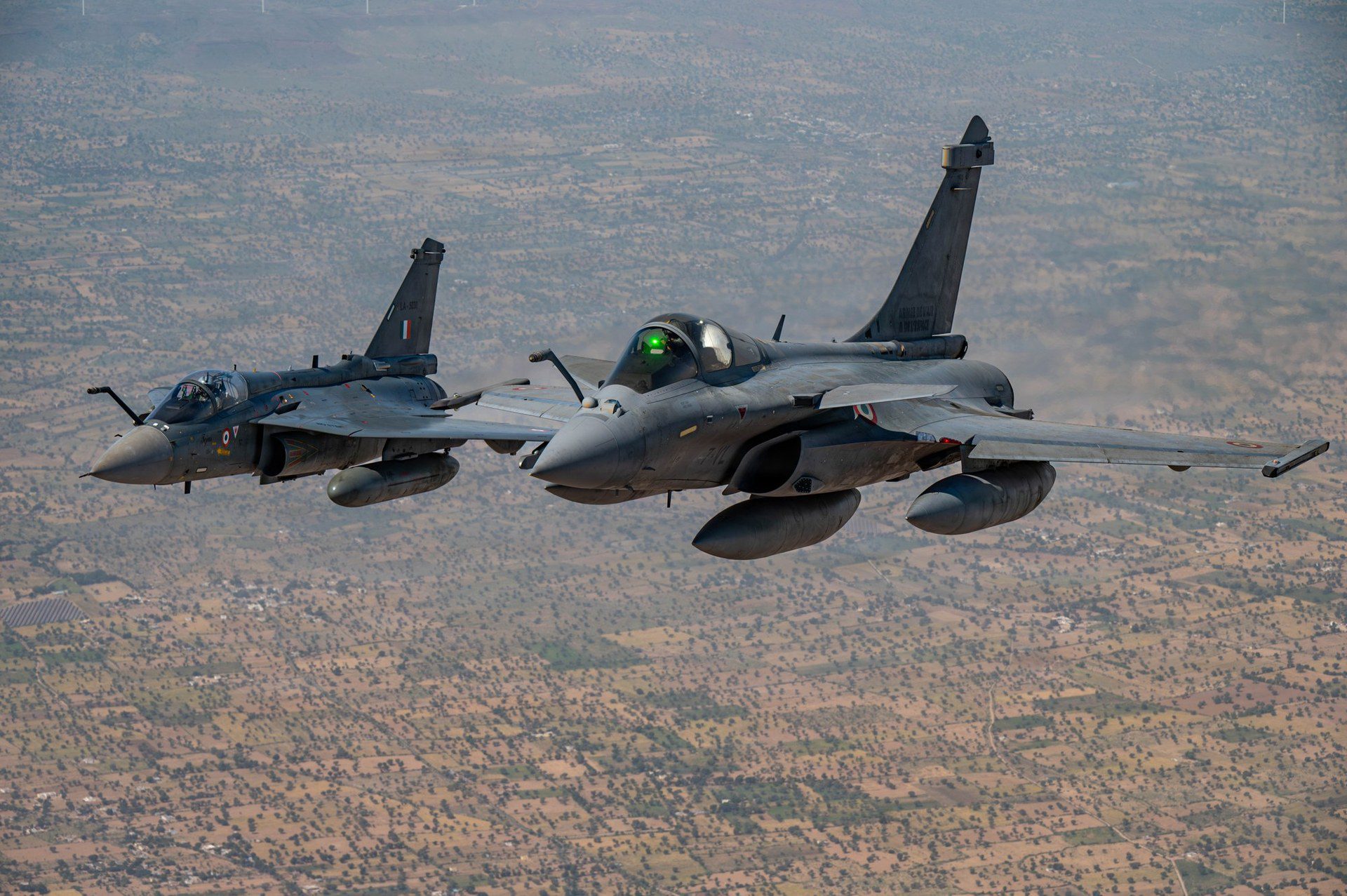
Beyond flying, the exercise included professional engagements, industrial visits and cultural interactions — among them yoga sessions, heritage visits and an International Night showcasing the traditions of the participating countries. Photographs released by the US Air Force show, for example, a French Dassault Rafale flying in formation with an IAF Tejas over Jodhpur, and an IAF Su-30MKI landing after a joint training flight.
In his address, the Defence Minister observed that modern warfare now extends beyond land, sea and air into space, cyber, the electromagnetic spectrum and the information domain, and that drones, artificial intelligence, electronic warfare and long-range precision weapons increasingly shape military operations. He said future military power “will be determined by the speed of sensing, understanding, deciding, and acting”, and that defence ties of the future “will be about technology and trust, not just about platforms”. He called on the IAF to absorb the lessons of the exercise into its training, tactics, technology and doctrine.
Why a multinational air exercise matters
Air forces rarely fight alone today. Humanitarian relief, evacuation of citizens from conflict zones, maritime security and coalition operations all require aircraft from different countries to share airspace, talk on common procedures and refuel one another. A multinational exercise is the peacetime rehearsal for that. Pilots learn how a partner plans a mission; ground crews learn to handle visiting aircraft; commanders test whether their communication and command arrangements actually work together. That shared capacity is called interoperability, and it is the word the PIB release repeatedly uses.
There is also a diplomatic dimension. Hosting seven participating air forces and 32 observers turns Jodhpur into a showcase for defence diplomacy: it signals India’s capability, builds professional trust, and gives foreign observers a close look at Indian-made platforms. The release links this to Atmanirbharta (self-reliance) in defence, noting the minister’s point that self-reliance “did not mean isolation” but the ability to design, develop, manufacture, maintain and upgrade critical technology at home while cooperating with trusted partners. It also mentions programmes such as the Akash air defence system, the Dhruv, Rudra and Prachand helicopters, the Light Utility Helicopter and the Advanced Medium Combat Aircraft (AMCA), described as a step towards fifth-generation stealth fighter technology.
The release also connects the exercise to Operation Sindoor, stating that the decisive role of air power in that operation underlines the value of operational preparedness, integrated planning and credible deterrence — and therefore of exercises such as Tarang Shakti.
Background & Framework
Name: “Tarang Shakti” roughly means “the power of waves”. It is India’s own multinational air exercise — India is the host, not merely a participant, which is what sets it apart from exercises India attends abroad.
Editions: the inaugural edition was held in 2024; the 2026 edition is the second, hosted at Air Force Station Jodhpur.
Participating vs observer nations: “participating” countries send aircraft and crews that actually fly the missions; “observers” send officers to watch, learn and network. In 2026 there are 7 participants and 32 observers.
The IAF itself: the Indian Air Force was established on 8 October 1932, which is why Air Force Day is observed on 8 October — a date that fell during this year’s exercise. The Ministry of Defence is the administrative ministry; the President of India is the Supreme Commander of the armed forces under Article 53(2) of the Constitution.
Other exercises to link: India’s bilateral air exercises include Garuda (with France) and Cope India (with the USA); Pitch Black is a multinational air exercise hosted by the Royal Australian Air Force.
Reading the participant list
The seven participants span India’s neighbourhood (Bangladesh, Sri Lanka), the Gulf (UAE), Europe (France, Germany) and the Indo-Pacific partners Australia and the USA. For an exam, the most useful habit is to memorise the list as a set and to know which countries are neighbours, which are Quad partners (Australia and the USA; Japan is the fourth Quad member but is not on this participant list), and which are European. Questions often test exactly that kind of odd-one-out reasoning.
The CLAT Angle
Direct GK: expect questions on the host (IAF), venue (Jodhpur), edition (second; first in 2024), dates (26 September–12 October 2026) and the numbers (7 participating air forces, 32 observers). A favourite trap is to swap participants and observers, or to slip in a country that was not a participant.
Passage use: a GK passage could build on the idea that modern warfare spans space, cyber and the information domain, then ask which inference follows — for example, that platform numbers alone no longer define air power. A Legal Reasoning passage could pair the President’s role as Supreme Commander (Article 53(2)) with Parliament’s control over defence through the Union List (Entry 1, Defence of India).
Match-the-following: exercise ↔ partner pairs (Garuda–France, Cope India–USA, Pitch Black–Australia-hosted, Tarang Shakti–India-hosted multinational) are standard fare.
Analysis: what the second edition signals
Three points stand out. First, continuity: a second edition turns a one-off event into a recurring Indian-hosted platform, which is how exercises such as Pitch Black acquired their reputation. Second, breadth: 32 observer nations is a large audience, and it widens the circle of air forces that have seen Indian procedures and equipment first-hand. Third, indigenous showcasing: by flying the Tejas and Prachand alongside foreign fighters, the IAF presents home-built platforms in a working environment rather than at a static air show.
The limits are also worth noting. Exercises build familiarity, not alliances; participation does not imply any treaty commitment. Their value lies in procedures and trust that can be drawn on later — in disaster relief, evacuations or coalition tasks — which is precisely the “technology and trust” theme of the minister’s address.
Key Facts
- Exercise: Tarang Shakti 2026 — multinational air exercise hosted by the Indian Air Force.
- Edition: second; the inaugural edition was in 2024.
- Venue: Air Force Station Jodhpur.
- Dates: 26 September to 12 October 2026.
- Participating air forces (7): Australia, Bangladesh, France, Germany, Sri Lanka, UAE, USA.
- Observer nations: 32.
- Indigenous platforms: LCA Tejas and LCH Prachand took part.
- Capabilities: combat, transport, surveillance and air-to-air refuelling.
- Address: Defence Minister addressed participants on 10 October 2026 (PIB, Ministry of Defence).
- Tagline: “Different nations. Different aircraft. Different experiences. But one sky.”
- IAF founded: 8 October 1932 (Air Force Day).
Memory Hook / Mnemonic
“2nd wave, 7 flags, 32 eyes, one sky.” Tarang = wave — the 2nd wave (first in 2024) at Jodhpur. 7 flags fly (remember “SUB FUGA”: Sri Lanka, UAE, Bangladesh, France, USA, Germany, Australia), 32 eyes watch as observers, all under one sky from 26 Sep to 12 Oct.
Practice Quiz — 10 CLAT-Style Questions
Click an option to reveal the answer and explanation.






