
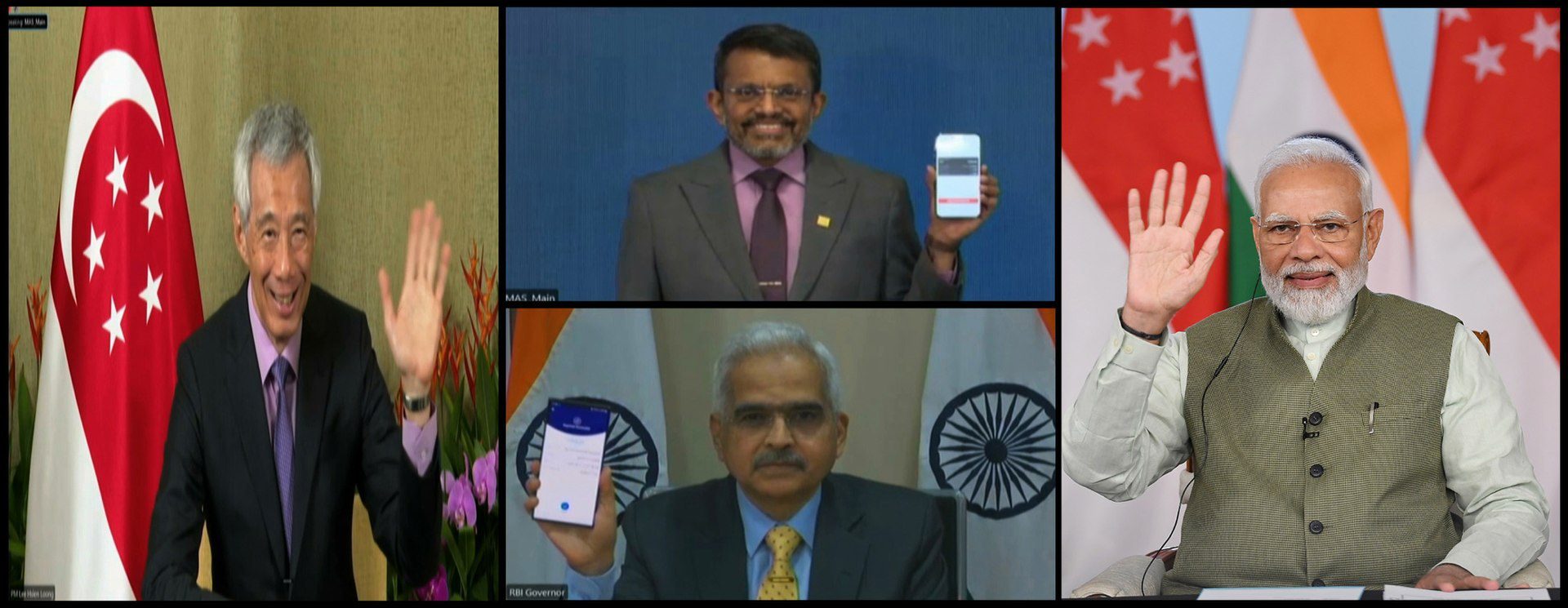
VIDEO EXPLAINER | 30 OCTOBER 2026
In August 2026 Parliament passed the Taxation and Other Laws (Amendment) Bill, 2026, which rewrites Section 10A of the Payment and Settlement Systems Act, 2007 so that the Centre, by notification, decides which payment modes stay charge-free. This opens the door to a merchant fee (MDR) on large-merchant UPI payments. The Finance Ministry said consumers and person-to-person transfers will stay free. The debate prompted a wider look at how India exports UPI abroad, first through bilateral links, then through DPI advocacy at the G20, and now through capacity transfer (connect via Project Nexus, build via NIPL, share open protocols). Scholars describe this as a form of ‘infrastructural power’ that differs from the EU’s rule-exporting ‘Brussels Effect’.
What happened
The Finance Ministry ‘categorically’ stated that consumers will not pay transaction charges for using UPI and that all person-to-person (P2P) UPI transactions stay free.
The Taxation and Other Laws (Amendment) Bill, 2026 was introduced in the Lok Sabha on 4 August 2026 and replaces the Income-tax (Amendment) Ordinance, 2026 promulgated on 5 June 2026.
The Lok Sabha passed the Bill on Thursday, 6 August 2026.
The Bill is a Money Bill. The Rajya Sabha discussed it and returned it to the Lok Sabha on 10 August 2026, completing its passage through Parliament.
FM Nirmala Sitharaman told Parliament that no MDR will be imposed on small merchants, calling them central to UPI’s inclusive growth.
The Bill amends three laws: the Income-tax Act, 2025, the Finance Act, 2026 and the Payment and Settlement Systems Act, 2007.
Background and the rules behind it
UPI was launched on 11 April 2016 as a pilot with 21 member banks, inaugurated in Mumbai by RBI Governor Raghuram G. Rajan.
UPI is operated by the National Payments Corporation of India (NPCI) and regulated by the Reserve Bank of India.
NPCI was incorporated on 19 December 2008 as a not-for-profit company under Section 25 of the Companies Act, 1956 (now Section 8 of the Companies Act, 2013), jointly promoted by the RBI and the Indian Banks’ Association (IBA).
NPCI is headquartered in Mumbai. Its MD & CEO is Dilip Asbe, reappointed for five years from 8 January 2023.
Project Nexus, developed by the BIS Innovation Hub (Singapore Centre), aims to link domestic instant payment systems so that a cross-border payment arrives within 60 seconds.
On 30 June 2024 in Basel, the RBI joined the central banks of Malaysia, the Philippines, Singapore and Thailand as a founding member of Project Nexus, with Indonesia as a special observer.
Key terms
- MDR (Merchant Discount Rate): Fee a merchant’s bank charges the merchant per digital payment accepted, as a percentage of value; the payer does not pay it.
- P2P / P2M: Person-to-person transfers vs person-to-merchant payments; the proposed fee concerns only some P2M payments.
- Digital Public Infrastructure (DPI): Shared, interoperable digital systems (identity, payments, data exchange) built on open standards for society-wide service delivery.
- Fast payment system (FPS): A retail payment system that settles transfers between accounts in real time, around the clock.
- Interoperability: Any app or bank can send to any other on the same network; the IMF credits it for UPI’s adoption.
- Infrastructural power: Michael Mann’s term for a state’s capacity to reach citizens and implement decisions across its territory.
Constitutional / Legal / Institutional framework
- Payment and Settlement Systems Act, 2007, s.10A (as amended by the Taxation and Other Laws (Amendment) Act, 2026): No bank or system provider may charge anyone paying or receiving through the electronic modes the Central Government notifies; earlier the protected modes were fixed by reference to s.269SU of the Income-tax Act, 1961.
- Income-tax Act, 1961, s.269SU (now replaced by the Income-tax Act, 2025): Businesses with turnover above Rs 50 crore had to offer prescribed electronic modes (RuPay debit, BHIM-UPI, UPI QR); zero MDR on these from 1 Jan 2020.
- Art. 110 and Art. 109, Constitution of India: Money Bill: introduced only in the Lok Sabha; the Rajya Sabha may only recommend and must return it within 14 days; the Taxation Bill took this route.
- GDPR (EU) Art. 45: European Commission may find a third country’s data protection adequate, allowing free data transfers (e.g. Brazil, Jan 2026).
CLAT angle
- Passage on UPI as ‘infrastructural power’ vs the EU’s ‘Brussels Effect’; inference questions on why adoption ‘costs nothing and returns capacity’.
- Institution questions: who runs UPI (NPCI, not RBI), who regulates it (RBI), NPCI’s legal form (Section 8, RBI + IBA, 2008).
- What is charged: P2P UPI stays free; any MDR falls on large merchants, not payers; the 2026 law only enables charges.
- Legal-reasoning: applying amended s.10A PSS Act to a scenario where a bank charges a consumer on a non-notified mode.
- Matching: Project Nexus (connect, BIS + Malaysia, Philippines, Singapore, Thailand), NIPL builds (Namibia, Peru, Trinidad and Tobago), Indonesia Open Network (share, Beckn).
Key facts
| Fact | Detail |
|---|---|
| 1930 | BIS founded in Basel |
| 2007 | Payment and Settlement Systems Act enacted |
| 2008-12-19 | NPCI incorporated |
| 2016-04-11 | UPI launched with 21 banks |
| 2020-01-01 | Zero-MDR regime for RuPay debit and BHIM-UPI begins |
| 2020 | NIPL set up |
| 2022-04-29 | ONDC pilot launched |
| 2023-02-21 | UPI-PayNow linkage with Singapore |
Mnemonic / memory hook
Remember the trap.
Trap 1: NPCI (not the RBI, not the government) runs UPI; the RBI regulates it under the PSS Act, 2007. Trap 2: the 2026 law does NOT impose a UPI charge; it lets the Centre notify which modes stay free. Consumers and P2P stay free, and any MDR is borne by merchants. Trap 3: Section 269SU belonged to the 1961 Income-tax Act, which the Income-tax Act, 2025 replaced on 1 Apr 2026.
Sources
Primary documents and reporting listed in the fact base: prsindia.org, aninews.in, medianama.com, en.wikipedia.org, business-standard.com, bis.org, thepaypers.com. Lead image: no ASSET-MANIFEST.json.
Free in the CLAT Gurukul app
These notes (as a PDF lesson) and the 10-question CBT are in the app under Current Affairs → 30 Oct 2026. Get the app on Google Play or open app.clatgurukul.com.
Practice Quiz — 10 CLAT-Style Questions
Click an option to reveal the answer and explanation.