VIDEO EXPLAINER | 30 OCTOBER 2026
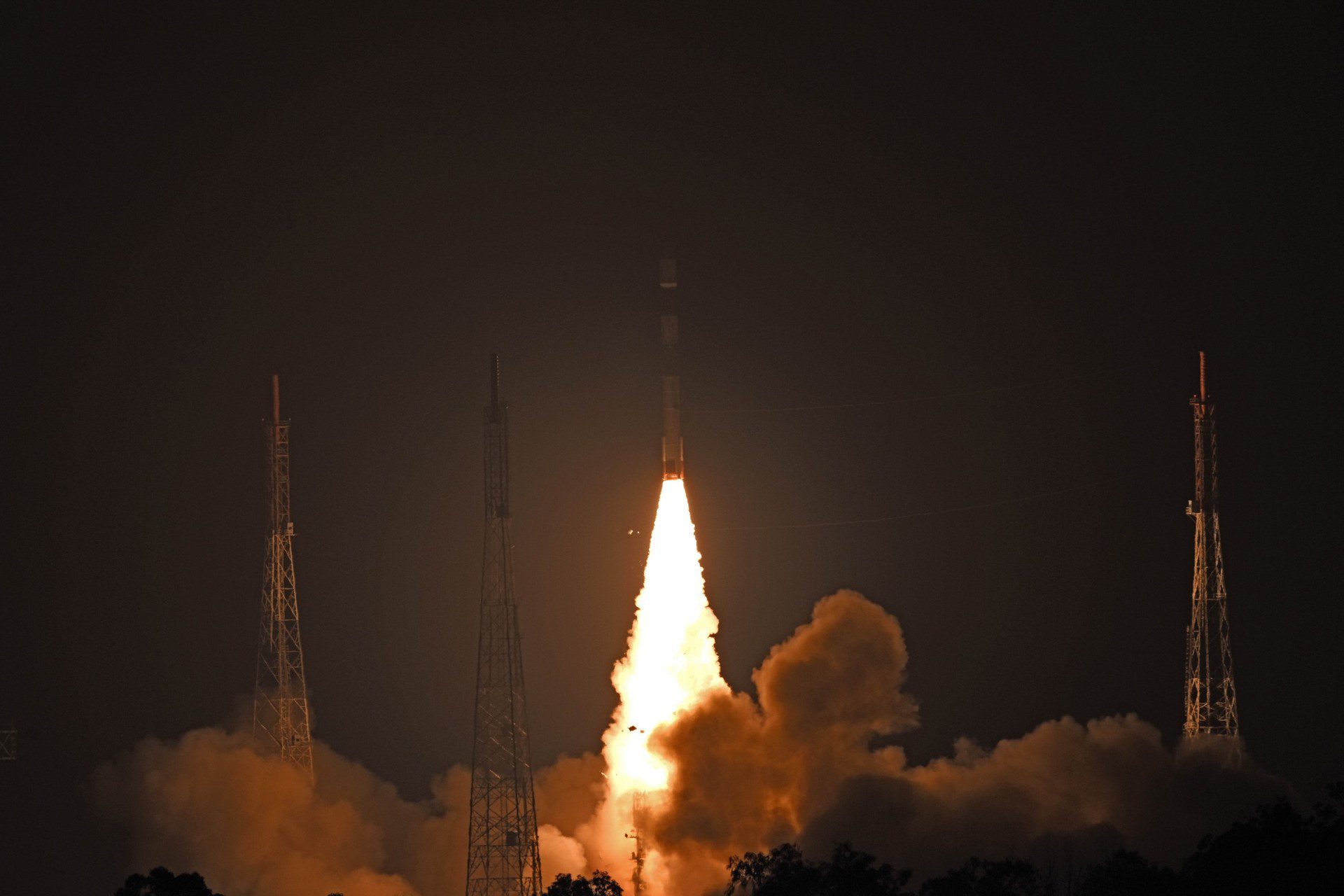
On 18 July 2026 Skyroot Aerospace’s Vikram-1 lifted off from Sriharikota under ‘Mission Aagaman’ and placed satellites in a 450 km low Earth orbit. It was the first orbital launch by a private Indian company, and it succeeded on the first attempt. The flight builds on the 2020 space reforms that created IN-SPACe, the Indian Space Policy 2023, and Skyroot’s own sub-orbital Vikram-S of November 2022. Under Article VI of the Outer Space Treaty, India remains internationally responsible for the launch; domestically, IN-SPACe authorised it.
What happened
In February 2026 IN-SPACe facilitated the Rs 511 crore, 10-year transfer of SSLV technology to Hindustan Aeronautics Limited.
On Saturday 25 April 2026 Telangana CM A. Revanth Reddy flagged off Vikram-1 from Skyroot’s Max-Q campus in Hyderabad to Sriharikota.
India’s space economy (about USD 8.4 billion) is projected to reach USD 40-45 billion by 2030, with an aim of USD 100 billion by 2040.
Skyroot Aerospace’s Vikram-1 lifted off from the Satish Dhawan Space Centre, Sriharikota, on 18 July 2026 at 12:05:30 pm.
It has an all-carbon composite structure, solid-fuel boosters and a 3D-printed liquid engine.
Customer payloads included Skyroot’s SCOPE, DCUBED’s technology demonstrator, Grahaa Space’s SOLARAS S3 and Cosmoserve Space’s ‘Embrace’ debris-capture robotic arm.
The rocket’s liquid-fuelled ‘Raman’ engine sits in its orbital adjustment module for precise insertion.
It was the first time a private Indian company undertook an orbital launch from Indian soil, and it succeeded on the first attempt.
Two satellites, SCOPE and Grahaa, were injected into low Earth orbit; other payloads stayed on the upper stage for experiments.
ISRO describes Vikram-1 as a 4-stage rocket with three solid stages and a liquid stage.
ISRO let Skyroot use its solid-motor casting and static-test facilities at SDSC, where the first stage was cast and tested; the second stage was tested at LPSC.
Vikram-1 flew from the First Launch Pad at Sriharikota.
The mission, named ‘Mission Aagaman’, injected payloads into a 450 km orbit.
Lift-off came 35 minutes after the original 11:30 am slot, following a planned hold.
A government release says Vikram-1 can place about 350 kg into low Earth orbit (the figure is approximate; reports differ).
About 36 days after the launch, Skyroot began shipping the first stage (Kalam-1200) of its second Vikram-1 to Sriharikota.
Background and the rules behind it
The Indian Space Policy 2023 was approved by the Cabinet Committee on Security in April 2023.
The Outer Space Treaty was opened for signature in January 1967 by its three depositaries (Russia, UK, USA) and entered into force in October 1967.
Low Earth orbit is usually taken as 160-2,000 km above Earth; satellites there circle the planet in about 90-120 minutes.
Key terms
- Orbital vs sub-orbital launch: An orbital rocket reaches the speed to keep a payload circling Earth; a sub-orbital one goes up and falls back.
- Low Earth orbit (LEO): Orbits about 160-2,000 km above Earth; used for Earth observation and communication constellations.
- Non-Government Entity (NGE): A private company or start-up doing space activities, as defined in India’s Space Policy 2023.
- IN-SPACe: Indian National Space Promotion and Authorization Centre: single-window body that authorises private space activity in India.
- Mission Aagaman: Name of Vikram-1’s maiden orbital flight; ‘aagaman’ means arrival.
Constitutional / Legal / Institutional framework
- Outer Space Treaty, 1967, Art. VI: The State is internationally responsible for national space activities, including private ones, which need its authorisation and continuing supervision.
- Outer Space Treaty, 1967, Art. II: No national appropriation of outer space by claim of sovereignty, use or occupation.
- Indian Space Policy 2023: Opens the whole space value chain to NGEs; IN-SPACe authorises them; NSIL is ISRO’s commercial arm.
CLAT angle
- First private SUB-orbital (Vikram-S, 18 Nov 2022, Mission Prarambh) vs first private ORBITAL (Vikram-1, 18 Jul 2026, Mission Aagaman). Expect options that swap them.
- Regulator question: private launches are authorised by IN-SPACe (created 2020), not ISRO or NSIL.
- Treaty application: under OST Art. VI, India, not Skyroot, is internationally responsible for Vikram-1.
- Numbers: 350 kg to LEO; 450 km orbit; 4 stages per ISRO (3 solid + liquid); lift-off 12:05 pm.
Key facts
| Fact | Detail |
|---|---|
| 1967-10 | Outer Space Treaty enters into force |
| 2018 | Skyroot Aerospace founded in Hyderabad |
| 2020-06-24 | Cabinet approves space reforms; IN-SPACe created |
| 2022-11-18 | Vikram-S (Mission Prarambh): first private rocket launch, sub-orbital |
| 2023-04 | Indian Space Policy 2023 approved |
| 2024-05 | Agnikul launches from private pad Dhanush |
| 2026-04-25 | Vikram-1 flagged off from Hyderabad to Sriharikota |
| 2026-07-18 | Vikram-1 reaches orbit (Mission Aagaman) |
Mnemonic / memory hook
Remember the trap.
(1) Vikram-S (2022) was sub-orbital, and Vikram-1 (2026) is the first private orbital launch. (2) IN-SPACe was created by the Cabinet decision of 24 June 2020; the Space Policy came in 2023. (3) The rocket was launched from ISRO’s SDSC First Launch Pad, not from Agnikul’s private pad ‘Dhanush’. (4) Mission names: Prarambh (Vikram-S), Aagaman (Vikram-1).
Sources
Primary documents and reporting listed in the fact base: isro.gov.in, newsonair.gov.in, newindianexpress.com, pib.gov.in, businessworld.in, timesofindia.indiatimes.com, moneycontrol.com, unoosa.org. Lead image: no ASSET-MANIFEST.json.
Free in the CLAT Gurukul app
These notes (as a PDF lesson) and the 10-question CBT are in the app under Current Affairs → 30 Oct 2026. Get the app on Google Play or open app.clatgurukul.com.
Practice Quiz — 10 CLAT-Style Questions
Click an option to reveal the answer and explanation.