
CURRENT AFFAIRS | 26 SEPTEMBER 2026
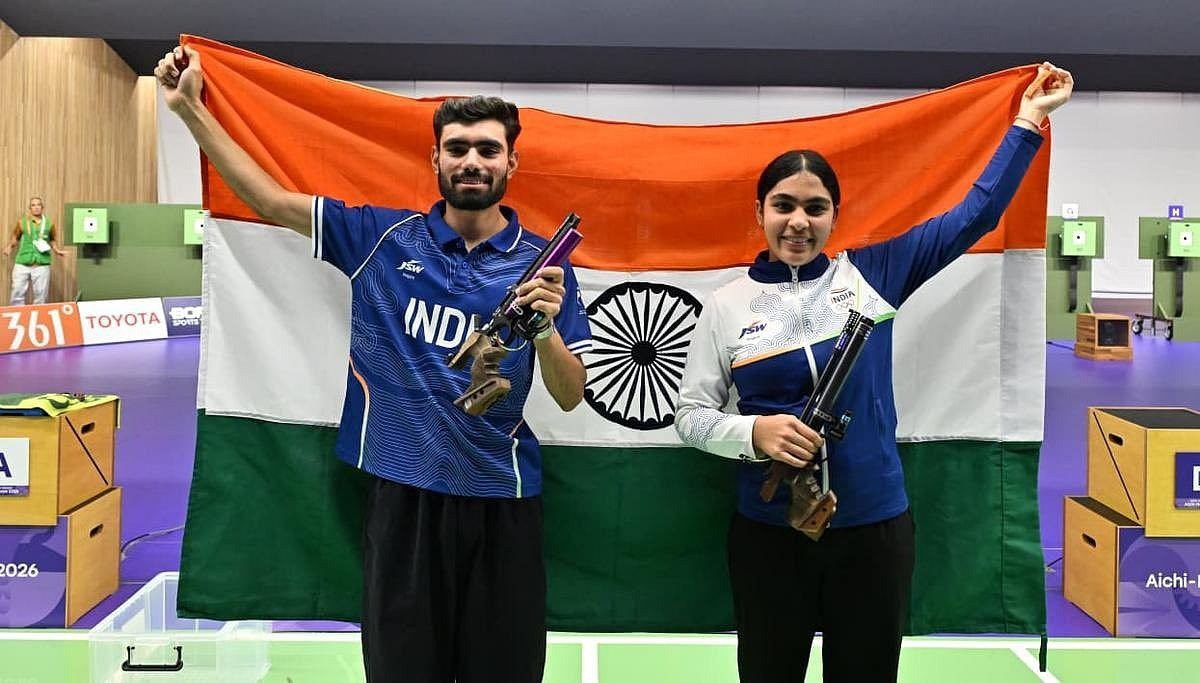
On 25 September 2026, Day 7 of the 20th Asian Games (Asian Games 2026) in Aichi–Nagoya, Japan, the Indian pistol pair of Suruchi Singh (Suruchi Inder Singh) and Kamaljeet won the 10m air pistol mixed team gold. It was India’s second gold of the Games and its first in any shooting event, as The Indian Express recorded in its Day 7 capsule on 26 September. The pair shot 484.6 in the final — reported as a new Asian record — to beat the Republic of Korea (478.0), with Iran taking bronze. According to Olympics.com and the Free Press Journal, they had earlier set an Asian Games qualification record of 587, bettering the 577 shot by Sarabjot Singh and Divya Subbaraju at Hangzhou.
The medal carried a story of recovery. Reports noted that Kamaljeet had finished ninth in the men’s individual qualification, narrowly missing the final, and Suruchi, competing in her maiden Asian Games, had placed 26th in the women’s event. Combining in the mixed team, they produced India’s best shooting result of the Games so far.
India’s Day 7 haul, per The Indian Express, was one gold, two silver and three bronze. The Express medal table printed on 26 September placed India on 2 gold, 9 silver and 12 bronze — 23 medals. China led the table with 98 gold and 159 medals, and hosts Japan were second with 115 medals.
The other Indian medals of the day
Gulveer Singh — 10,000m silver. In one of the races of the day, Gulveer Singh took silver in the men’s 10,000m, upgrading his Hangzhou bronze and becoming the first Indian to win two Asian Games medals in the 10,000m. He stayed with the leaders for almost the entire race before Birhanu Balew of Bahrain, an Ethiopia-born runner and Diamond League 5,000m champion, pulled clear on the final lap to win by 1.87 seconds. The Express noted that Gulveer holds the Indian national records in the 5,000m and 10,000m and is also entered in the 1,500m and 5,000m in Nagoya.
Men’s 50m rifle 3 positions team — silver. Aishwary Pratap Singh Tomar, Niraj Kumar and Rudrankksh Balasaheb Patil won the second shooting medal of the day, finishing behind China.
Three bronzes. Manpreet Kaur won bronze in the women’s shot put with a best throw of 17.17m, her first Asian Games medal. Baranica Elangovan cleared 4.15m to win bronze in the women’s pole vault — India’s first-ever Asiad medal in the event. In table tennis, Manush Shah and Diya Chitale won mixed doubles bronze after losing to China in the semi-final; the Express noted it is India’s second mixed doubles Asiad podium after Achanta Sharath Kamal and Manika Batra in 2018.
Background & Framework
The Asian Games are a multi-sport event held every four years under the Olympic Council of Asia (OCA), headquartered in Kuwait City. The first Asian Games were held in New Delhi in 1951, and India hosted again in 1982, also in New Delhi. The 2026 Games are the 20th edition, hosted by Aichi Prefecture and Nagoya, and run from 19 September to 4 October 2026. Japan has hosted the Games twice before — Tokyo 1958 and Hiroshima 1994. The previous edition, the 19th Asian Games at Hangzhou, China, was postponed from 2022 and held in 2023; India recorded its best-ever showing there, with 28 gold and more than 100 medals. In shooting, the mixed team format pairs one man and one woman from the same nation; mixed events have been expanded across international sport to promote gender balance, and the 10m air pistol mixed team has also been an Olympic event since Tokyo 2020.
India’s first gold of Aichi–Nagoya
The shooting gold was India’s second of the Games. The first came on 22 September, when the Indian women’s cricket team, led by Harmanpreet Kaur, beat Sri Lanka in the final. According to the Olympics.com report of that day, India made 216/3 and bowled Sri Lanka out for 69, winning by 147 runs. Cricket has been part of the Asian Games programme intermittently; its return at Hangzhou and again at Aichi–Nagoya has given India a strong medal opportunity.
Reading the numbers
A tally of two golds after seven days is modest when set against India’s 28 golds at Hangzhou. The Express, in its reporting on 26 September, observed that defending champions were struggling — including the men’s badminton doubles pair of Satwiksairaj Rankireddy and Chirag Shetty, Hangzhou gold medallists, who lost in the first round. Several of India’s strongest events — athletics finals, kabaddi (both Indian teams were set to face Iran in the gold-medal matches on Day 8, per the Express), and more shooting — lay ahead in the second week, so a fair assessment must wait until the Games close on 4 October.
The Express also highlighted a structural issue in athletics: African-born athletes who have switched nationality, mainly to Gulf nations such as Bahrain and Qatar, winning distance events. Balew’s gold in the 10,000m is one such case. The paper recalled that World Athletics froze all transfers of allegiance from February 2017 to July 2018 and resumed them under reformed rules including a three-year waiting period. This is a live debate in sports governance: the right of an athlete to change nationality versus the integrity of national representation.
The CLAT Angle
Sports questions in CLAT GK are usually fact-recall: host city and edition (20th, Aichi–Nagoya), governing body (OCA, Kuwait City), “first-ever” achievements (Baranica Elangovan in pole vault; Gulveer Singh’s two 10,000m medals) and record-setting scores (484.6 Asian record; 587 qualification record). Watch for the trap that the first gold of the Games was in shooting — it was not; it came in women’s cricket on 22 September. The nationality-transfer debate is well suited to a reasoning passage: a rule that athletes must wait three years before representing a new country balances an individual’s freedom of movement and livelihood against a sporting body’s interest in genuine national representation — a classic “competing interests” question.
Why the mixed team gold matters
Beyond the medal count, the pistol gold continues a trend. Indian shooting has become one of the country’s most reliable medal sources across the Olympics, Asian Games and World Cups, supported by the National Rifle Association of India (NRAI), a strong junior pipeline and government schemes such as Khelo India and the Target Olympic Podium Scheme (TOPS). A qualification record of 587 — ten points above the previous Games mark — followed by an Asian-record final score shows depth of consistency, not a one-off peak. That the medal came from two shooters who had missed their individual finals is also instructive: team events reward the combined score, and composure under the mixed-team format is a distinct skill.
For India’s sporting policy, the Asian Games are a crucial benchmark between Olympic cycles. Results here feed into funding decisions, selection for elite schemes and the planning of preparation for the next Olympics. The mix of medals on Day 7 — from shooting, distance running, throws, pole vault and table tennis — reflects a broadening base of competitive sports, even if the gold count is lower than hoped.
Key Facts
- Event: 20th Asian Games, Aichi–Nagoya, Japan, 19 September – 4 October 2026.
- Gold (25 Sep): Suruchi Singh & Kamaljeet, 10m air pistol mixed team — India’s 2nd gold, 1st in shooting.
- Final score: 484.6 (Asian record); Korea silver (478.0), Iran bronze.
- Qualification: 587, a Games record, beating 577 by Sarabjot Singh & Divya Subbaraju (Hangzhou).
- Silver: Gulveer Singh, men’s 10,000m — first Indian with two Asiad 10,000m medals.
- Silver: Men’s 50m rifle 3 positions team (Tomar, Niraj Kumar, Rudrankksh Patil).
- Bronze: Manpreet Kaur, shot put (17.17m); Baranica Elangovan, pole vault (4.15m) — India’s first in the event.
- Bronze: Manush Shah & Diya Chitale, table tennis mixed doubles.
- India’s first gold: Women’s cricket, beat Sri Lanka by 147 runs on 22 Sep.
- Tally (IE, 26 Sep): India 2 G, 9 S, 12 B = 23; China leads with 98 gold.
- Static: OCA HQ Kuwait City; first Asian Games New Delhi 1951.
To sum up, Day 7 at Aichi–Nagoya gave India its first shooting gold and a record-breaking one, plus a spread of medals across five sports. The exam essentials are the names, events and records; the analytical layer is the debate over the pace of India’s gold count and the governance question of nationality transfers in athletics.
Memory Hook / Mnemonic
“SK-484, 587, Gold No. 2” — Suruchi + Kamaljeet, final 484.6, qualification 587, India’s second gold (the first was cricket). For Day 7, think “1-2-3”: 1 gold, 2 silvers (Gulveer, rifle team), 3 bronzes (shot put, pole vault, table tennis). And “20 in Aichi” — the 20th Games, 19 Sep to 4 Oct.
Practice Quiz — 10 CLAT-Style Questions
Click an option to reveal the answer and explanation.