CURRENT AFFAIRS | 26 SEPTEMBER 2026
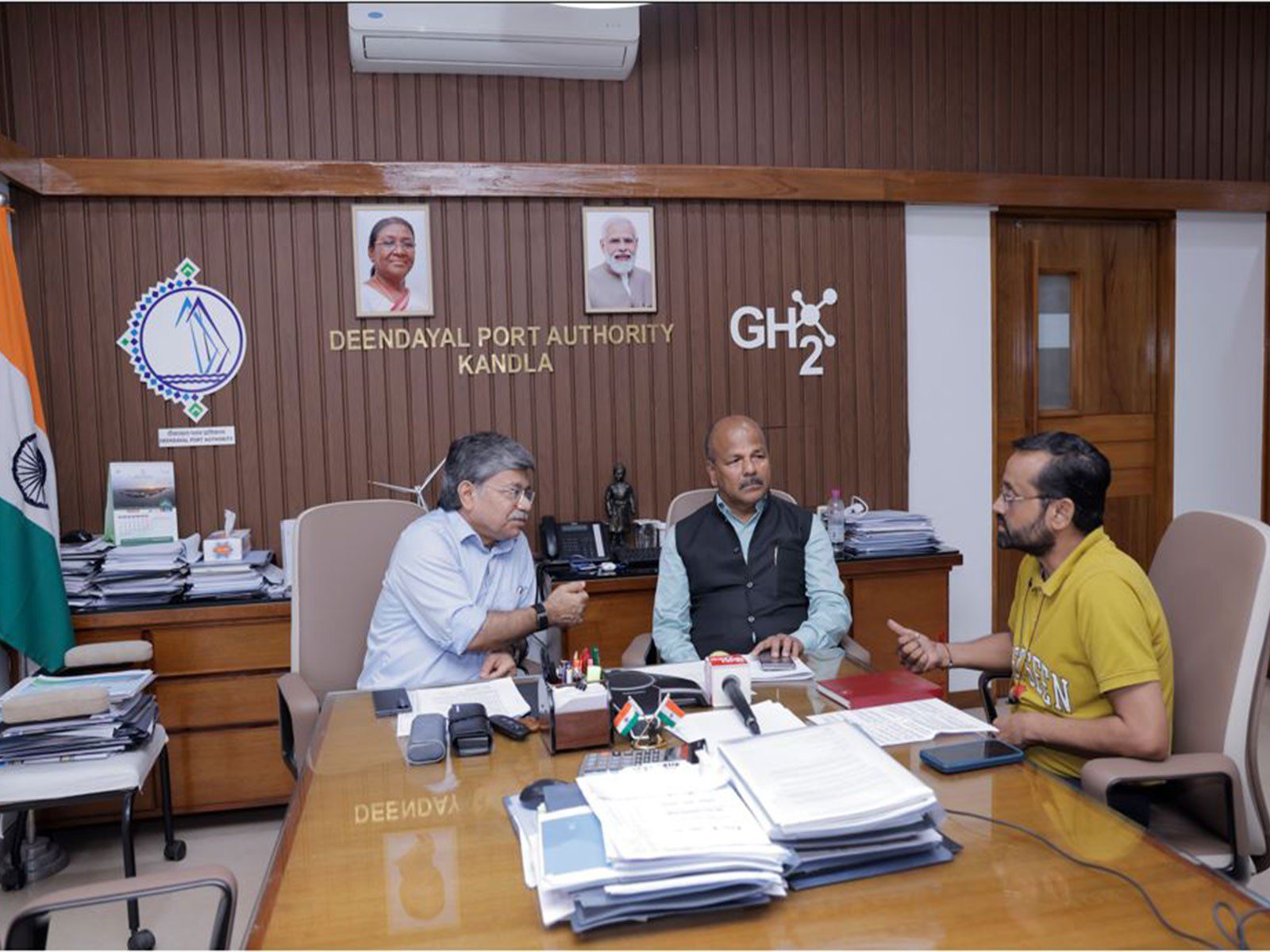
The foundation stone of a 150 tonnes-per-day (TPD) e-Methanol plant at the Deendayal Port Authority (DPA), Kandla, was scheduled to be laid at 11 AM on 26 September 2026 at the DPA Exhibition Ground in Gandhidham, Gujarat. According to an ANI report of 24 September and a Ministry of Ports, Shipping and Waterways notice published in The Indian Express on 26 September, the project is a joint initiative of the DPA and Assam Petro-Chemicals Limited (APCL), Namrup, Assam, with an estimated investment of about ₹2,300 crore, to be built as scalable modules in phases. The ceremony was to be led by Union Minister of Ports, Shipping and Waterways Sarbananda Sonowal, with Gujarat Chief Minister Bhupendra Patel and Assam Chief Minister Himanta Biswa Sarma.
The Ministry’s notice describes the plant as “among India’s largest e-Methanol facilities” and says its fuel is meant for ships on the Singapore–Rotterdam corridor, positioning India “as a global green-fuel supplier, not just a buyer”. ANI reported that the project is expected to create more than 3,500 direct and indirect jobs and to promote e-Methanol as a cleaner marine fuel, reducing dependence on imported fossil fuels. For CLAT, the story sits at the meeting point of three syllabi: the chemistry of green fuels, India’s energy-transition policy, and the international law of shipping emissions.
What is e-Methanol?
Methanol (CH3OH) is the simplest alcohol, a liquid at room temperature that is widely used as an industrial chemical. Most methanol today is made from natural gas or coal, which makes it a fossil fuel. e-Methanol (electro-methanol) is instead synthesised from two inputs: green hydrogen, produced by splitting water in an electrolyser powered by renewable electricity, and captured carbon dioxide. The core reaction is:
CO2 + 3H2 → CH3OH + H2O
Because the carbon in the fuel was captured rather than dug out of the ground, and the hydrogen came from renewable power, e-Methanol can have a much lower lifecycle emission footprint than conventional marine fuel. Its big practical advantage for shipping is that it is a liquid at ambient temperature and pressure, so it can be stored and bunkered with modest changes to existing infrastructure — unlike hydrogen, which must be compressed or cooled to extreme temperatures, or ammonia, which is toxic. Several global shipping lines have already ordered dual-fuel vessels that can run on methanol, which is why ports are racing to become methanol bunkering hubs.
Background & Framework
National Green Hydrogen Mission. Approved by the Union Cabinet on 4 January 2023 with an initial outlay of ₹19,744 crore, the Mission targets 5 million metric tonnes (MMT) of green hydrogen production capacity a year by 2030. Its main incentive programme is SIGHT (Strategic Interventions for Green Hydrogen Transition). Green hydrogen “derivatives” such as green ammonia and green methanol are central to the Mission because they are easier to transport and use than hydrogen gas.
International shipping law. Emissions from international shipping are regulated through the International Maritime Organization (IMO), a UN specialised agency headquartered in London, chiefly via Annex VI of the MARPOL Convention (prevention of air pollution from ships). The 2023 IMO GHG Strategy set the goal of reaching net-zero greenhouse-gas emissions from international shipping by or around 2050. A global fuel-intensity standard and emissions-pricing mechanism, the IMO Net-Zero Framework, was approved in draft in April 2025, but its formal adoption was deferred in October 2025.
Green shipping corridors. The idea of zero-emission maritime routes between specific ports was launched through the Clydebank Declaration at COP26, Glasgow (2021). The Singapore–Rotterdam green and digital corridor, announced in 2022, links two of the world’s largest bunkering ports.
Why Kandla, and why Assam?
Deendayal Port (renamed from Kandla Port in 2017) sits on the Gulf of Kutch in Gujarat and is one of India’s major ports, now governed under the Major Port Authorities Act, 2021. The Ministry’s notice highlights its location on India’s busiest western trade route. Kutch also has abundant land, strong solar and wind resources and existing port-side industry — the ingredients that green-fuel production needs: cheap renewable power, water for electrolysis, a source of CO2, and ships to fuel.
Assam Petro-Chemicals Limited, based at Namrup in Assam, is an established methanol producer. The Ministry’s notice frames the project as bringing together “Assam’s industrial strength” with “Gujarat’s port gateway”. That pairing is itself notable: a public sector enterprise from India’s north-east investing on the western coast, with the Union ministry acting as convenor. It is a practical illustration of how state-owned enterprises and port authorities are being used as anchor investors in new green industries whose private market is still immature.
The economics: from fuel importer to fuel exporter
The government’s pitch, as set out in its advertisement, is that “every tonne of e-Methanol made here is a tonne we don’t import” and that India can move “from being a fuel importer to a fuel exporter for the world’s ships”. The logic is straightforward. India imports most of its crude oil. Ships calling at Indian ports and passing along the Arabian Sea route between Asia and Europe will increasingly need low-carbon fuels as international rules tighten. A country that can produce green fuel cheaply at scale — which depends above all on cheap renewable electricity — can capture that bunkering market.
The challenges are equally clear. Green hydrogen is still considerably more expensive than hydrogen made from natural gas, and e-Methanol inherits that cost. Demand depends on shipping lines committing to methanol-capable vessels and on global regulation creating a price on carbon; the deferral of the IMO Net-Zero Framework shows that such regulation is not guaranteed. A 150 TPD plant is significant for India but modest against global marine fuel demand. The project’s phased, modular design reflects that uncertainty: capacity can be scaled up as demand materialises.
The CLAT Angle
GK questions may ask: the location (Deendayal Port, Kandla, Gujarat), the capacity (150 TPD), the investment (~₹2,300 crore), the partner (Assam Petro-Chemicals Limited), the target corridor (Singapore–Rotterdam), or the minister concerned (Ports, Shipping and Waterways). Static links: National Green Hydrogen Mission (2023, ₹19,744 crore, 5 MMT by 2030), IMO (London), MARPOL Annex VI, Clydebank Declaration (COP26).
Science-based passages can test the chemistry: e-Methanol = green hydrogen + captured CO2. A classic trap: e-Methanol still releases CO2 when burnt, so it is called low-carbon or carbon-neutral over its lifecycle, not “zero-emission at the exhaust”.
Critical-reasoning items may ask what assumption underlies “every tonne made here is a tonne we don’t import” — that domestic output substitutes for imports rather than being exported or serving new demand.
How this fits India’s wider climate commitments
At COP26 in Glasgow, India announced a target of net-zero emissions by 2070. The Ministry’s advertisement quotes Prime Minister Narendra Modi on India’s progress in solar power and non-fossil capacity. Shipping and heavy industry are among the hardest sectors to decarbonise, because batteries are too heavy for long-haul vessels. Liquid green fuels are therefore the most discussed route, and ports are where their production, storage and bunkering naturally concentrate. The Ports Ministry’s Harit Sagar green port guidelines (2023) and the Maritime Amrit Kaal Vision 2047 both point ports towards cleaner energy and green-fuel infrastructure; the Kandla plant is a concrete step in that direction.
There is also a legal-economic dimension. International shipping has in practice been left largely outside national climate pledges under the Paris Agreement, because emissions on the high seas are not easily attributed to any one country; that is why the IMO, rather than national governments alone, sets the rules. When IMO rules eventually price emissions, fuel suppliers with low-carbon products gain a cost advantage. A country positioning itself as a supplier is therefore betting on the direction of international law — an argument that makes for a strong CLAT passage on the interaction between domestic industrial policy and global regulation.
Analysis: a small plant with a big signal
In sheer tonnage, 150 TPD will not transform global shipping. Its importance is as a signal and a template. It shows a major port authority stepping in as host and co-developer of a green-fuel plant; it links a north-eastern public sector enterprise with a western port; and it ties domestic production to a named international corridor. If it works, the model — port land, renewable power, green hydrogen, captured carbon and a guaranteed market in passing ships — could be copied at other major ports. If costs stay high or global rules stall, it will remain a demonstration project. Either way, it offers students a clean example of how energy, trade, chemistry and international law meet in one policy decision.
Key Facts
- Foundation stone scheduled 26 September 2026, 11 AM, DPA Exhibition Ground, Gandhidham, Gujarat.
- Plant: 150 TPD e-Methanol at Deendayal Port Authority, Kandla.
- Partners: DPA and Assam Petro-Chemicals Limited (APCL), Namrup, Assam.
- Investment: about ₹2,300 crore, built as scalable modules in phases.
- Jobs: over 3,500 direct and indirect.
- Target use: marine fuel for ships on the Singapore–Rotterdam corridor.
- Ceremony led by Sarbananda Sonowal with CMs Bhupendra Patel and Himanta Biswa Sarma.
- e-Methanol: CO2 + 3H2 → CH3OH + H2O (green H2 + captured CO2).
- National Green Hydrogen Mission: approved 4 Jan 2023; ₹19,744 crore; 5 MMT/year by 2030.
- IMO: London; MARPOL Annex VI; 2023 GHG Strategy → net-zero shipping by or around 2050.
- Green shipping corridors: Clydebank Declaration, COP26 Glasgow (2021).
Memory Hook / Mnemonic
“150 at Kandla, 2,300 to build, 3,500 to work” — 150 TPD, ₹2,300 crore, 3,500+ jobs.
“Assam brews, Gujarat ships, Singapore to Rotterdam sails” — APCL (Assam) + Deendayal Port (Gujarat) → fuel for the Singapore–Rotterdam corridor. Chemistry: “one CO2, three H2, one methanol”.
Practice Quiz — 10 CLAT-Style Questions
Click an option to reveal the answer and explanation.