
CURRENT AFFAIRS | 26 SEPTEMBER 2026
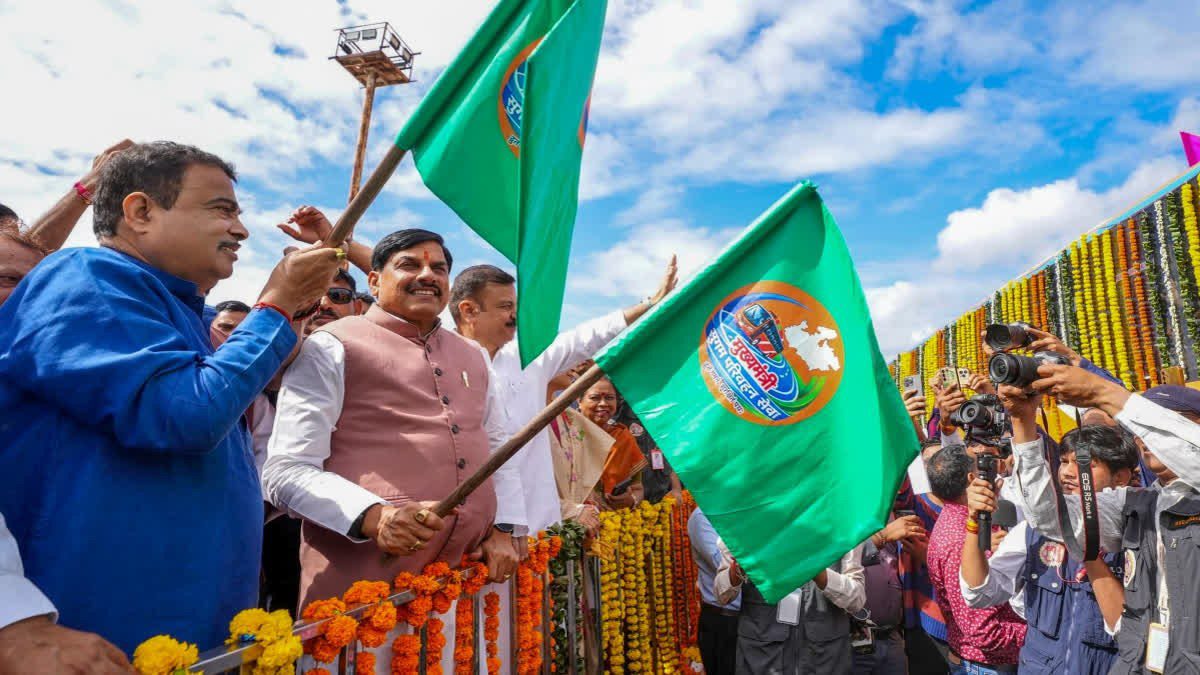
On 25 September 2026, Union Road Transport and Highways Minister Nitin Gadkari and Madhya Pradesh Chief Minister Mohan Yadav flagged off 351 buses at the BHEL Dussehra Ground in Bhopal under two schemes running side by side: the state’s newly launched Mukhyamantri Sugam Parivahan Seva and the Centre’s PM-eBus Sewa. According to the ANI report of the event, the buses — a mix of intercity and intracity services — will run in seven cities: Indore (145), Bhopal (106), Jabalpur (67), Rewa (18), Dewas (10), Katni (3) and Bhind (2). The Indian Express reported that the launch formally brings back a state-backed public bus network 21 years after the state wound up its earlier one, and that Gadkari used the occasion to demand safer buses, stricter enforcement and a much larger shift to electric public transport.
The flag-off is a single state event, but the policy it rides on is national. PM-eBus Sewa is a Centrally assisted scheme for city bus operations on electric buses, open to cities across India, and it is the clearest example of how the Union government is trying to change the way Indian cities buy, run and pay for public buses. For a CLAT aspirant, that makes it a compact case study in cooperative federalism, public–private partnership design, climate policy and road-safety regulation — all in one story.
What happened in Bhopal
ANI reported that the services were launched as part of the Seva Sankalp Abhiyan, and that the state has set a target of 1,500 buses in the first year and 15,000 buses by 2031, adding roughly 2,500 to 3,000 buses a year after the first phase. Chief Minister Yadav said the service would improve connectivity “from villages to cities”. ETV Bharat reported that the new buses carry CCTV cameras and emergency panic buttons, that operations will include both electric and conventional vehicles on a public–private partnership (PPP) model, and that the old Madhya Pradesh State Road Transport Corporation ceased operations in 2005.
Gadkari’s remarks were pointed. “Manufacturers need to be clearly told to pull up their socks,” he said, according to The Indian Express, adding that bus manufacturers who do not meet the desired standards would be dealt with “in the same manner” as the government deals with contractors. He also placed the launch in a national frame: as reported by ETV Bharat, he said India has about two buses for every 1,000 people, against a world standard of eight per 1,000. The same day’s Indian Express carried a report of a sleeper bus fire near Greater Noida that killed nine people — a grim reminder of why bus-body standards and enforcement dominate the transport-safety debate.
PM-eBus Sewa: the central scheme
The Union Cabinet chaired by Prime Minister Narendra Modi approved PM-eBus Sewa on 16 August 2023. According to the PIB factsheet on the scheme, it aims to augment city bus operations with 10,000 electric buses on the PPP model, at an estimated cost of ₹57,613 crore, of which ₹20,000 crore is Central assistance. The scheme supports bus operations for 10 years and covers cities with a population of three lakh and above as per Census 2011, including all capital cities of Union Territories, the North Eastern Region and the Hill States. Priority goes to cities with no organised bus service — which is exactly the gap a state that had no public bus network for two decades would fill. PIB estimated 45,000 to 55,000 direct jobs.
The scheme has two segments. Segment A – Augmenting City Bus Services covers 169 cities: the 10,000 e-buses, plus support for developing or upgrading depots and for behind-the-meter power infrastructure such as substations. Segment B – Green Urban Mobility Initiatives (GUMI) covers 181 cities and funds bus-priority infrastructure, multimodal interchange facilities, NCMC-based automated fare collection and charging infrastructure. The division of labour is explicit in the factsheet: States and cities are responsible for running the bus services and paying the operators; the Centre supports those operations through a subsidy. The scheme is administered by the Ministry of Housing and Urban Affairs.
Background & Framework
Constitutional basis. Under the Seventh Schedule, “mechanically propelled vehicles” is a subject in the Concurrent List (Entry 35), so both Parliament and state legislatures can legislate on it; the principal central law is the Motor Vehicles Act, 1988, while states run their own transport undertakings, many under the Road Transport Corporations Act, 1950. Urban transport is largely a state and municipal function, which is why a central scheme like PM-eBus Sewa works through Central assistance plus state operation rather than direct central control.
The PPP / GCC model. Under a Gross Cost Contract (GCC), a private operator supplies, runs and maintains the buses and is paid a fixed rate per kilometre by the public transport authority, which keeps the fare revenue and the ridership risk. The weak point of such contracts is the operator’s fear of delayed payment by cash-strapped city agencies.
Companion schemes. In September 2024 the Cabinet approved the PM-eBus Sewa – Payment Security Mechanism (PSM), with an outlay of ₹3,435.33 crore, to back the deployment of more than 38,000 e-buses from FY 2024-25 to FY 2028-29, supporting operation for up to 12 years. The same month saw approval of PM E-DRIVE, a ₹10,900 crore scheme that, among other electric vehicles, supports 14,028 e-buses for state transport agencies in nine major cities. Together with PM-eBus Sewa, these form the Centre’s electric public-transport toolkit.
Why payment security is the real story
E-buses cost far more to buy than diesel buses, even if they are cheaper to run per kilometre. The GCC model moves that up-front capital cost to private operators and manufacturers. But a manufacturer will only lend or invest if it trusts that a state transport undertaking will pay its monthly bills. That is why the PSM scheme matters. Under the design described in the Cabinet decision, if a public transport authority defaults on its payment to the manufacturer or operator, a dedicated fund steps in and pays on time; the defaulting authority must repay the fund within 90 days, failing which a Direct Debit Mandate can be invoked through the Reserve Bank of India. In short, the Centre is using its credit and institutional reach to lower the risk premium that private investors would otherwise charge cities.
The safety debate: standards, enforcement and accountability
Gadkari’s warning to manufacturers is part of a longer campaign by the Road Transport Ministry to tighten bus-body standards. Bus bodies in India are expected to conform to the Bus Body Code (AIS-052), an Automotive Industry Standard, and fire and emergency-exit requirements have become a public issue after a series of bus fires. The minister’s comparison with contractors signals that the government wants manufacturers held to account for defects in the same way highway contractors are penalised for poor construction. In legal terms, this is the language of regulatory liability — the idea that a manufacturer owes a duty not only to its buyer but to every passenger who boards the product.
For law students, the tort-law parallel is direct: a defectively built bus that causes injury raises questions of negligence, product liability and vicarious liability of the operator. The Motor Vehicles Act, 1988 already provides a statutory compensation framework for road-accident victims, and the Consumer Protection Act, 2019 introduced an express chapter on product liability. A legal-reasoning passage built on this story might ask who is liable when a privately operated bus under a public contract catches fire — the manufacturer, the operator, or the public authority that certified and deployed it.
The CLAT Angle
GK questions can test the scheme numbers: 10,000 e-buses, 169 cities (Segment A), 181 cities (Segment B / GUMI), ₹57,613 crore total, ₹20,000 crore Central assistance, 10 years of operational support, cities of three lakh-plus population (Census 2011), and approval in August 2023. Expect linked questions on PM E-DRIVE (₹10,900 crore) and the PSM (₹3,435.33 crore, 38,000+ e-buses).
Legal-reasoning passages could frame: (i) Concurrent List competence over motor vehicles and whether a central scheme may attach conditions to assistance; (ii) product liability of bus manufacturers after a fire; (iii) the enforceability of a Direct Debit Mandate against a defaulting public authority.
Critical-reasoning items may use Gadkari’s “two buses per 1,000 people versus eight” statistic: does a shortage of buses prove that more buses will reduce private-vehicle use? Identify the assumption (that demand is suppressed by supply rather than by fares, routes or reliability).
Analysis: what the Bhopal launch tells us
Three lessons stand out. First, the return of the state bus. The closure of several loss-making state transport corporations in the 1990s and 2000s left many regions to private operators. The Bhopal launch shows a different model: the state sets routes, standards and fares and pays per kilometre, while private firms own and run the fleet. This keeps public control over the network without putting the full capital cost on a strained state budget.
Second, cooperative federalism in practice. PM-eBus Sewa does not run a single bus itself. It offers money, a template contract and a payment guarantee; states and cities do the rest. The fact that a state brands its own service (Sugam Parivahan Seva) alongside the central scheme is typical of how centrally sponsored programmes are delivered.
Third, climate commitments reach the street. PIB lists reduced noise and air pollution, curbed carbon emissions and a modal shift towards buses as the scheme’s aims. Buses carry many more people per road-metre than cars, so electrifying city buses delivers larger emission cuts per rupee than many other interventions. The success test, however, will be operational: reliable charging, timely payments, and ridership that justifies the fleet.
Key Facts
- 25 September 2026: 351 buses flagged off in Bhopal by Nitin Gadkari and CM Mohan Yadav.
- Schemes: state’s Mukhyamantri Sugam Parivahan Seva + Centre’s PM-eBus Sewa.
- Seven cities: Indore 145, Bhopal 106, Jabalpur 67, Rewa 18, Dewas 10, Katni 3, Bhind 2.
- State target: 1,500 buses in year one; 15,000 buses by 2031.
- Gadkari: India has ~2 buses per 1,000 people vs a world standard of 8.
- PM-eBus Sewa approved by the Union Cabinet on 16 August 2023.
- 10,000 e-buses on PPP model; cost ₹57,613 crore; Central assistance ₹20,000 crore.
- Segment A: 169 cities; Segment B (Green Urban Mobility Initiatives): 181 cities.
- Covers cities of 3 lakh+ population (Census 2011); operations supported for 10 years.
- PSM scheme: ₹3,435.33 crore; 38,000+ e-buses (FY25–FY29). PM E-DRIVE: ₹10,900 crore, 14,028 e-buses.
- Motor vehicles: Concurrent List, Entry 35; central law = Motor Vehicles Act, 1988.
Memory Hook / Mnemonic
“10K buses, 169 + 181, 57-20-10” — 10,000 e-buses; 169 cities in Segment A and 181 in Segment B; ₹57,613 crore cost, ₹20,000 crore from the Centre, 10 years of support.
For the Bhopal launch: “351 buses, 7 cities, 21 years” — and Gadkari’s ratio “2 versus 8” buses per 1,000 people.
Practice Quiz — 10 CLAT-Style Questions
Click an option to reveal the answer and explanation.