
CURRENT AFFAIRS | 23 SEPTEMBER 2026
The 11th Ayurveda Day was observed on 23 September 2026, with the grand national celebration held at Nagpur, Maharashtra. According to the PIB release issued by the Ministry of Ayush on 23 September 2026 (Release ID 2313893), this year’s theme was “Ayurveda for a Healthier Tomorrow”, rendered in Hindi as स्वस्थ भविष्य के लिए आयुर्वेद. The same theme appears in the Ministry’s curtain-raiser release of 7 September 2026 (Release ID 2307397). A loose paraphrase, “Ayurveda for a Healthy Future”, circulates in secondary write-ups; the Ministry’s own wording is Healthier Tomorrow, and that is the version to carry into an exam hall.
The ceremony was inaugurated virtually by Shri Prataprao Jadhav, Union Minister of State (Independent Charge) for Ayush and MoS for Health and Family Welfare, with Ayush Secretary Vaidya Rajesh Kotecha and the Director General of the Central Council for Research in Ayurvedic Sciences (CCRAS), Prof. (Vaidya) Rabinarayan Acharya. A message from Prime Minister Narendra Modi was read out, saying Ayurveda’s journey from tradition to knowledge, evidence and innovation will help secure the health of future generations, and noting the Ayush Visa that lets foreign nationals seek treatment under Ayush systems in India.
The detail an examiner will pick: why 23 September?
This is the part of the story most likely to become a question. Ayurveda Day was not always a fixed date. From its inception in 2016 it was observed on Dhanvantari Jayanti (Dhanteras), a date set by the lunar calendar and therefore moving each year — the 9th Ayurveda Day, for instance, fell in late October 2024.
That changed by executive action. A PIB release of 26 August 2025 (Release ID 2160853) records that “for the first time since its inception in 2016, Ayurveda Day will be observed on a fixed date i.e. on 23 September – every year, as notified by the Government of India through a Gazette Notification issued in March 2025.” The stated rationale is that a fixed date gives Ayurveda a universal calendar identity and enables greater participation at the global level. The 2025 edition, the 10th, carried the theme “Ayurveda for People & Planet”.
Notice what kind of change this is. Not legislation, not a constitutional amendment, but a gazette notification — an executive instrument — converting a lunar-calendar observance into a calendar-fixed one: a clean illustration of how much of the Indian state’s day-to-day working runs on executive instruments rather than statute.
Constitutional / Legal Framework
Health sits mainly with the States. Entry 6 of the State List (List II, Seventh Schedule) reads “Public health and sanitation; hospitals and dispensaries.” But Entry 26 of the Concurrent List covers “Legal, medical and other professions” — the source of Parliament’s power over medical education and practice, and so of the two 2020 Commission Acts below. Drugs and poisons also sit in the Concurrent List.
The directive-principle anchor is Article 47: “The State shall regard the raising of the level of nutrition and the standard of living of its people and the improvement of public health as among its primary duties”, with a specific endeavour towards prohibition of intoxicating drinks and of drugs injurious to health, except for medicinal purposes. Article 47 is non-justiciable under Article 37, but courts have read it with Article 21 to give content to the right to health.
For Ayurvedic, Siddha and Unani medicines, the operative statute is the Drugs and Cosmetics Act, 1940, whose Chapter IVA deals specifically with ASU drugs — including the ASU Drugs Technical Advisory Board (s. 33C) and the definitions of misbranded (s. 33E), adulterated (s. 33EE) and spurious (s. 33EEA) ASU drugs.
What was actually launched on the day
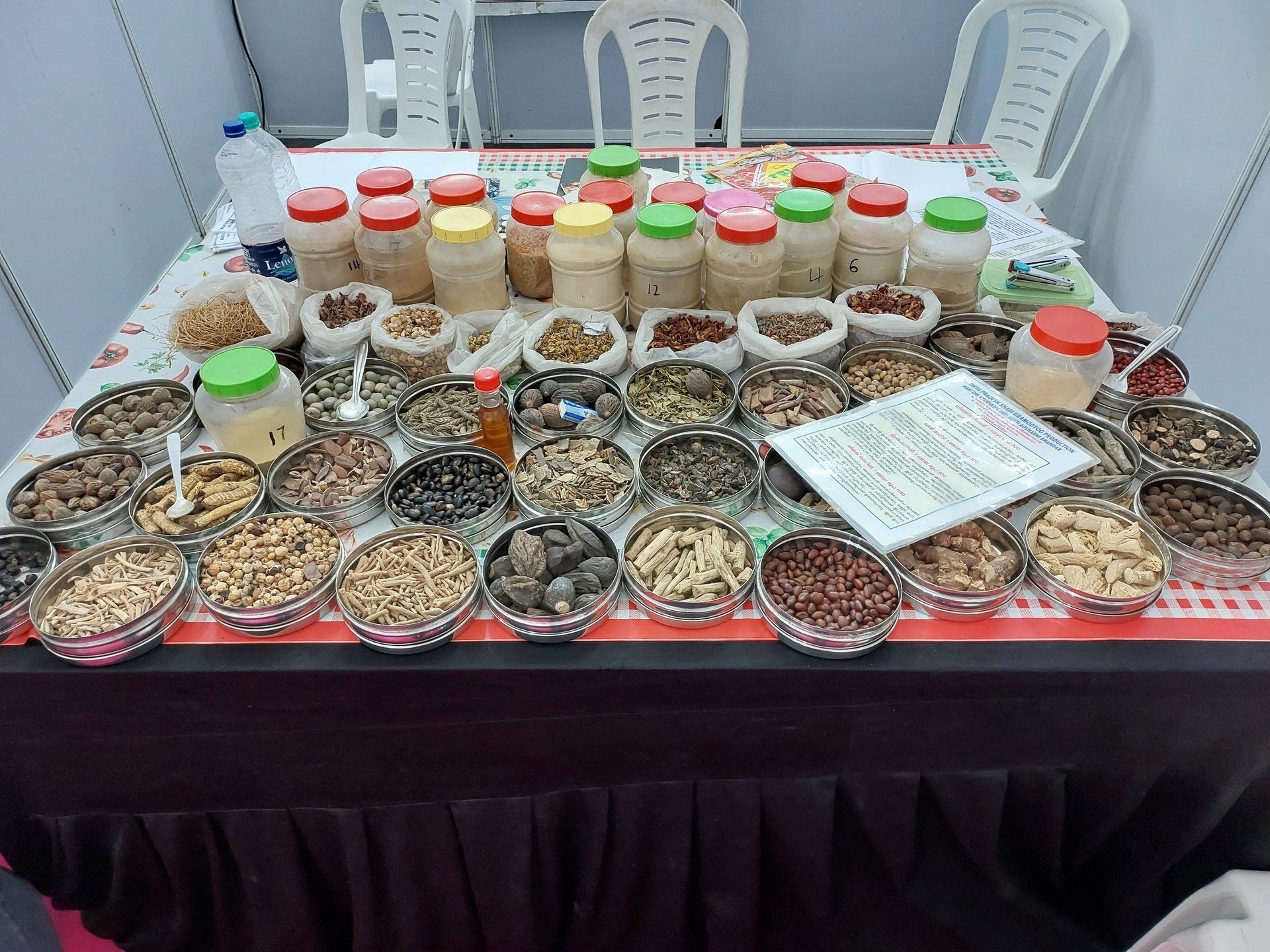
The PIB release lists the documents unveiled at Nagpur, and they are worth knowing as a set. First, safety dossiers on two medicinal plants — Gokshura (Tribulus terrestris) and Chandrasura (Lepidium sativum). Second, Standard Treatment Guidelines on skin disorders. Third, the first-ever Report on the “Ayush Services Sector”, prepared by the Research and Information System for Developing Countries (RIS). Fourth, “From Traditional Wisdom to Global Leadership: Ayush Vision 2030”. Fifth, a Status Report on Ayush-related Inventions in India. Sixth, the CCRAS–AGNI Assessment Scale Web Portal. Ayush Quality Mark certification went to four industries, and a National Medicinal Plants Exhibition ran at the venue.
Two scientific sessions framed the day: one on Ayurveda’s road to 2047, featuring a unit head of the WHO Global Traditional Medicine Centre, Jamnagar; the other on integrating therapies to reduce the burden of non-communicable diseases.
On the scale of participation, Prasar Bharati’s News on AIR reported on 21 September 2026, citing the Ministry, that more than 9,700 activities had been registered across 30 States and Union Territories, with over 3 lakh registered participants, about 89 lakh citizens pledging support through the ayurvedaday.org.in microsite, and over 1,900 international participants from 10 countries and territories. These were pre-event registration figures; the Ministry’s 23 September release did not restate them, so treat them as reported data rather than an audited count.
The CLAT Angle
Expect this first as a static-plus-current GK item: the theme, the venue, the edition number, and above all the date change — “Ayurveda Day was earlier observed on which occasion?” is close to ideal for a setter, because it rewards the candidate who read the reason and not just the date.
It also supports a serious legal-reasoning passage. Try this principle: a State may promote a system of medicine, but the promotion of a therapy does not relieve its practitioners or manufacturers of the ordinary duties of safety, truthful labelling and professional regulation. Apply it: an ASU manufacturer whose label overstates therapeutic value (misbranding); a practitioner registered in one system who prescribes outside it; an advertisement claiming a cure. A second principle is federal: if public health is a State subject under Entry 6, on what basis does the Union run a national regulator? The answer lies in Concurrent List Entry 26 and in the Union’s spending power through centrally sponsored schemes — the distinction between legislative competence and fiscal capacity.
The institutions behind the day
According to the Ministry of Ayush’s own portal, the Ministry of Ayush was formed on 9 November 2014. It succeeded the Department of Indian System of Medicine and Homoeopathy (ISM&H), created in March 1995, which was renamed the Department of AYUSH in November 2003. The name was restyled from the acronym “AYUSH” to the word “Ayush” on 13 April 2021, because the term had come to cover Ayurveda, Yoga, Naturopathy, Unani, Siddha, Homoeopathy and Sowa-Rigpa — note that Sowa-Rigpa sits inside the Ayush umbrella even though it does not appear in the original acronym.
Regulation was overhauled in 2020. A PIB release of 15 September 2020 records that the National Commission for Indian System of Medicine Bill, 2020 and the National Commission for Homoeopathy Bill, 2020 were passed by the Lok Sabha on 14 September 2020 (the Rajya Sabha having passed them on 18 March 2020), and that the twin bills replace the Indian Medicine Central Council Act, 1970 and the Homoeopathy Central Council Act, 1973, revamping CCIM and the Central Council of Homoeopathy. Research is led by CCRAS; apex institutions include the All India Institute of Ayurveda (AIIA), New Delhi, the National Institute of Ayurveda (NIA), Jaipur, and the Institute of Teaching and Research in Ayurveda (ITRA), Jamnagar, which has been recognised as an Institute of National Importance.
Internationally, the WHO Global Centre for Traditional Medicine at Jamnagar was inaugurated in 2022 and is described by PIB as the first and only global out-posted centre for traditional medicine, and the first in a developing country. India and the WHO co-hosted the first Traditional Medicine Global Summit at Gandhinagar on 17–18 August 2023. Ayurveda, Siddha and Unani are also included in the WHO’s ICD-11. Domestically, more than 12,500 Ayush Health and Wellness Centres — now Ayushman Arogya Mandir (Ayush) — were planned under Ayushman Bharat.
Traditional knowledge and its protection
Ayurveda’s other legal dimension is intellectual property. The Traditional Knowledge Digital Library (TKDL) was built because India’s traditional medicinal knowledge sat in Sanskrit, Urdu, Tamil, Arabic and Persian texts that patent examiners abroad could neither access nor read — so the same knowledge could be claimed elsewhere as a novel invention. The TKDL’s own account cites the grant of a US patent on the wound-healing properties of turmeric, and the cost of getting it revoked, as the episode that proved the need for a proactive mechanism. The TKDL now holds more than 4.54 lakh formulations and practices from Ayurveda, Siddha, Unani, Sowa-Rigpa and Yoga in five languages, accessible to sixteen patent offices under non-disclosure agreements. The operative idea is prior art: knowledge already in the public domain cannot be patented, and the TKDL makes that prior art legible to foreign examiners.
Key Facts
- 11th Ayurveda Day observed on 23 September 2026; grand national celebration at Nagpur, Maharashtra.
- Theme: “Ayurveda for a Healthier Tomorrow” (स्वस्थ भविष्य के लिए आयुर्वेद), per the Ministry of Ayush.
- Ayurveda Day began in 2016, earlier observed on Dhanvantari Jayanti (Dhanteras), a movable lunar date.
- A Gazette Notification of March 2025 fixed it to 23 September every year, from 2025 onwards.
- Inaugurated virtually by Prataprao Jadhav, MoS (I/C) Ayush; Ayush Secretary Vaidya Rajesh Kotecha present.
- Launched: safety dossiers on Gokshura and Chandrasura, STGs on skin disorders, the first Ayush Services Sector report, Ayush Vision 2030, the CCRAS–AGNI portal.
- Reported participation (News on AIR, 21 Sep 2026): 9,700+ activities, 30 States/UTs, 3 lakh+ registered participants, ~89 lakh pledges, 1,900+ international participants from 10 countries/territories.
- Ministry of Ayush formed 9 November 2014; successor to the Department of ISM&H (1995), renamed Department of AYUSH (November 2003); restyled “Ministry of Ayush” on 13 April 2021.
- NCISM Act, 2020 and NCH Act, 2020 replaced the Indian Medicine Central Council Act, 1970 and the Homoeopathy Central Council Act, 1973.
- WHO Global Centre for Traditional Medicine, Jamnagar, inaugurated 2022; first WHO Traditional Medicine Global Summit at Gandhinagar, 17–18 August 2023.
- Constitutional hooks: Article 47; State List Entry 6 (public health); Concurrent List Entry 26 (medical profession).
- TKDL holds 4.54 lakh+ formulations in five languages, accessible to sixteen patent offices; built after the turmeric patent episode.
Memory Hook / Mnemonic
For the date, remember “Dhanteras drifted, so the gazette fixed it” — movable Dhanvantari Jayanti until 2024, fixed 23 September by a March 2025 Gazette Notification. For the ministry’s lineage, count “95–03–14–21”: Department of ISM&H in 1995, renamed AYUSH in 2003, Ministry in 2014, restyled “Ayush” in 2021. For the regulators, “Two Councils out, two Commissions in” — CCIM and CCH replaced by NCISM and NCH, both by Acts of 2020. And for the constitutional split: “Hospitals are State, professions are Concurrent, health is Article 47.”
Practice Quiz — 10 CLAT-Style Questions
Click an option to reveal the answer and explanation.