CURRENT AFFAIRS | 13 OCTOBER 2026
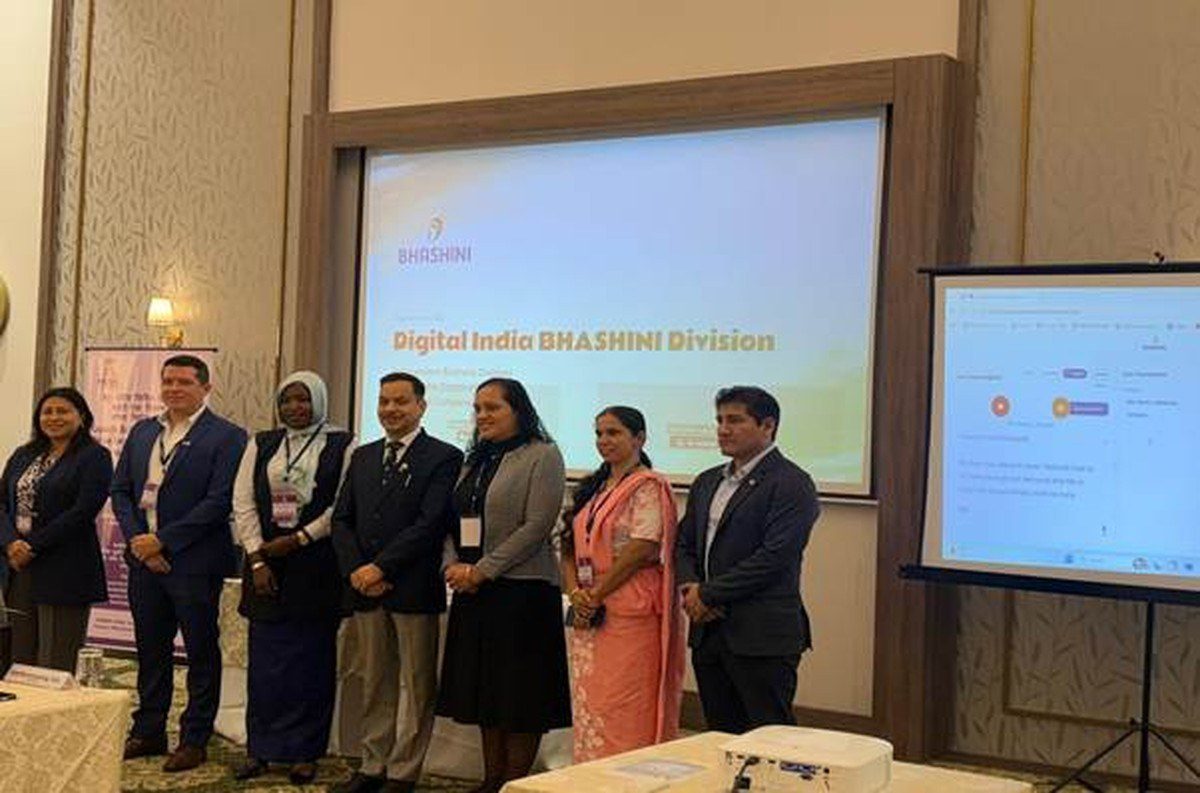
India’s government language-AI platform BHASHINI has taken its “Voice-First Multilingual AI” to an international classroom. According to a release issued by the Ministry of Electronics and Information Technology (MeitY) through the Press Information Bureau (PIB) on Tuesday, 13 October 2026, BHASHINI’s Shrutlekh platform provided real-time translation between English and Spanish at a training programme for foreign civil servants run by the National Centre for Good Governance (NCGG) in Mussoorie.
The programme — the Capacity Building Programme on Urban Service Delivery for Civil Servants of Multiple Countries — runs from 12 to 23 October 2026. It is sponsored by the Ministry of External Affairs (MEA) under the Indian Technical and Economic Cooperation (ITEC) Programme, and organised by NCGG under the Department of Administrative Reforms and Public Grievances (DARPG).
What happened at Mussoorie
The PIB release says the programme brings together civil servants and public-sector representatives from countries including Peru, Cambodia, Nigeria, Kenya, Palestine, Lebanon, The Gambia, Ecuador and Spain. Several delegations come from Spanish-speaking countries, which is where Shrutlekh came in.
During the ice-breaking session, BHASHINI deployed Shrutlekh to translate speech in both directions — English to Spanish and Spanish to English — so that delegates could follow and participate despite the language barrier. The BHASHINI team helped participants use the platform, introduced them to the wider BHASHINI ecosystem and its uses in healthcare, finance, agriculture and public service delivery, and encouraged them to try the BHASHINI mobile app. Shrutlekh is intended to remain available throughout the programme, which ends on 23 October 2026, subject to operational requirements.
What BHASHINI is
BHASHINI is run by the Digital India BHASHINI Division (DIBD), which sits under the Digital India Corporation (DIC) of MeitY. The release describes it as India’s “Language Digital Public Infrastructure” — a shared base of datasets, AI models, APIs and applications that other government and private services can plug into, in the same way that Aadhaar and UPI serve as shared rails for identity and payments.
The scale figures in the release are worth memorising:
- integrated across 2,353 government platforms, including over 800 government websites;
- support for 36 Indian languages in text, 23 Indian languages in voice and 35 international languages;
- more than 9 billion cumulative AI inferences, and over 24 million inferences daily.
BHASHINI (short for “Bhasha Interface for India”) was launched in July 2022 at Gandhinagar under the National Language Translation Mission of MeitY.
Background & Framework
Languages and the Constitution: The Eighth Schedule lists 22 languages. Article 343 makes Hindi in Devanagari script the official language of the Union, and Article 351 directs the Union to promote the spread of Hindi. Article 350A asks States to provide facilities for instruction in the mother tongue at the primary stage. BHASHINI’s 36-language text coverage goes beyond the Eighth Schedule list.
ITEC: India’s flagship bilateral capacity-building programme, run by the MEA and launched on 15 September 1964. It trains officials and professionals from partner developing countries — a pillar of India’s South–South cooperation.
NCGG and DARPG: NCGG is an autonomous institution under DARPG (Ministry of Personnel, Public Grievances and Pensions) that trains Indian and foreign civil servants in governance and public service delivery.
Reading the release closely
Two details in the PIB text deserve attention because they are the kind of fine print that examiners like to test. First, the translation was deployed during the ice-breaking session — the release does not claim that every lecture of the twelve-day course was machine-translated; it says only that Shrutlekh is intended to remain available for the rest of the programme, “subject to operational requirements”. Second, the release is careful about roles: MEA sponsors, NCGG organises (under DARPG), and BHASHINI facilitates communication. A question that credits the wrong body with organising the course would be testing exactly this distinction.
The subject of the course — urban service delivery — is also relevant. Cities in many partner countries face the same problems India does: water supply, sanitation, transport and grievance redressal. Training of this kind is meant to be an exchange of experiences and best practices, which is how the release frames it.
Why it matters: language as infrastructure
The Mussoorie deployment is small in size but signals a larger idea. Until now, BHASHINI has largely been pitched as a domestic inclusion tool — helping a citizen who speaks only Odia, Assamese or Marathi use a government website or service. Translating between English and Spanish for foreign delegates shows the same stack being offered as part of India’s development diplomacy, alongside training under ITEC.
Three themes connect this to the broader debate on technology and governance:
1. Digital Public Infrastructure (DPI). India has promoted the DPI model — open, interoperable public platforms on which others build services. Calling BHASHINI the “Language DPI” places it in that family.
2. Voice-first access. A speech-based interface lowers the barrier for people who cannot read or type comfortably in English. The gap between 36 text languages and 23 voice languages shows that speech remains the harder technical problem.
3. Accuracy and accountability. Machine translation used in public services raises questions a CLAT passage could probe: who is responsible if a translated instruction is wrong, how personal voice data is handled, and whether a translation can be relied upon in an official or legal setting. India’s Digital Personal Data Protection Act, 2023 is the relevant data-protection law.
The CLAT Angle
Current Affairs / GK: Match the institutions correctly — BHASHINI → DIBD → Digital India Corporation → MeitY; NCGG → DARPG; ITEC → MEA. Option sets often swap these parents.
Numbers: 36 text / 23 voice / 35 international languages; 2,353 platforms; 9 billion+ cumulative and 24 million+ daily inferences; programme dates 12–23 October 2026.
Polity: Language questions often draw on the Eighth Schedule (22 languages) and Articles 343, 350A and 351. Do not confuse BHASHINI’s count of supported languages with the Eighth Schedule count.
Reading Comprehension: Expect passages on AI in governance balancing inclusion against accuracy, privacy and accountability.
Key Facts
- Source: PIB release by MeitY, 13 October 2026 (Release ID 2322621).
- Platform used: BHASHINI Shrutlekh, for real-time English ↔ Spanish translation.
- Event: NCGG’s Capacity Building Programme on Urban Service Delivery, Mussoorie, 12–23 October 2026.
- Sponsor: Ministry of External Affairs, under the ITEC Programme.
- Organiser: NCGG, under DARPG.
- Participating countries include Peru, Cambodia, Nigeria, Kenya, Palestine, Lebanon, The Gambia, Ecuador and Spain.
- BHASHINI is run by the Digital India BHASHINI Division under Digital India Corporation, MeitY.
- Integrated across 2,353 government platforms, including 800+ government websites.
- Languages: 36 Indian (text), 23 Indian (voice), 35 international.
- 9 billion+ cumulative AI inferences; 24 million+ daily.
- BHASHINI launched July 2022 under the National Language Translation Mission; ITEC launched 15 September 1964.
Memory Hook / Mnemonic
“36 write, 23 speak, 35 abroad” — BHASHINI supports 36 Indian languages in text, 23 in voice and 35 international languages.
“Shrutlekh = Shruti (heard) + Lekh (written)” — the name joins “heard” and “written”: speech in, words out.
Chain to remember: “MEA pays (ITEC), DARPG trains (NCGG), MeitY translates (BHASHINI)”.
Practice Quiz — 10 CLAT-Style Questions
Click an option to reveal the answer and explanation.