

CURRENT AFFAIRS | 08 OCTOBER 2026
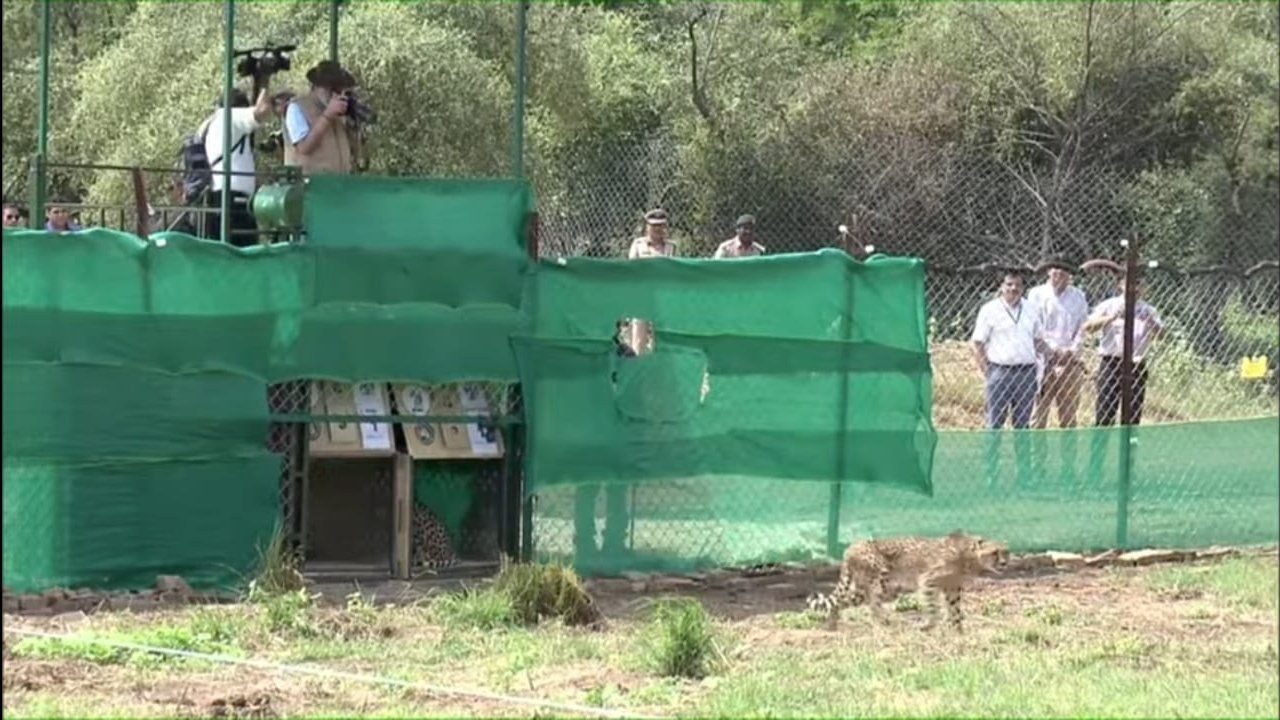
Project Cheetah, India’s programme to bring back a large carnivore declared extinct in the country more than seventy years ago, gained a new home on Wednesday, 7 October 2026. Two cheetahs, named Vyom and Neera, were released into the Veerangana Durgavati Tiger Reserve (VDTR) in Sagar district of Madhya Pradesh, according to The Hindu (8 October 2026). The release was carried out by Chief Minister Mohan Yadav on the concluding day of Wildlife Conservation Week, and was also reported by ThePrint and Business Standard.
The reserve, in the Bundelkhand region, becomes the third cheetah habitat in Madhya Pradesh, after Kuno National Park (Sheopur district) and Gandhi Sagar Wildlife Sanctuary (Mandsaur district). The State government also said that two more cheetahs would be brought to VDTR next month.
For exam purposes, this is a national conservation story rather than a regional one. Project Cheetah is run by the Union government’s wildlife institutions. Every new site tests the central question of the project: can a reintroduced cheetah population spread across several connected landscapes, instead of depending on one park?
The new habitat: Veerangana Durgavati Tiger Reserve
According to officials quoted by The Hindu, VDTR, also known as the Nauradehi Tiger Reserve, is Madhya Pradesh’s largest tiger habitat. It covers about 2,339 sq km across Sagar, Damoh and Narsinghpur districts, and was designated a tiger reserve on 20 September 2023 after being integrated with the Nauradehi Wildlife Sanctuary. Its wildlife includes tigers, leopards, chital, sambar, nilgai and bears, and it matters for the conservation of endangered vultures.
About 439 hectares have been specially set aside for the cheetahs, with modern bomas. A boma is a fenced acclimatisation enclosure where translocated animals settle in, are monitored and adjust to local prey before a full release into the open landscape. Nauradehi was named as a candidate cheetah site well before 2026, in the national action plan for introducing the cheetah, and was later prepared for the role.
The reserve is named after Rani Durgavati, the sixteenth-century Gond queen of Garha who resisted Mughal forces and died in battle in 1564. The word Veerangana means a brave woman warrior.
Background & Framework
Extinction and return. The cheetah was declared extinct in India in 1952, making it the only large carnivore known to have been wiped out in India since Independence. Project Cheetah was launched on 17 September 2022, when eight cheetahs from Namibia were released at Kuno National Park. A second batch of twelve came from South Africa in February 2023. It was described as the world’s first intercontinental translocation of a large wild carnivore.
Institutions. The project is implemented by the National Tiger Conservation Authority (NTCA), a statutory body under the Ministry of Environment, Forest and Climate Change, together with the Wildlife Institute of India and the State forest department. The NTCA was set up under the Wildlife (Protection) Act, 1972, through its 2006 amendment. Tiger reserves are notified by State governments under Section 38V of the same Act, on the NTCA’s recommendation.
Conservation status. The cheetah (Acinonyx jubatus) is listed as Vulnerable on the IUCN Red List. The Asiatic subspecies, which once roamed India, is Critically Endangered and now survives only in Iran. That is why India imported African cheetahs.
Why multiple sites matter
A reintroduction that depends on one park is fragile. Kuno’s early years showed the problems: cheetahs straying out of the park, disease and climate stresses, and mortality among both adults and cubs. Ecologists generally argue that a single site cannot give a large, wide-ranging predator enough room or enough genetic exchange. Spreading animals across Kuno, Gandhi Sagar and now Nauradehi moves the project from a single-site experiment towards a metapopulation: several groups in separate habitats, managed together, so that a setback in one does not end the programme.
Each new site also brings a new set of neighbours. VDTR already holds tigers and leopards, so managers will watch for competition between predators, and cheetahs need open grassland and enough prey. The State government has linked conservation with local livelihoods. The Hindu reports homestays for buffer-zone households and grants to villagers, and a share of sanctuary revenue going to nearby residents. Co-existence with communities on the edges of reserves is the real long-term test for any large-carnivore project.
The CLAT Angle
Direct GK: the name of the new habitat (Veerangana Durgavati Tiger Reserve, alias Nauradehi), the names of the cheetahs (Vyom and Neera), the earlier two sites (Kuno and Gandhi Sagar), the year of extinction (1952), the launch date of Project Cheetah (17 September 2022) and the source countries (Namibia, South Africa). Watch for a trap option offering “Asiatic cheetahs from Iran”: India’s cheetahs are African.
Reasoning passages on conservation often set up a trade-off: protecting a flagship species versus the rights and livelihoods of forest-edge communities, or spending on one charismatic animal versus protecting whole grasslands. A legal passage might ask whether a State may notify a new protected habitat without NTCA approval. Under Section 38V it cannot notify a tiger reserve without NTCA’s recommendation, which is a clean rule-application question.
Analysis
Project Cheetah has always faced two kinds of scrutiny: scientific (is the habitat right, can the animals survive?) and policy-related (is the money better spent on grassland species such as the Great Indian Bustard?). Adding a third site in Madhya Pradesh answers part of the first concern by spreading risk. Whether it works will be judged over years, by survival, breeding in the wild and the absence of conflict, not by a single release ceremony. For an aspirant, the safe takeaway is the structure of the programme: African cheetahs, NTCA-led, Kuno first, Gandhi Sagar second, Nauradehi (VDTR) third.
Key Facts
- Event: two cheetahs, Vyom and Neera, released on Wednesday, 7 October 2026.
- Site: Veerangana Durgavati Tiger Reserve (Nauradehi), Sagar district, Bundelkhand region.
- Significance: third cheetah habitat in Madhya Pradesh after Kuno NP (Sheopur) and Gandhi Sagar WLS (Mandsaur).
- VDTR area: about 2,339 sq km across Sagar, Damoh and Narsinghpur.
- Tiger reserve since: 20 September 2023; about 439 hectares set aside for cheetah enclosures (bomas).
- Next step: two more cheetahs to be brought to VDTR next month (State government).
- Occasion: concluding day of Wildlife Conservation Week (first week of October).
- Cheetah extinct in India: 1952.
- Project Cheetah launched: 17 September 2022 at Kuno, with 8 cheetahs from Namibia; 12 from South Africa in February 2023.
- Implementing body: NTCA (statutory, Wildlife (Protection) Act, 1972); tiger reserves notified under Section 38V.
- IUCN status: cheetah Vulnerable; Asiatic cheetah Critically Endangered (survives only in Iran).
Memory Hook / Mnemonic
“K-G-N: Keep Growing Nationwide”: the order of cheetah homes is Kuno (2022) → Gandhi Sagar → Nauradehi, i.e. Veerangana Durgavati TR (7 Oct 2026).
The new pair: Vyom (sky) and Neera (water), “sky and water come to Sagar”. And the numbers: 1952 gone, 2022 back, 70 years in between.
Practice Quiz — 10 CLAT-Style Questions
Click an option to reveal the answer and explanation.