CURRENT AFFAIRS | 13 OCTOBER 2026
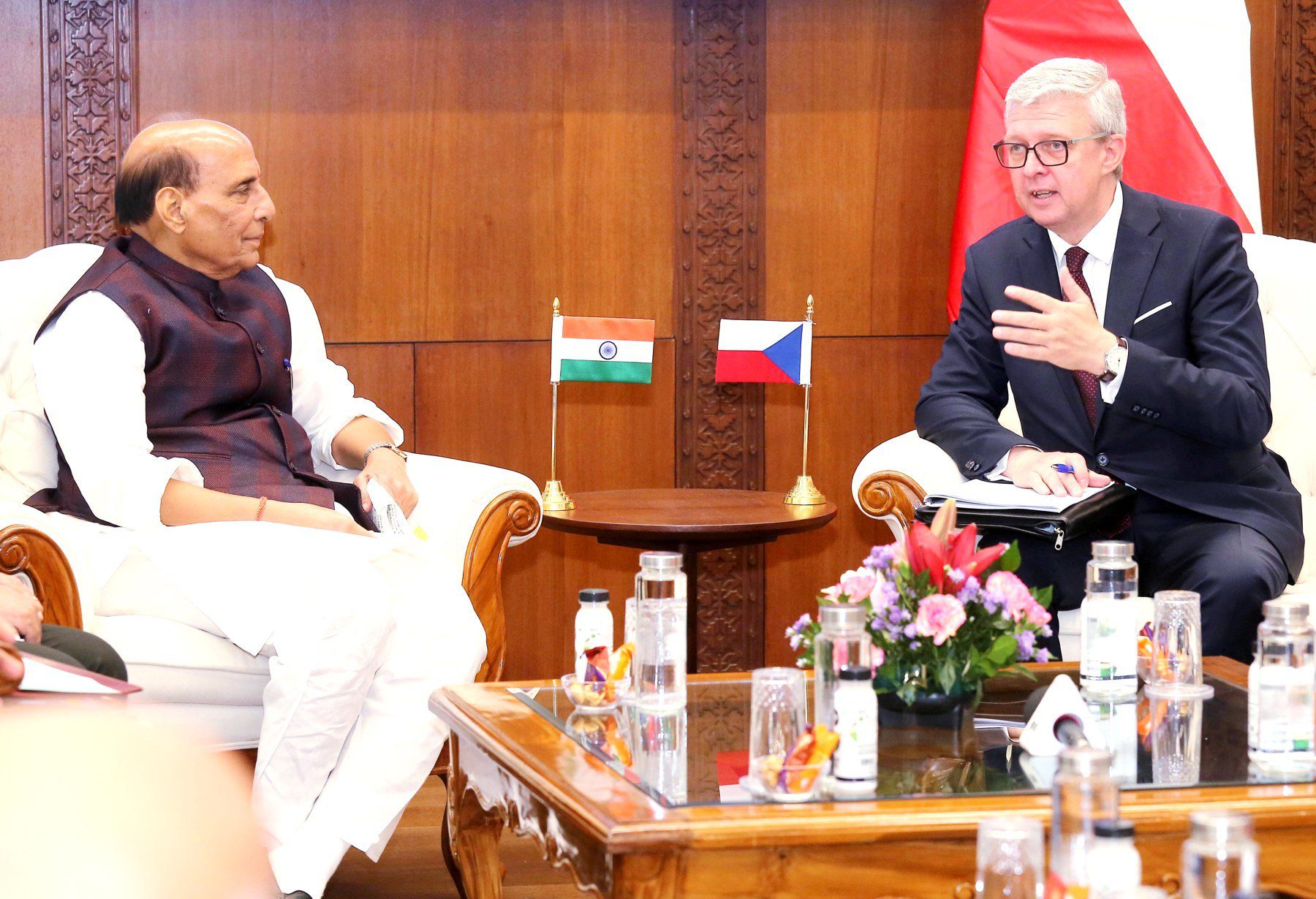
India and the Czech Republic have agreed to expand their defence industrial cooperation, including under the India–Czech Joint Defence Committee, to promote ‘Make in India’ and ‘Aatmanirbhar Bharat’. According to a release of the Press Information Bureau (Ministry of Defence) posted at 1:16 PM on Tuesday, 13 October 2026, Raksha Mantri Shri Rajnath Singh held bilateral talks in New Delhi on 13 October 2026 with Mr Karel Havlíček, the Czech Republic’s 1st Deputy Prime Minister and Minister of Industry and Trade.
The meeting is a small but useful marker of how India’s defence partnerships are changing. The emphasis is no longer only on buying equipment from abroad; it is increasingly on joint ventures, co-production and building an industrial base in India. For CLAT aspirants, the story links current affairs on defence diplomacy with static GK on Central Europe and with the constitutional framework for India’s foreign relations.
What happened
The PIB release states that the two leaders “reviewed the entire spectrum of defence industrial cooperation” between the two countries. They welcomed the ongoing collaboration and the successful establishment of various joint ventures, and agreed to expand this cooperation further, “including under the aegis of India-Czech Joint Defence Committee”.
The two sides also discussed issues of peace and security and acknowledged the need for greater cooperation to maintain regional stability. They reiterated that the partnership is based on historical and cultural ties and on shared values of mutual trust and respect.
According to the release, Mr Havlíček is on a four-day visit to India, interacting with various Ministries, trade bodies and businesses. He is scheduled to visit industries in Bengaluru and Mumbai during his stay.
Background & Framework
Czech Republic (Czechia): a landlocked country in Central Europe, bordered by Germany, Poland, Slovakia and Austria. Capital: Prague. It is a parliamentary republic.
Birth of the state: Czechoslovakia was peacefully dissolved on 31 December 1992; the Czech Republic and Slovakia became independent states from 1 January 1993 (often called the “Velvet Divorce”). The Velvet Revolution of November 1989 had earlier ended communist rule.
Memberships: the Czech Republic is a member of the United Nations, NATO, the European Union, the OECD, the OSCE, the Council of Europe and the Visegrád Group.
Indian framework: ‘Defence’ and ‘Foreign affairs’ are subjects in the Union List (Seventh Schedule). The Ministry of Defence handles defence cooperation, while the Ministry of External Affairs leads overall foreign policy.
Policy anchors: Make in India was launched in September 2014 to encourage manufacturing in India; the Aatmanirbhar Bharat Abhiyan (self-reliant India campaign) was announced in May 2020. In defence, both translate into a preference for equipment designed, developed or produced in India, often with foreign partners bringing in technology through joint ventures.
Why a Joint Defence Committee matters
A Joint Defence Committee is an institutional, government-to-government mechanism. Such bodies give defence cooperation a regular, structured channel, so that discussions on industrial projects, technology and training do not depend only on occasional high-level visits. The release places future expansion of cooperation explicitly “under the aegis” of this committee, signalling that both sides want the momentum to be sustained through official machinery.
The stress on joint ventures is equally significant. A joint venture lets a foreign firm partner with an Indian firm to produce equipment or components in India. This fits the policy goals of ‘Make in India’ (manufacturing in India) and ‘Aatmanirbhar Bharat’ (self-reliance), both named in the release. For a partner country, it opens access to India’s large market; for India, it helps build domestic capability and supply chains.
It is also notable that the visiting leader is the Czech Minister of Industry and Trade, not a defence minister. That choice reflects the theme of the visit: defence industry, trade and business links, rather than military operations. His itinerary — Ministries plus industry visits in Bengaluru and Mumbai — points the same way.
Analysis: India and Central Europe
India’s engagement with Central and Eastern Europe has often been less visible than its ties with larger European powers. Countries such as the Czech Republic, however, have a strong engineering and manufacturing tradition and are members of both the European Union and NATO. Closer industrial cooperation with such partners helps India diversify its sources of technology and investment.
For the Czech side, India offers scale: a large domestic market and a policy push to manufacture locally. The phrase “regional stability” in the release also shows that both sides see security cooperation as part of a wider relationship, not only a commercial one. The overall message is of a partnership being moved from a buyer–seller model towards co-development and co-production.
The CLAT Angle
In GK, questions can test the who/where/what of the meeting: the Czech office-holder (1st Deputy Prime Minister and Minister of Industry and Trade), the forum (India–Czech Joint Defence Committee), the policy goals named (Make in India, Aatmanirbhar Bharat) and the cities on the itinerary (Bengaluru, Mumbai).
Static links are just as likely: the capital of the Czech Republic (Prague), the year the country came into being (1993), the meaning of the Velvet Revolution (1989) vs the Velvet Divorce (1993), and the Visegrád Group. On the polity side, remember that defence and foreign affairs are Union List subjects.
Constitutional link: who conducts foreign and defence relations?
Under India’s Constitution, the executive power of the Union extends to matters on which Parliament can make laws (Article 73), which include the Union List subjects of defence and foreign affairs. Treaties and agreements are entered into by the Union executive; Article 253 empowers Parliament to make laws for implementing any treaty, agreement or convention with other countries. Among the Directive Principles, Article 51 asks the State to promote international peace and security and to maintain just and honourable relations between nations — a principle echoed in the release’s reference to regional stability.
Key Facts
- Event: India–Czech Republic bilateral defence talks, New Delhi, 13 October 2026.
- Source: PIB (Ministry of Defence) release ID 2322692, posted 13 October 2026, 1:16 PM.
- Czech side: Mr Karel Havlíček, 1st Deputy Prime Minister and Minister of Industry and Trade.
- Indian side: the Raksha Mantri (Defence Minister).
- Outcome: agreement to expand defence industrial cooperation; ongoing joint ventures welcomed.
- Mechanism: India–Czech Joint Defence Committee.
- Policy goals named: Make in India and Aatmanirbhar Bharat.
- Visit: four days; industry visits in Bengaluru and Mumbai.
- Czech Republic: capital Prague; independent since 1 January 1993; member of the EU and NATO.
- Constitution: Article 73 (Union executive power); Article 253 (laws to implement treaties); Article 51 (international peace, DPSP).
Memory Hook / Mnemonic
“Prague Partners Produce in India.” Three P’s: Prague (capital), Partners (joint ventures under the Joint Defence Committee), Produce (Make in India / Aatmanirbhar Bharat).
And for the history: “Velvet Revolution ’89, Velvet Divorce ’93” — communism ended in 1989; Czech Republic and Slovakia went separate ways on 1 January 1993.
Practice Quiz — 10 CLAT-Style Questions
Click an option to reveal the answer and explanation.