CURRENT AFFAIRS | 12 OCTOBER 2026
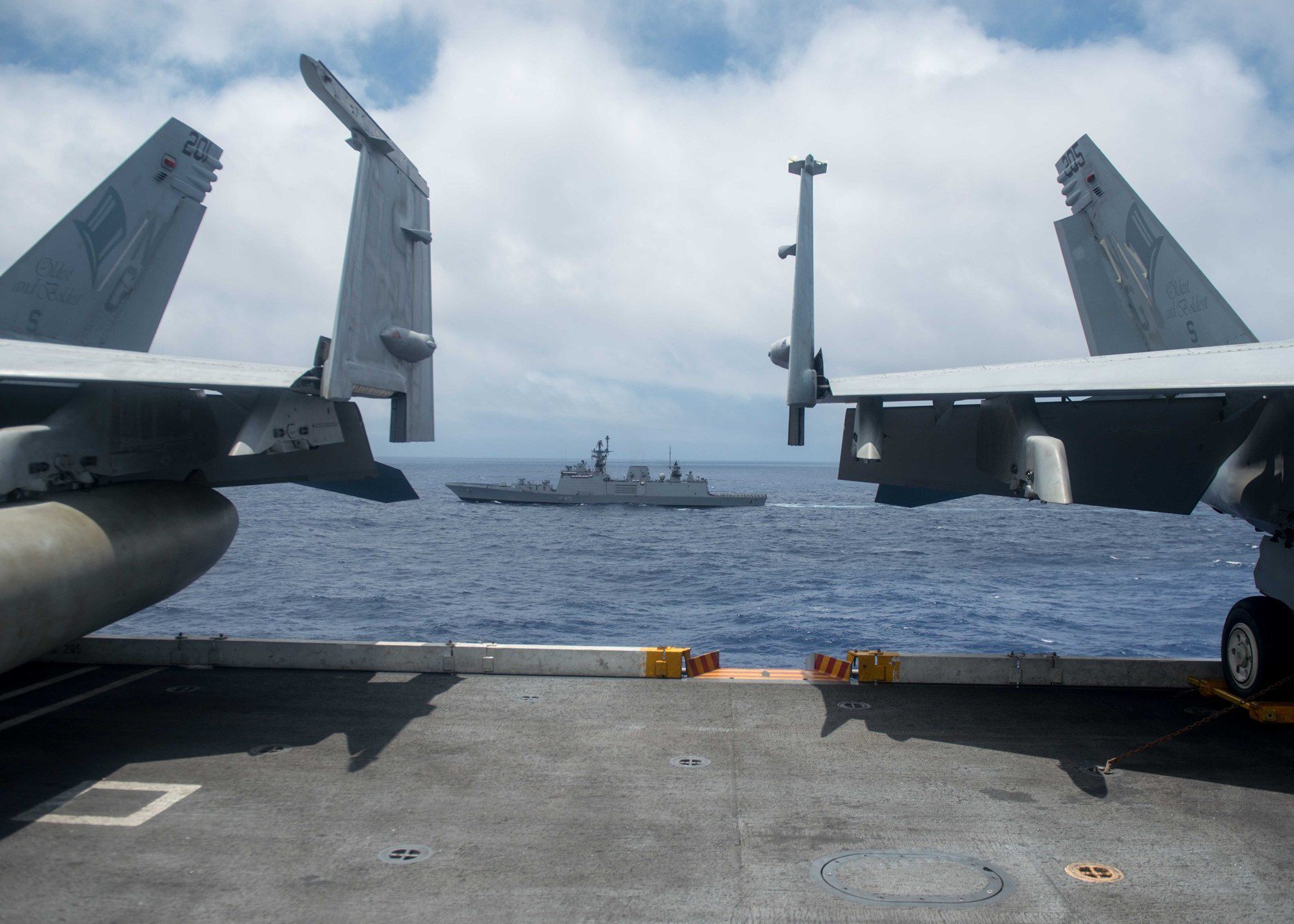
The Indian Navy’s guided-missile stealth frigate INS Sahyadri arrived at Vladivostok, Russia, on Saturday, 10 October 2026, to take part in Exercise INDRA 2026, the bilateral naval exercise between the Indian Navy and the Russian Federation Navy. The exercise is scheduled from 13 to 18 October 2026. The arrival was reported on 11 October by ANI (quoting the Ministry of Defence), UNI and India Blooms News Service (quoting a Government of India statement).
According to these reports, INDRA 2026 will begin with a harbour phase, followed by coordinated operational activities at sea. The Ministry of Defence described the deployment as an opportunity for “professional engagements and operational interaction between the two navies”, aimed at improving interoperability and mutual understanding. Social and cultural interactions are also planned to build people-to-people ties between the two navies.
What the deployment signals
The government statement links the deployment to India’s maritime vision of MAHASAGAR — Mutual and Holistic Advancement for Security and Growth Across Regions — and says it builds on the India–Russia defence and maritime partnership. It also says the deployment carries forward the momentum of the 23rd India–Russia Annual Summit, held on 4–5 December 2025.
Holding the exercise at Vladivostok is itself significant. Vladivostok is Russia’s principal port on the Pacific coast and the home of its Pacific Fleet, located on the Sea of Japan. For the Indian Navy, a frigate operating so far east is an example of the long-range deployments it now undertakes beyond the Indian Ocean.
Background & Framework
The INDRA series: according to a PIB (Ministry of Defence) release of 4 April 2025, the INDRA series has been “a cornerstone of India–Russia Defence relations since its inception in 2003.” The same release recorded that INDRA 2025, the 14th edition of the naval exercise, was held from 28 March to 2 April 2025.
Naval vs tri-service INDRA: the name INDRA (from INDia and RussiA) has been used both for single-service exercises and, from 2017, for a joint tri-services edition. The edition starting this week is the naval one.
INS Sahyadri: a PIB release of 14 October 2025 describes her as “indigenously designed, constructed, and commissioned in 2012” and as the third ship of the Shivalik class of guided-missile stealth frigates (built under Project 17). She is based at Visakhapatnam as part of the Eastern Fleet under the Eastern Naval Command.
Shivalik class: the Project 17 frigates
The Shivalik class comprises three frigates — INS Shivalik, INS Satpura and INS Sahyadri — named after Indian mountain ranges. They were India’s first indigenously designed stealth frigates, built by Mazagon Dock Shipbuilders in Mumbai. Their stealth design reduces the radar signature of the ship. The follow-on programme, Project 17A (the Nilgiri class), carries the same naming tradition of hill ranges with improved stealth and greater indigenous content. In its 2025 description, PIB called INS Sahyadri “a shining example of India’s ‘Aatmanirbhar Bharat’ vision”.
The ship has been a regular in India’s naval diplomacy. In October 2025, according to PIB, it made a port call at Busan for the inaugural India–Republic of Korea Navy bilateral exercise, as part of an operational deployment to the South China Sea and the Indo-Pacific.
Harbour phase and sea phase
Most bilateral naval exercises follow the two-part structure announced for INDRA 2026. The reports on this edition do not list the specific drills planned, but PIB’s description of INS Sahyadri’s exercise with the Republic of Korea Navy in October 2025 shows what such phases usually contain. That harbour phase included reciprocal cross-deck visits, sharing of best practices, cross-training sessions and sports fixtures, with the Commanding Officer calling on senior officials and local dignitaries. The sea phase then moved to joint exercises between the participating ships.
The harbour phase builds familiarity — officers learn each other’s procedures before any manoeuvre at sea. The sea phase tests that familiarity under operational conditions. Which drills are conducted in INDRA 2026 will be known only when the navies report on the exercise after it ends on 18 October.
Analysis: the logic of naval exercises
Bilateral naval exercises serve three purposes. First, interoperability: navies that train together can communicate and manoeuvre together, sharing procedures and signals. Second, diplomatic signalling: a warship’s port call is a visible expression of a partnership. Third, operational experience in unfamiliar waters, far from home bases.
INDRA’s long history — more than two decades and 14 naval editions up to 2025 — reflects the depth of the India–Russia defence relationship. India also runs a wide network of other naval exercises, such as Malabar (with the United States, Japan and Australia), Varuna (France), Konkan (United Kingdom), SIMBEX (Singapore) and JIMEX (Japan). Taken together, these show a multi-alignment approach: India trains with partners across different groupings rather than with any single bloc.
MAHASAGAR is the wider policy frame. It extends the earlier SAGAR (“Security and Growth for All in the Region”) idea, which focused on the Indian Ocean, to cooperation across regions. Naval deployments like this one are among the practical tools of that outreach.
The CLAT Angle
Defence-exercise questions are a staple of CLAT GK. Expect match-the-pair questions (exercise → partner country), “which edition” questions, and questions on location (Vladivostok → Russia’s Pacific coast). A passage might also ask you to distinguish the naval INDRA from the tri-service INDRA.
A common trap: confusing Project 17 (Shivalik class) with Project 17A (Nilgiri class), or Sahyadri the frigate with other ships named after mountains. Also be careful with acronyms — know that MAHASAGAR stands for Mutual and Holistic Advancement for Security and Growth Across Regions.
A sample question: “INS Sahyadri recently arrived at which port for Exercise INDRA 2026?” Options could include Vladivostok, Novorossiysk, Murmansk and Kaliningrad — all Russian naval ports, so only precise reading of the news helps.
Key Facts
- Exercise: INDRA 2026 — Indian Navy and Russian Federation Navy.
- Dates: 13–18 October 2026.
- Ship: INS Sahyadri arrived at Vladivostok on 10 October 2026.
- Structure: harbour phase, then coordinated operational activities at sea.
- Policy frame: MAHASAGAR — Mutual and Holistic Advancement for Security and Growth Across Regions.
- Summit link: 23rd India–Russia Annual Summit, 4–5 December 2025.
- Series began: 2003 (PIB, April 2025).
- Previous edition: INDRA 2025, the 14th, 28 March–2 April 2025.
- INS Sahyadri: third Shivalik-class (Project 17) stealth frigate, commissioned 2012.
- Home base: Visakhapatnam, Eastern Fleet, Eastern Naval Command.
- Vladivostok: home of Russia’s Pacific Fleet.
Memory Hook / Mnemonic
“IND + RA = INDRA, born 2003.” For the ship: “Shivalik, Satpura, Sahyadri — three S-hills of Project 17.” Sahyadri is the third one, commissioned in 2012. For the dates: “13 to 18 at Vladivostok” — and the vision is MAHASAGAR, the “great ocean”.
Practice Quiz — 10 CLAT-Style Questions
Click an option to reveal the answer and explanation.