CURRENT AFFAIRS | 09 OCTOBER 2026
Margaret Hamilton, the American computer scientist who led the team that wrote the on-board flight software for NASA’s Apollo lunar programme, has died at the age of 90. According to a statement published by the Massachusetts Institute of Technology (MIT) on Wednesday, 7 October 2026, she died on 30 September 2026. MIT called her a “computing pioneer” who helped to establish software engineering as a dedicated discipline. The news was carried in India by The Hindu on 8 October 2026 through the AFP wire.
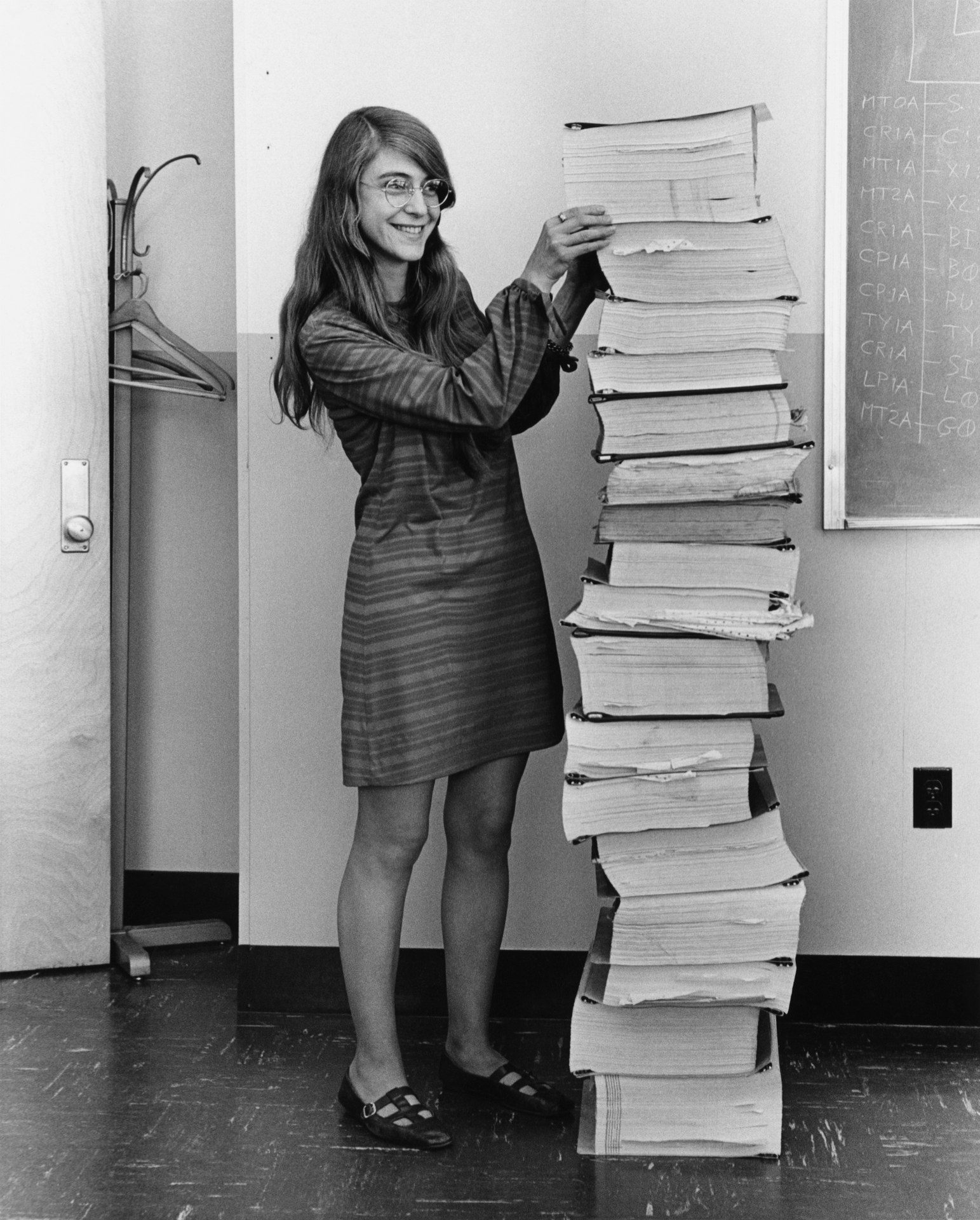
Hamilton is remembered for two things that every quiz-setter loves: she led the software effort that helped land the first humans on the Moon in July 1969, and she fought for the very idea that writing software is a form of engineering. The famous photograph of her standing beside a stack of printed program listings as tall as herself has become an icon for women in science and technology.
Who was Margaret Hamilton?
According to MIT, Hamilton was born in Paoli, Indiana, in 1936. She studied mathematics, earning a BA from Earlham College in 1958, and moved to Boston in 1959. Her first programming job was a temporary post in MIT’s meteorology department, working with Edward N. Lorenz on weather-prediction software — work that, MIT notes, informed Lorenz’s later publications on chaos theory. From 1961 she worked at MIT Lincoln Laboratory on the SAGE (Semi-Automatic Ground Environment) air-defence project, where she became interested in software reliability.
In 1965, she joined the MIT Instrumentation Laboratory, which had won the NASA contract to build the on-board flight software for Apollo. MIT says she was hired as the first programmer for the Apollo project at MIT, and its first female programmer. By 1968 she was assistant director in charge of the Command and Service Module team, and more than 400 people were working on Apollo’s software.
The Apollo 11 moment
Hamilton’s best-known contribution came during Apollo 11 in July 1969. As MIT recounts, moments before the lunar module Eagle was due to land, the on-board computer raised a “1202” alarm: it was overloaded because of a fault in a hardware switch. Hamilton’s team had built priority-driven software that could shut down less important background tasks and keep the mission-critical ones running. Mission Control in Houston trusted the software, the landing went ahead, and two men walked on the Moon for the first time.
An earlier episode shaped that design. MIT describes the so-called “Lauren error”: her four-year-old daughter, playing with a simulator, triggered a pre-launch program called P01 during simulated flight and crashed it. Hamilton’s proposed safeguard was at first overruled, but during Apollo 8 in 1968 an astronaut did launch P01 mid-flight, wiping navigation data; her fixes were then built in. MIT calls this an early example of “defensive” programming — software that anticipates and handles errors on its own.
Background & Framework
Apollo programme: NASA’s crewed lunar programme. Apollo 11 made the first crewed Moon landing in July 1969. Apollo’s guidance software was developed at the MIT Instrumentation Laboratory, which, as the programme wound down, spun out of MIT to become the independent Draper Laboratory.
“Software engineering”: Hamilton is widely credited with coining the term. In her own words, quoted by MIT from a 2018 interview, she “began to use the term ‘software engineering’” to give software the same legitimacy as hardware and other branches of engineering — and at first the phrase was treated as a joke.
Honours (per MIT): NASA Exceptional Space Act Award (2003); Presidential Medal of Freedom (2016), presented by President Barack Obama; Computer History Museum Fellow Award (2017); induction into the National Aviation Hall of Fame (2022). The Presidential Medal of Freedom is the highest civilian honour of the United States.
Later career: she founded Higher Order Software in 1976 and, a decade later, Hamilton Technologies, whose flagship product is the Universal Systems Language (USL). She authored more than 130 publications.
Why her work still matters
In the 1960s, software was, in Hamilton’s phrase quoted by MIT, “a mystery, a black box”. Spacecraft were judged by their engines and hardware; code was an afterthought. Apollo changed that. A single unhandled error could end a mission and endanger a crew, so the software had to be tested, documented and designed to fail safely. The ideas Hamilton championed — error prevention, fault tolerance and priority scheduling — are now basic principles in aviation, space, medical devices, banking systems and self-driving technology.
Her story also carries a lesson about institutions and recognition. MIT notes that she fought for years for software to be given “its due respect”. In 2015, the Apollo software she helped develop was posted in full on the code-sharing site GitHub, and in 2017 she became a Lego minifigure in a “Women of NASA” set. Recognition, in other words, came decades after the work itself.
For India, the link is direct. The country’s own lunar missions depend on the same discipline Hamilton helped create: autonomous landing software that must react in seconds, without help from the ground. Chandrayaan-3’s soft landing near the lunar south pole on 23 August 2023 — now marked as National Space Day — was, at its core, also a triumph of reliable on-board software.
The CLAT Angle
Current Affairs / GK: “Persons in news” questions may ask what Hamilton is known for (Apollo flight software; the term “software engineering”), which institution she worked at (MIT Instrumentation Laboratory) or which US honour she received in 2016 (Presidential Medal of Freedom).
Reading Comprehension: an English passage on the Apollo 11 “1202 alarm” could ask for the main idea (well-designed priorities saved the landing), the meaning of “defensive programming” from context, or the author’s attitude (admiring).
Critical Reasoning: the P01 story is a classic argument — “trained astronauts will never make that mistake, so no safeguard is needed”. Spot the flawed assumption: that human error can be ruled out by training. The Apollo 8 incident is the evidence that weakens it.
Key Facts
- Died: 30 September 2026, aged 90; MIT statement 7 October 2026.
- Born: Paoli, Indiana, USA, 1936.
- Known for: leading on-board flight software for NASA’s Apollo programme.
- Lab: MIT Instrumentation Laboratory (later Draper Laboratory), joined 1965.
- First: first programmer, and first female programmer, on MIT’s Apollo project.
- Team: by 1968, assistant director of the Command and Service Module team; 400+ people on Apollo software.
- Apollo 11 (July 1969): “1202” overload alarm handled by priority-driven software.
- Term: widely credited with coining “software engineering”.
- Honour: Presidential Medal of Freedom, 2016, from President Obama.
- Companies: Higher Order Software (1976); Hamilton Technologies.
- India link: Chandrayaan-3 landing, 23 August 2023 (National Space Day).
Memory Hook / Mnemonic
“Code that Landed — 65, 69, 2016”: joined Apollo at MIT in ’65, Moon landing in ’69, Medal of Freedom in 2016. And remember the alarm: “1202 — drop the extras, keep the landing” — priority-driven software sheds low-priority tasks so the critical ones survive.
Practice Quiz — 10 CLAT-Style Questions
Click an option to reveal the answer and explanation.