CURRENT AFFAIRS | 31 JULY 2026
In a striking proof-of-concept, an international research team has combined a photonic quantum computer with generative artificial intelligence to design immune-targeting peptides — the building blocks of a personalised cancer vaccine. It is an early but symbolically important step toward quantum-assisted drug and vaccine discovery. For Indian aspirants, the domestic hook is obvious: the National Quantum Mission, the country’s flagship programme to build quantum capability. This is a science-and-technology story with a strong law-and-ethics tail, making it ideal CLAT material.
What did the researchers actually do?
Scientists from institutions including the Technical University of Denmark, along with quantum-hardware companies, paired a photonic quantum processor (one that uses particles of light — photons — as its information carriers) with conventional generative AI. The quantum device produced complex probability patterns that guided the AI to search more effectively for promising peptides — short chains of amino acids.
These peptides are displayed on the surface of cells so that the immune system’s T cells can inspect them and recognise infected or cancerous cells. Designing the right peptides is central to immunotherapy and to personalised cancer vaccines, which are tailored to an individual patient’s tumour. The quantum-generated patterns were especially useful for predicting peptides linked to rare human leukocyte antigen (HLA) variants, where biological data is scarce.
Quantum computing — the essentials
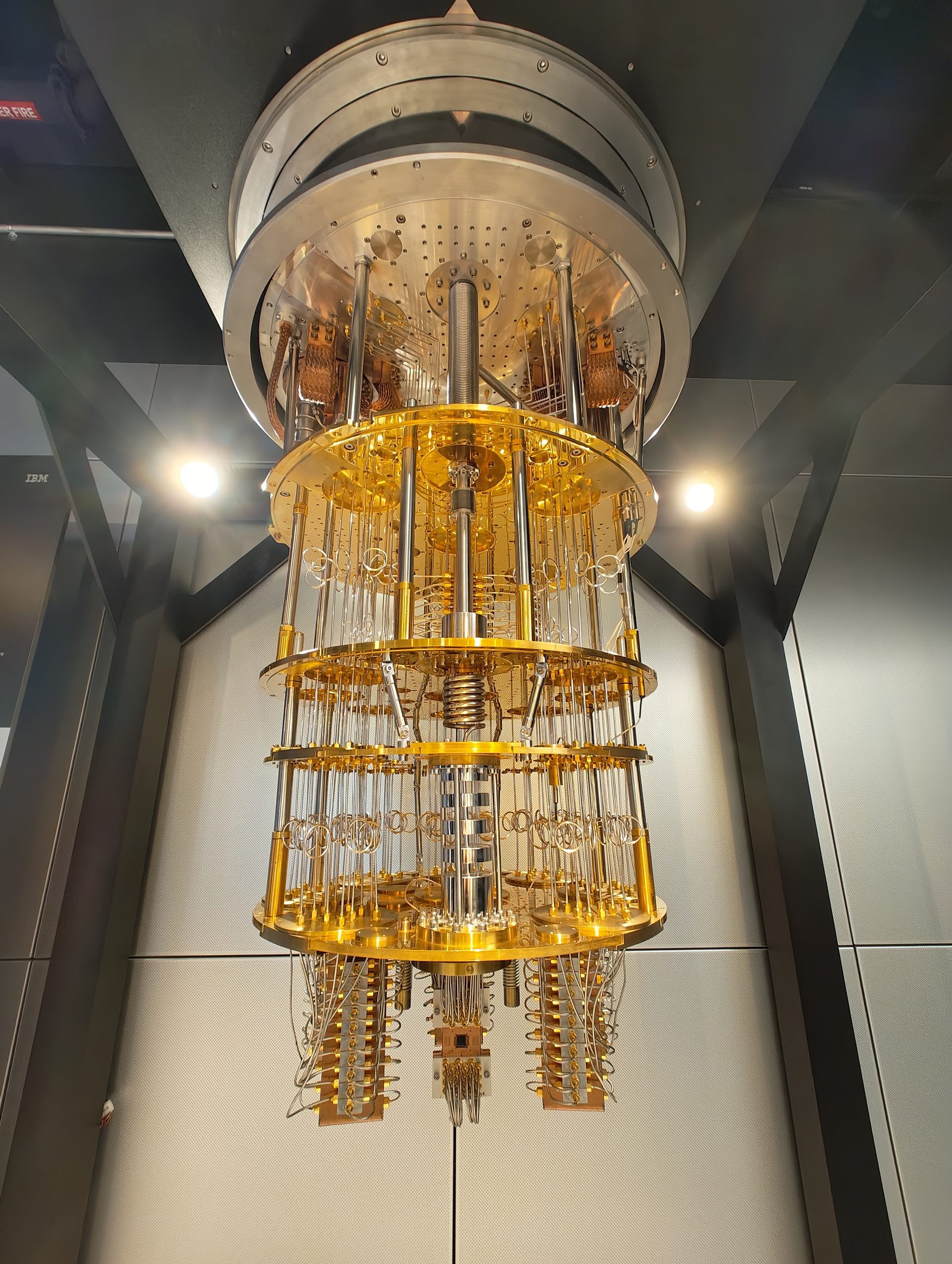
A classical computer stores information in bits (0 or 1). A quantum computer uses qubits, which exploit two quantum phenomena: superposition (a qubit can represent 0 and 1 at the same time) and entanglement (qubits can be correlated so the state of one instantly influences another). Together these give quantum machines the potential to explore many possibilities in parallel. When a quantum computer solves a problem that is effectively out of reach for the best classical machines, it is said to demonstrate quantum advantage (sometimes called quantum supremacy). Photonic quantum computers, which use light, are one of several competing approaches — others use superconducting circuits or trapped ions.
India’s push in this field is the National Quantum Mission, approved by the Union Cabinet in 2023 with an outlay of about ₹6,003 crore for 2023-2031. It aims to build intermediate-scale quantum computers of 50 to 1,000 physical qubits and to set up four thematic hubs (computing, communication, sensing/metrology, and materials/devices). On the medical side, AI-driven drug design intersects with the Digital Personal Data Protection Act, 2023 (genetic and health data are sensitive personal data), drug-approval regulation under the Central Drugs Standard Control Organisation (CDSCO), and emerging debates on liability and consent when algorithms shape treatment.
Why this matters
Personalised cancer vaccines are one of the most promising frontiers in oncology: instead of a one-size-fits-all drug, they train a patient’s own immune system to attack their specific tumour. The bottleneck is the enormous computational task of predicting which peptides will trigger an immune response. If quantum computing can accelerate that search — even modestly — it could shorten the path from diagnosis to a tailored therapy.
It is important to keep expectations realistic. This was a proof-of-concept, not a clinical breakthrough; today’s quantum devices remain small and error-prone. But the study signals that quantum computing is beginning to touch biomedicine, and that the race to useful quantum applications now spans healthcare, materials and cryptography.
How AI and quantum fit together
It helps to see the two technologies as partners rather than rivals. Generative AI is excellent at learning patterns from large datasets and proposing new candidates — new peptide sequences, new molecules. But where data is thin or the search space is astronomically large, AI can get stuck. A quantum computer can generate rich, hard-to-mimic probability distributions that seed the AI’s search with fresh diversity, helping it explore corners of the possibility space that a purely classical system might miss. In this study, the quantum device did not replace the AI; it enhanced it — a “hybrid quantum-classical” approach that is likely to define the near term, since fully fault-tolerant quantum computers are still years away.
This matters for medicine because the number of possible peptides or drug molecules is effectively limitless. Even a small improvement in how efficiently that space is searched can translate into faster candidate discovery, fewer laboratory dead-ends, and lower costs — the difference between a therapy that is theoretically possible and one that is practically deliverable.
The law-and-ethics frontier
As these tools move toward the clinic, lawmakers face hard questions. Who is liable if an AI-designed therapy causes harm — the developer, the hospital, or the algorithm’s owner? How is a patient’s genetic and health data — the most sensitive personal data — protected when it trains these models? Should AI-designed drugs face a distinct regulatory-approval pathway? And crucially, how do we ensure equitable access so that cutting-edge, personalised therapies do not become the preserve of the wealthy? These are exactly the kinds of principle-application dilemmas CLAT legal-reasoning sections are built around.
Two layers here. First, static S&T GK: the National Quantum Mission (2023, ₹6,003 crore, 50-1,000 qubits), and quantum basics (qubit, superposition, entanglement, quantum advantage, photonic computers). Second, a legal-reasoning ethics angle: AI in medicine raises questions of data privacy (health and genetic data), informed consent, liability when an algorithm’s recommendation causes harm, regulatory approval of AI-designed therapies, and equitable access to expensive personalised treatments. A CLAT passage might give you a principle on medical negligence or data protection and ask you to apply it to an AI-designed drug scenario.
India’s quantum ambitions
The National Quantum Mission places India among a small group of nations investing seriously in quantum technology. Beyond computing, it targets quantum communication (ultra-secure, tamper-evident data links), quantum sensing (precise measurement for navigation and healthcare) and advanced quantum materials. Success would have strategic implications — quantum computers could one day break widely used encryption, which is why “post-quantum cryptography” is itself a policy priority.
| The study | Photonic quantum computer + AI to design cancer-vaccine peptides |
| Immune role | Peptides help T cells identify cancerous cells |
| India’s mission | National Quantum Mission (approved 2023) |
| Outlay | ~₹6,003 crore (2023-2031) |
| Qubit target | 50 to 1,000 physical qubits; 4 thematic hubs |
| Key terms | Qubit, superposition, entanglement, quantum advantage |
“Photonic qubits + AI → cancer-vaccine peptides • India = National Quantum Mission (2023, ₹6,003 cr).” Lock the mission numbers as “6,003 for 50-1,000” — ₹6,003 crore to build 50-1,000 qubits. And remember the study’s chain: light-based qubits guide AI, AI designs peptides, peptides train T cells to spot cancer.
There is also a national-security dimension worth remembering. The same quantum power that could accelerate drug discovery could one day break the encryption that secures banking, defence and government data — which is why quantum research, “post-quantum cryptography” and quantum communication are treated as strategic priorities, not merely scientific curiosities. A country that leads in quantum technology gains an edge across medicine, industry and security alike; one that falls behind risks dependence on others for a foundational technology. That dual-use character — enormous benefit alongside serious risk — is exactly why governments, India’s included, are investing early and building domestic capability.
For CLAT, keep the National Quantum Mission facts crisp and be ready to reason about the law and ethics of AI in healthcare — the questions of privacy, consent, liability and access that lawmakers and courts will increasingly have to answer as science like this moves from the lab toward the clinic.
Practice Quiz — 10 CLAT-Style Questions
Click an option to reveal the answer and explanation.