CURRENT AFFAIRS | 31 JULY 2026
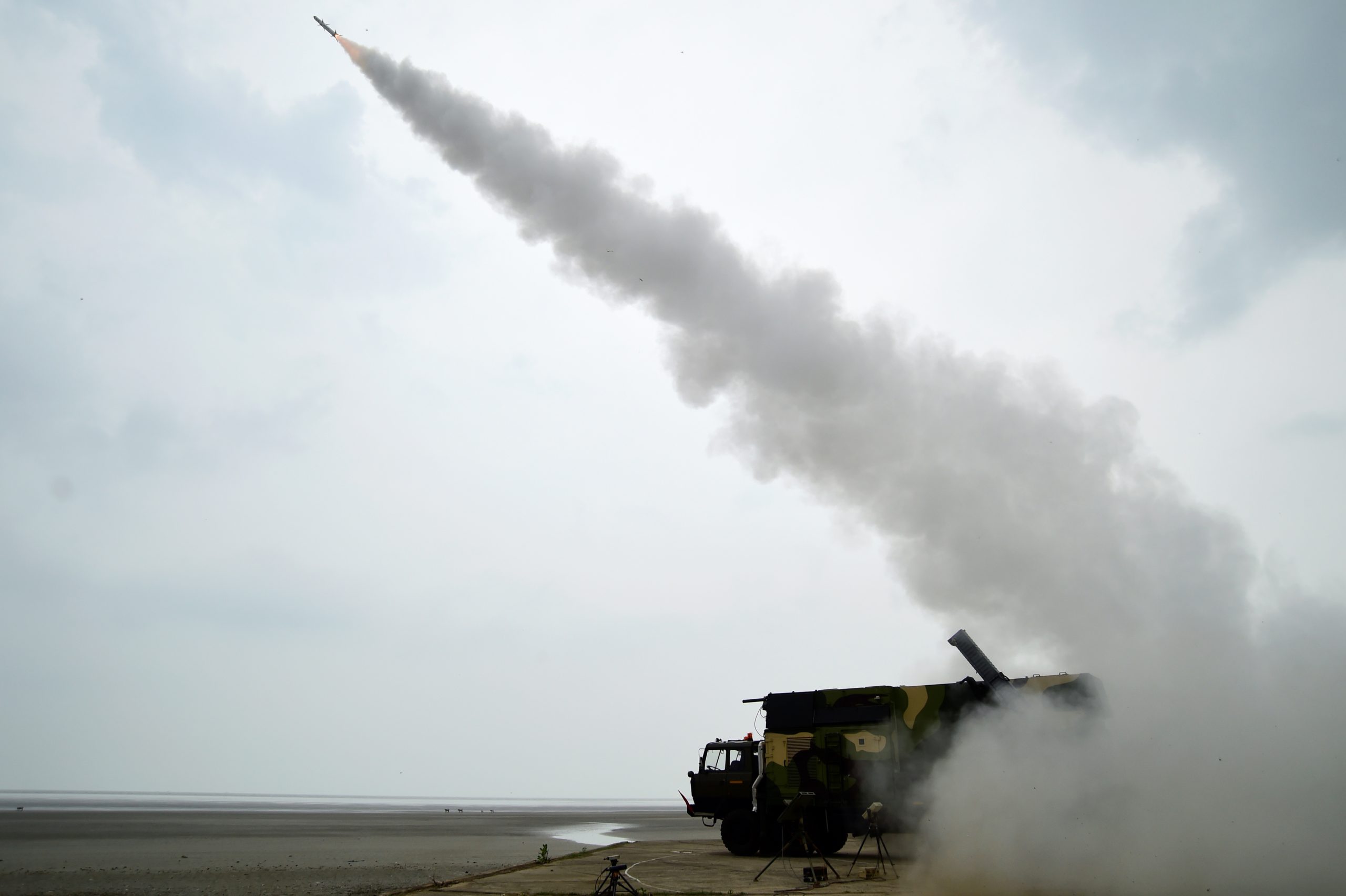
India has taken a significant step toward self-reliance in air defence. On 23 July 2026, the Defence Research and Development Organisation (DRDO) carried out the maiden flight-test of Project Kusha, an indigenous Long-Range Surface-to-Air Missile (LRSAM) system, off APJ Abdul Kalam Island on the Odisha coast. The missile intercepted an electronic target simulating a high-speed, high-altitude aerial threat — placing India in a small club of nations that can independently field long-range air-defence systems. For CLAT aspirants, this is a defence/science-and-technology GK story tightly bound to the Atmanirbhar Bharat policy narrative.
What is Project Kusha?
Project Kusha is an indigenous long-range surface-to-air missile programme designed to protect Indian airspace from a wide spectrum of threats — enemy fighter jets, cruise and ballistic missiles, drones (UAVs) and large aircraft. Its defining feature is a three-tier (layered) architecture: three interceptor variants (M1, M2 and M3) with approximate ranges of 150 km, 250 km and up to 350-400 km. Each tier covers a different band of range and altitude, giving the system depth — an incoming threat that slips past the outer layer can be engaged by the next.
Crucially, all elements of the system — the missiles, the radars, and the command-and-control network — have been developed by DRDO laboratories together with Indian industry partners. That indigenous stack is what makes Kusha strategically important.
The maiden test
The first flight-test took place off APJ Abdul Kalam Island (formerly Wheeler Island), a well-known DRDO missile-testing site off Odisha. The missile successfully intercepted an electronic target that simulated a fast, high-altitude aerial threat — validating the system’s guidance, propulsion and interception chain in its debut trial. The Defence Minister hailed the test as a milestone, noting that only a handful of countries can independently develop such long-range air-defence technology.
Defence is a Union subject (Union List, Entry 7 — defence of India; Entry 8 — armed forces; Entry 25 — arms and ammunition), so missile development and procurement fall squarely within the Central Government’s domain. DRDO functions under the Department of Defence Research and Development, Ministry of Defence. Programmes like Kusha advance the Atmanirbhar Bharat and “Make in India” policy of indigenising defence production — reducing reliance on imported systems, conserving foreign exchange, and building a domestic defence-industrial base supported by measures such as positive indigenisation lists and higher domestic-procurement targets.
Why it matters: India’s own “S-400”
Kusha is widely described as an indigenous alternative to the Russian S-400 Triumf, the long-range air-defence system India has imported. While the S-400 remains a formidable capability, dependence on imported systems carries costs — foreign exchange outflow, supply-chain and sanctions risk, and limited control over upgrades. A home-grown LRSAM lets India build, maintain and improve its own strategic shield, and potentially export it in future.
Kusha is designed to slot into India’s multi-layered air-defence grid alongside systems like the medium-range Akash and MR-SAM (Barak-8), forming successive rings of protection. Layered air defence is the modern doctrine: no single interceptor can counter every threat, so a mix of short-, medium- and long-range systems provides overlapping coverage.
How a long-range air-defence system works
An air-defence system is far more than a missile. It is a chain: radars detect and track incoming threats at long range; a command-and-control centre classifies each threat, assigns priority and decides which interceptor to launch; and the interceptor missile then flies out, guided by the radar and its own seeker, to destroy the target — often by getting close enough for a proximity-fused warhead to detonate. Because Kusha builds all three components — radars, command-and-control, and the three interceptor variants — indigenously, India controls the entire “kill chain,” from detection to interception, without foreign dependence.
The three-tier design lets commanders match the interceptor to the threat: a long-range M3 (350-400 km) can engage a high-value enemy aircraft or aerial tanker far from Indian airspace, while shorter-range variants deal with closer, faster-approaching missiles and drones. This flexibility, and the sheer reach, is what places India among the select nations — alongside the United States, Russia, China and a few others — that can independently field such systems.
Decades in the making
Kusha did not appear overnight. It is the fruit of an indigenous missile ecosystem built over decades — from the Integrated Guided Missile Development Programme (which delivered Prithvi, Agni, Akash, Trishul and Nag) championed by Dr APJ Abdul Kalam, to the supersonic BrahMos cruise missile and the Ballistic Missile Defence programme. Each generation seeded the talent, testing infrastructure and industrial base that a system as complex as Kusha demands. A successful maiden test is the first of many trials before the system is inducted into the armed forces, but it is a clear marker of how far India’s missile capability has matured.
This is primarily a defence/S&T GK item with reliable static hooks: DRDO (its parent ministry), Project Kusha, the meaning of LRSAM, the S-400 comparator, and APJ Abdul Kalam Island (formerly Wheeler Island). It also connects to the broader theme of self-reliance in defence — a favourite for both GK and reasoning passages on India’s strategic autonomy. Remember the constitutional placement of defence in the Union List, a detail examiners like to pair with current defence news.
The bigger picture
India has steadily built indigenous missile capability over decades — from the Integrated Guided Missile Development Programme (which gave us Prithvi, Agni, Akash, Trishul and Nag) to the BrahMos cruise missile and now long-range air defence. Kusha represents the maturing of that ecosystem into a top-tier strategic system. A successful maiden test is only the first of many trials before induction, but it marks a clear signal of intent: to secure Indian skies with Indian technology.
| System | Project Kusha — indigenous LRSAM (air defence) |
| Developer | DRDO (with industry partners) |
| Test date & site | 23 July 2026, APJ Abdul Kalam Island, Odisha |
| Range tiers | ~150 km, 250 km, 350-400 km (M1/M2/M3) |
| Comparator | Imported Russian S-400 Triumf |
| Policy link | Atmanirbhar Bharat in defence |
“Kusha = 3 shields (150 / 250 / 350-400 km) • DRDO • India’s own ‘S-400’.” Picture three concentric rings around Indian skies. And remember the site name swap: Wheeler Island → APJ Abdul Kalam Island, off the Odisha coast.
There is a strategic-autonomy argument too. Imported systems can come with conditions, delivery delays, and exposure to the supplier’s foreign policy — and in a crisis, a nation that cannot replenish or upgrade its own defences is dangerously constrained. By owning the technology end-to-end, India insulates a critical shield from such pressures, conserves scarce foreign exchange, and opens the door to becoming a defence exporter rather than only an importer. That shift — from buyer to builder — is the deeper significance of a maiden test like Kusha’s, beyond the engineering achievement itself.
For CLAT, hold the static anchors (DRDO under the Ministry of Defence, the S-400 comparator, Kalam/Wheeler Island, defence as a Union-List subject) alongside the current fact (maiden Kusha test, three range tiers), and connect them to the self-reliance policy that examiners increasingly weave through defence current affairs.
Practice Quiz — 10 CLAT-Style Questions
Click an option to reveal the answer and explanation.