CURRENT AFFAIRS | 31 JULY 2026
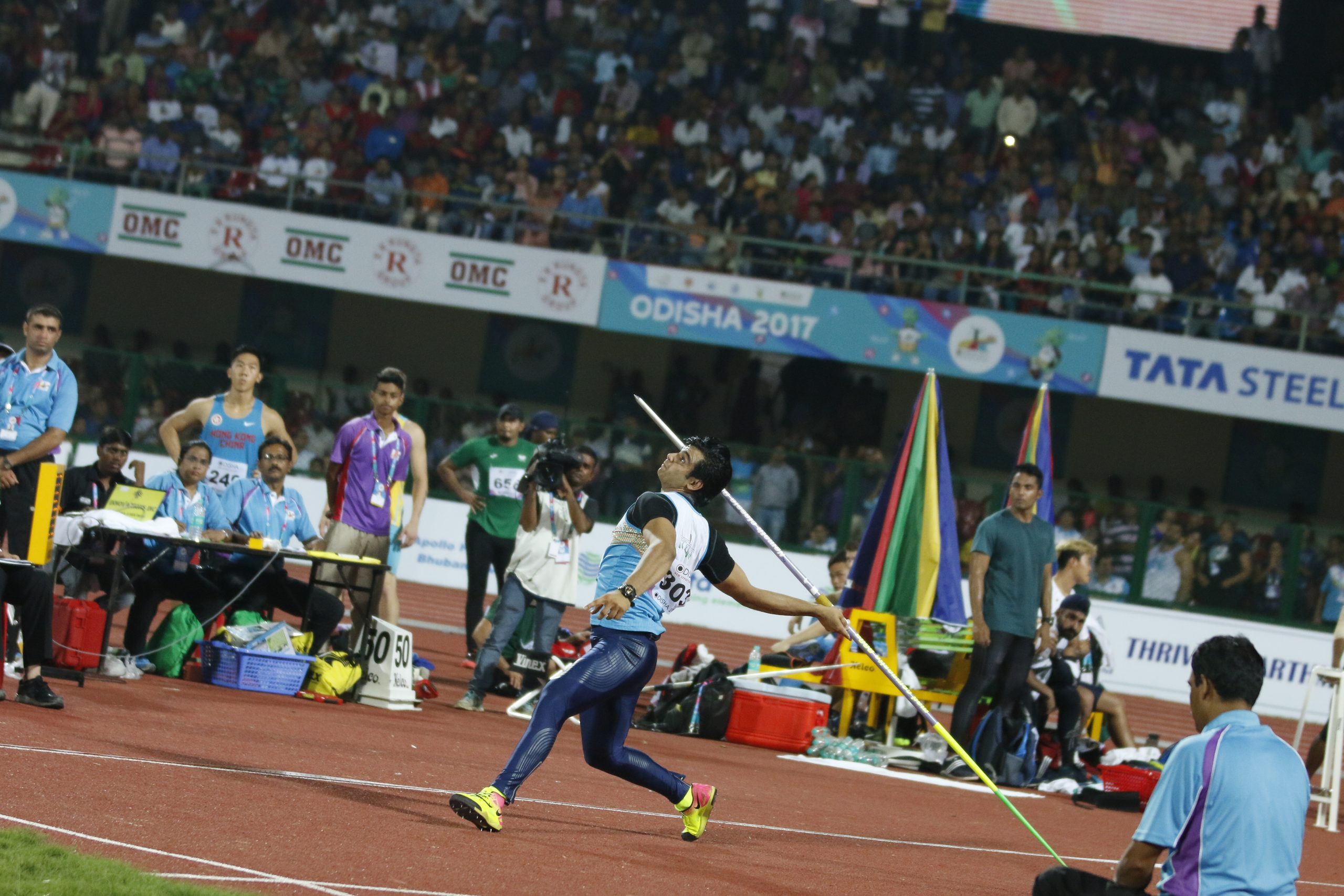
At the Commonwealth Games Glasgow 2026, India’s star javelin thrower Neeraj Chopra battled a gusty headwind to book his place in the men’s javelin final — and, for the first time ever, three Indian throwers (Neeraj Chopra, Rohit Yadav and Yashvir Singh) qualified for a Commonwealth Games javelin final together. As India’s medal tally climbed across the Games, the spotlight fell on both a familiar champion and a rather unusual, scaled-down edition of the Commonwealth Games. For CLAT aspirants, this is a sports GK story rich in static hooks, with a clear personality anchor in Neeraj Chopra.
Neeraj Chopra at Glasgow
Competing in tricky, windy conditions that made big throws difficult, none of the Indian trio breached the automatic qualification mark, so the finalists were decided on overall rankings — and all three Indians made the cut. Neeraj led the way, advancing to a final scheduled in the early hours of 1 August (IST).
Neeraj Chopra is India’s most celebrated track-and-field athlete. He won Olympic gold at Tokyo 2020 (held in 2021) — India’s first-ever Olympic athletics gold — and followed it with silver at Paris 2024 and a World Championship title in 2023. He is a member of the elite “90-metre club”, having crossed the 90m mark with a personal best of 90.23m. He had won javelin gold at the 2018 Gold Coast Commonwealth Games but missed the 2022 Birmingham edition through injury, making Glasgow 2026 a chance at a second CWG title.
Sport in India is a State subject (State List, Entry 33 — “sports”), though the Union promotes sport through the Ministry of Youth Affairs and Sports, the Sports Authority of India (SAI) and schemes like Khelo India and the Target Olympic Podium Scheme (TOPS). National sports bodies must comply with the National Sports Code and anti-doping law (the National Anti-Doping Act, 2022, and NADA). The Commonwealth Games themselves are run by the Commonwealth Games Federation for members of the Commonwealth of Nations — a voluntary association, mostly of former territories of the British Empire, headed by the British monarch as its symbolic head.
A “scaled-down” Commonwealth Games
Glasgow 2026 is unusual: it is a reduced-format edition, built around roughly ten sports rather than the usual broad programme. This happened because the Australian state of Victoria withdrew as host, citing spiralling costs, leaving the Games without a venue until Glasgow — which had successfully hosted in 2014 — stepped in with a leaner, more affordable model. The episode has fuelled a real debate about the future and relevance of the Commonwealth Games in an era of ballooning event budgets and questions about the Commonwealth’s colonial legacy.
Commonwealth Games — the static essentials
The Games trace back to 1930, when the first edition (then the British Empire Games) was held in Hamilton, Canada. They are held every four years. India first participated in 1934 and has hosted once — Delhi 2010. Glasgow’s hosting in 2014 and 2026 makes it a two-time host. The Games are distinct from the Olympic movement, though many athletes (like Neeraj) compete in both.
Expect sports GK questions on the Commonwealth Games (first held 1930 in Hamilton, Canada; every four years; Delhi 2010; Glasgow 2014 & 2026) and on the Commonwealth of Nations (a voluntary association of former British territories). The personality hook is Neeraj Chopra — Tokyo 2020 gold, Paris 2024 silver, 2023 World champion, 90m club. A current-affairs passage may also test comprehension of why Glasgow 2026 was scaled down (Victoria’s withdrawal) and the debate over the Games’ future — a comprehension-plus-inference style question.
India’s medal march
Across the Games, India’s medal tally climbed steadily, with the hockey team taking the field and athletes across disciplines adding to the count. For India, events like the Commonwealth Games serve as an important stage on the road to the bigger targets — the Asian Games and the LA 2028 Olympics — and as a showcase for the results of sustained investment through Khelo India and TOPS.
Why the Commonwealth Games faces an existential question
The Victoria withdrawal was not a one-off. Over the past decade, several prospective hosts have balked at the cost of staging a full multi-sport Games, and critics increasingly ask what the Commonwealth Games are for in the 21st century. The Commonwealth itself is a voluntary association rooted in the former British Empire, and some member nations debate its continued relevance amid conversations about colonial history. Glasgow’s willingness to host a leaner, cheaper 2026 edition — reusing existing venues and trimming the sport list — is being watched as a possible template for the Games’ survival: smaller, more sustainable, and less of a financial gamble for host cities.
For athletes, though, the Games remain valuable. They offer high-quality international competition, a rare chance for smaller nations and emerging athletes to win medals against strong fields, and a stepping stone between national events and the Olympics. That is precisely why India, with its growing depth in athletics, wrestling, weightlifting, badminton and shooting, treats the CWG as both a medal opportunity and a proving ground.
India’s sporting rise
Neeraj Chopra is the headline, but he sits atop a broader story. India’s improving medal hauls reflect a decade of structural investment — the Khelo India talent-identification programme, the Target Olympic Podium Scheme (TOPS) that funds elite athletes’ training and travel, and a growing professional support system of coaches, physios and sports science. The result is a pipeline that no longer depends on a handful of stars. For a CLAT aspirant, the policy scaffolding behind India’s athletes — the ministry, SAI, Khelo India and TOPS — is as examinable as the medals themselves.
| Event | Commonwealth Games 2026, Glasgow (scaled-down) |
| First CWG | 1930, Hamilton, Canada (every 4 years) |
| Why scaled down | Victoria (Australia) withdrew as host |
| Neeraj Chopra | Tokyo 2020 gold, Paris 2024 silver, 2023 World champ |
| Milestone | ’90m club’; 3 Indians in the CWG javelin final |
| India hosted | Delhi 2010 |
“CWG since 1930 • Glasgow 2014 & 2026 (scaled-down) • Neeraj = javelin, 90m club.” Remember Glasgow as the “double host” (2014 and 2026), and the reason for shrinkage as “Victoria vanished.” For Neeraj, the medal ladder: Tokyo gold → Paris silver → World champ.
It is useful to keep the Commonwealth Games clearly distinct from the Olympic movement in your mind. The Olympics are run by the International Olympic Committee and are open to the whole world; the Commonwealth Games are run by the Commonwealth Games Federation and are limited to Commonwealth members. Both are held every four years, and many athletes — Neeraj among them — compete in both, which is why a strong CWG showing is often read as a barometer of a nation’s Olympic prospects. India’s javelin depth at Glasgow, with three finalists, is exactly the kind of signal that points toward a competitive squad for LA 2028.
For CLAT, keep the Commonwealth Games static facts sharp (1930 Hamilton, every four years, Delhi 2010, Glasgow twice) and pair them with the Neeraj Chopra personality profile and the topical twist — a scaled-down 2026 Games after Victoria’s withdrawal — which examiners love because it blends static GK with a live current-affairs debate.
Practice Quiz — 10 CLAT-Style Questions
Click an option to reveal the answer and explanation.