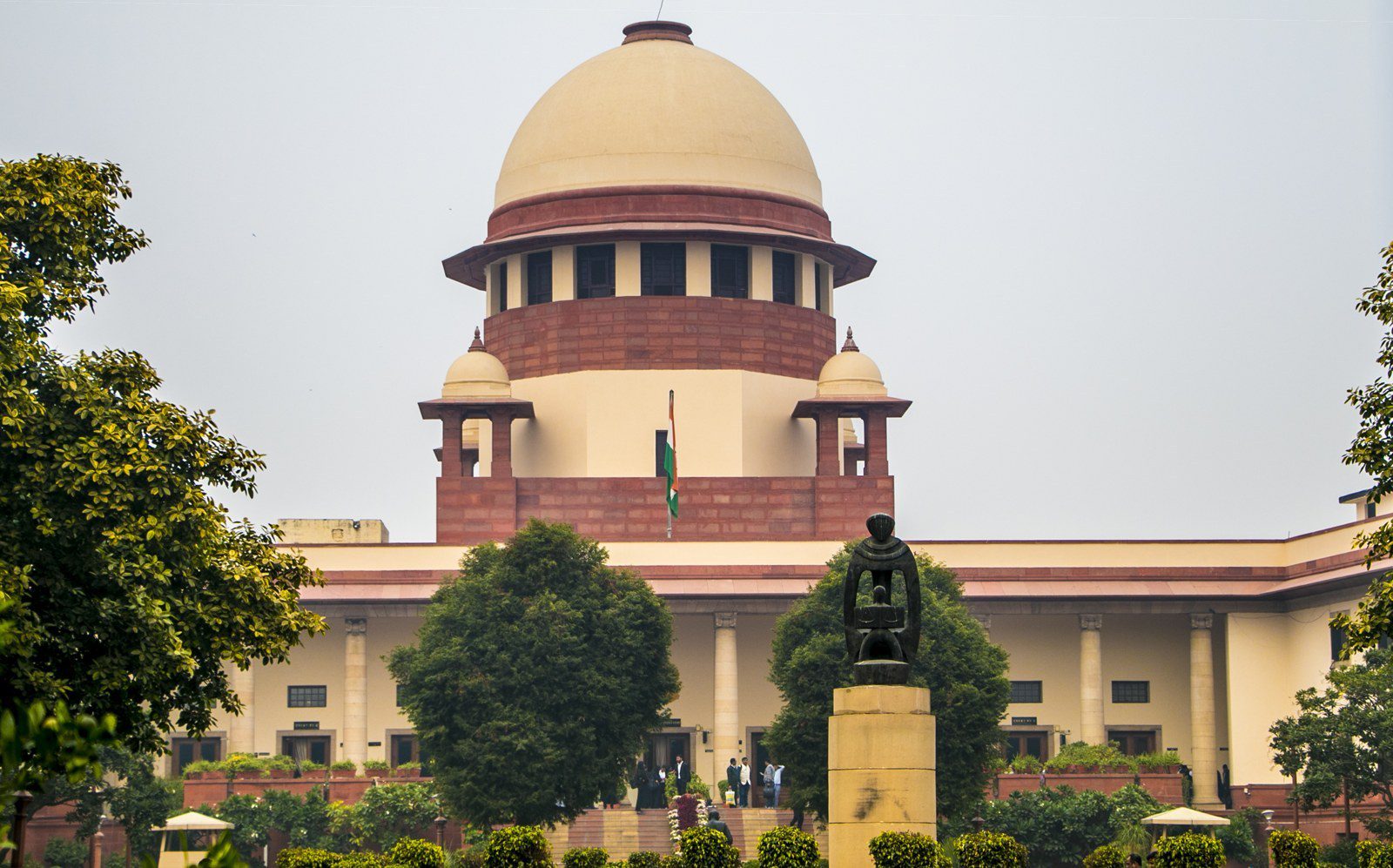
CURRENT AFFAIRS | 14 OCTOBER 2026
The Supreme Court has quashed a woman’s prosecution under the Narcotic Drugs and Psychotropic Substances Act, 1985 (NDPS Act), holding that a case resting only on confessions — her own and those of her co-accused — with no recovery of contraband from her, served “no useful purpose”. Going further, the Court described a person at the end of the narcotics chain as “in one way, … a victim being last in the chain of supply”, and said the focus of enforcement must be on breaking the supply chain, not on merely punishing the user.
The order in Sanjana Bhaskaran v State of Telangana & Anr. (Criminal Appeal arising out of SLP (Crl) No. 3435 of 2026; 2026 LiveLaw (SC) 1044) was passed by a Bench of Justice J.B. Pardiwala and Justice K. Vinod Chandran and is dated Friday, 9 October 2026. The signed order was uploaded on 12 October and reported by LiveLaw on Tuesday, 13 October 2026. The appeal was brought against an order of the High Court for the State of Telangana dated 29 December 2025.
The facts
According to the order, the police received information that two persons would come to sell marijuana near a college. A police team, with two government employees deputed as independent (panch) witnesses, reached the spot in the afternoon. Two men arrived on a scooter; the appellant is said to have walked out of the college, approached them, received a cover and put it in her bag. The police then apprehended all three.
The two alleged sellers were found with a much larger quantity of marijuana in their scooter and disclosed the name of their supplier, who was also arrayed as an accused. The appellant was the fourth accused. A medical test showed she had used marijuana. The prosecution’s version was that she “voluntarily” produced the cover from her bag.
Crucially, as the Court recorded, “even according to the statements of the officers of the police team, there was no recovery made from her or from the bag which she carried.” The case against her was built on the confession of the co-accused — who had a commercial quantity with them — and on her own alleged confession.
What the Supreme Court held
The Bench made four points that together form the ratio of the order:
- Search safeguard: when the police saw her putting the cover in her bag, they “should have informed her about her right to be examined before a Magistrate” and searched only if she consented. The story that she produced the cover voluntarily, the Court said, “raises a suspicion” even about whether she knew there was contraband in it.
- Confessions: “Trite is the principle that no confession can be relied on.” With no recovery from her, the prosecution had nothing independent to stand on.
- No conscious possession: the Court found “no complicity” on her part “with respect to the allegations raised of conscious possession of narcotics”, and quashed her arraignment in the Sessions Case pending before the Special Sessions Judge (Fast Track Court).
- The user as victim: “Prosecuting such victims can have a spiralling effect and incarceration pending trial, can lead to more disastrous consequences of the victim joining the supply chain, by reason only of associations developed in prisons.” Hence: “Curbing availability and breaking the supply chain shall be the focus and not merely punishing the user, who is actually the victim.”
The State had argued that she was caught at the scene and had produced the contraband herself, and that, under a government notification, it would not press prosecution if she agreed to undergo de-addiction. The Court declined that route too: it was “not persuaded to subject the appellant to a de-addiction process”, since it found no complicity at all. It also made clear that it had not examined the case of the other accused, whose trial continues. The appeal was allowed.
Constitutional / Legal Framework
NDPS Act, 1985: India’s central drug law. It punishes production, possession, sale, transport and consumption of narcotic drugs and psychotropic substances, with punishment graded by quantity graded by small, intermediate and commercial quantitymdash; small, commercial and the range in between. Section 20 deals with cannabis; for ganja, the notified small quantity is 1 kg and commercial quantity 20 kg.
Section 27 (consumption): consuming a drug is itself an offence — up to one year or fine up to ₹20,000 (or both) for drugs such as cocaine, morphine and heroin; up to six months or fine up to ₹10,000 (or both) for any other drug, including cannabis.
Section 64A (immunity for addicts): a person charged with consumption (s.27) or an offence involving a small quantity who volunteers for de-addiction treatment at a government-run or recognised centre is immune from prosecution; the immunity can be withdrawn if treatment is not completed. Section 39 lets a court release such an addict on probation for treatment.
Section 50 (personal search): a person to be searched has the right to be taken before the nearest Gazetted Officer or Magistrate. Constitution Benches in State of Punjab v Baldev Singh (1999) and Vijaysinh Chandubha Jadeja v State of Gujarat (2011) held the duty to inform the suspect of this right is mandatory.
Confessions: a confession made to a police officer cannot be proved against the accused (s.25, Indian Evidence Act, 1872; now Section 23, Bharatiya Sakshya Adhiniyam, 2023). In Tofan Singh v State of Tamil Nadu (2020) a three-judge Bench held that NDPS officers are “police officers” for this purpose, so statements recorded under s.67 cannot be used as confessions. A co-accused’s confession is not substantive evidence and can at most lend assurance to other evidence (Kashmira Singh v State of MP, 1952; Haricharan Kurmi v State of Bihar, 1964).
Constitution: Article 21 (personal liberty), Article 20(3) (no compulsion to be a witness against oneself), Article 47 (State to endeavour to prohibit consumption of drugs injurious to health, except for medicinal purposes) and Article 136 (special leave to appeal).
Why the order matters
1. Evidence before labels. The NDPS Act contains reverse-burden presumptions — Section 35 presumes a culpable mental state and Section 54 presumes an offence from unexplained possession. But a presumption needs a foundation: possession must first be shown. Where nothing is recovered from the accused and the only material is confession, the foundation is missing, and the presumptions never begin to operate. That is the logical core of this order.
2. Procedure is substance. The Court tied the defect in the search — failing to tell her of her right to be examined before a Magistrate — to the credibility of the “voluntary production” story. In NDPS cases, where punishments are severe, procedural safeguards are the main check against wrongful prosecution.
3. A public-health lens on users. The order echoes the statute’s own design: Sections 39 and 64A already treat addicts as persons to be treated rather than jailed. The Bench’s worry is practical — pre-trial custody can push a user into the trade through prison associations. Its stated priority, supply-side enforcement, mirrors the distinction the Act draws between consumers and traffickers.
4. Limits of the ruling. This is a short order on its own facts. It does not decriminalise consumption: Section 27 remains on the statute book, and the Court expressly left the case of the other accused untouched. Its value lies in the reasoning on confessions, recovery and the treatment of users.
The CLAT Angle
CLAT legal reasoning passages often set out a principle and ask you to apply it to facts. This order supplies three testable principles:
- Principle: a confession made to the police cannot be proved against the accused. Facts: the only evidence is the accused’s statement to the police, and nothing is recovered from her. Answer: the prosecution cannot stand on that statement.
- Principle: possession under the NDPS Act means conscious possession. Being present near sellers is not, by itself, possession.
- Principle: a co-accused’s confession is not substantive evidence; it can only support other evidence.
Also note the distinction between decriminalisation (removing an offence from the statute — done only by the legislature) and the Court’s quashing of one prosecution for want of evidence. An option claiming the Court “legalised drug use” is a classic trap.
Key Facts
- Case: Sanjana Bhaskaran v State of Telangana & Anr., arising out of SLP (Crl) No. 3435 of 2026; 2026 LiveLaw (SC) 1044.
- Bench: Justice J.B. Pardiwala and Justice K. Vinod Chandran.
- Order dated 9 October 2026; reported by LiveLaw on 13 October 2026.
- Impugned order: High Court for the State of Telangana, 29 December 2025.
- No contraband was recovered from the appellant or her bag, per the police team’s own statements.
- The case rested on her alleged confession and the co-accused’s confessions.
- Court: “Trite is the principle that no confession can be relied on.”
- Her arraignment in the Sessions Case was quashed; the other accused’s case was not examined.
- The Court declined to require de-addiction, finding no complicity in conscious possession.
- Static: NDPS Act s.27 (consumption), s.64A (immunity for addicts), s.50 (search safeguard); BSA 2023 s.23 (confession to police).
Memory Hook / Mnemonic
“No BAG, No CASE” — Bag empty (no recovery), Admission to police is inadmissible (s.25 IEA / s.23 BSA), Guarantee of search before a Magistrate (s.50). Remember the Bench as “P & C” — Pardiwala and Chandran: Punish the Chain, not the Consumer.”
Practice Quiz — 10 CLAT-Style Questions
Click an option to reveal the answer and explanation.