CURRENT AFFAIRS | 21 SEPTEMBER 2026
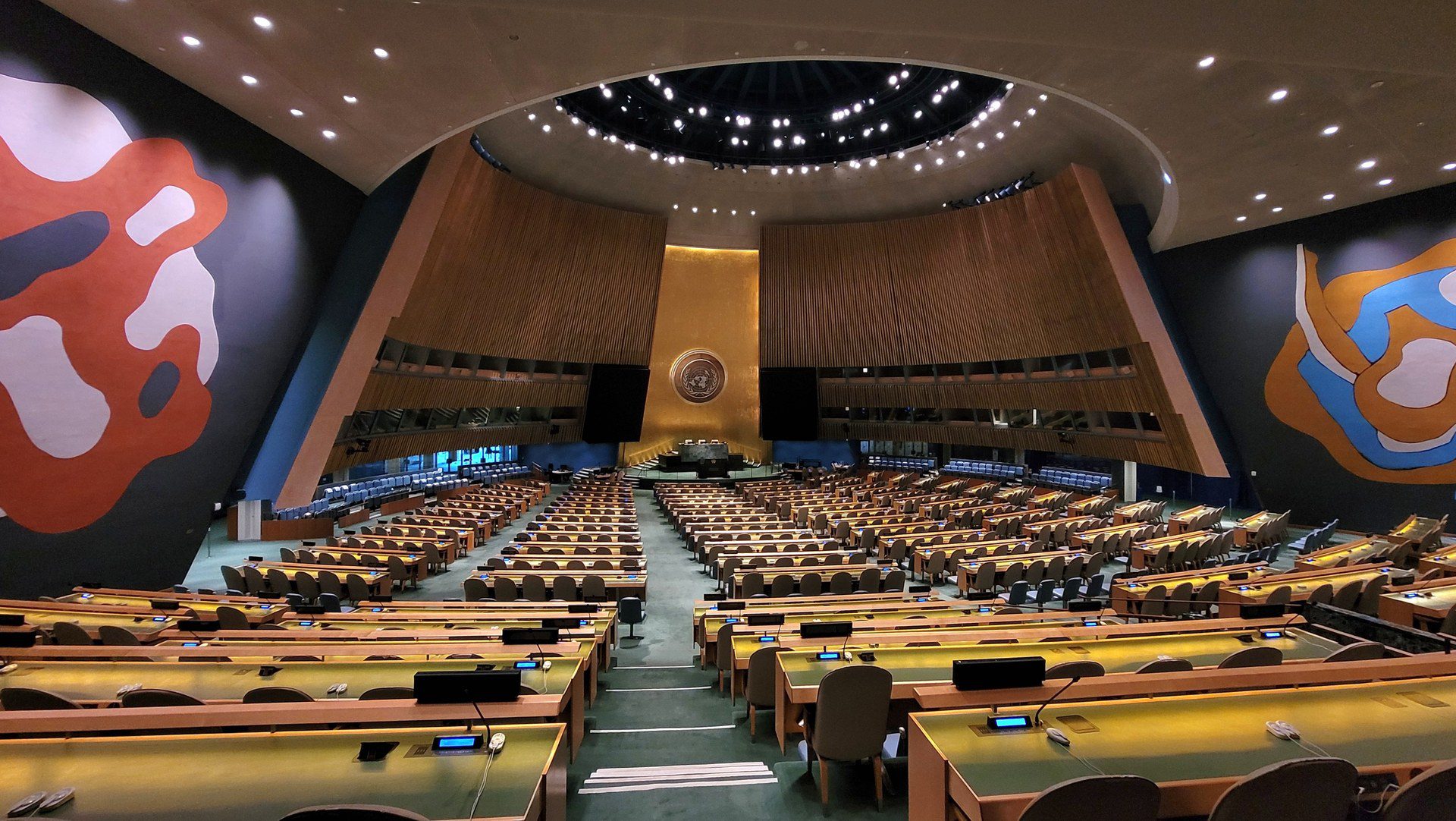
The world’s leaders converge on New York this week for the High-Level Week of the 81st session of the United Nations General Assembly (UNGA 81). According to the United Nations’ own High-level Week 2026 page, the General Debate opens on 22 September 2026 and runs to 28 September, under the theme “Restoring trust, managing transformation: A United Nations that delivers for all”. The year-long session is presided over by Khalilur Rahman, the Foreign Minister of Bangladesh, who was elected President of the General Assembly on 2 June 2026.
India’s participation was confirmed on 20 September 2026, when the Ministry of External Affairs (MEA) announced that External Affairs Minister S Jaishankar would lead the Indian delegation. In the MEA’s words, “EAM’s address at the High Level Session of the 81st United Nations General Assembly is scheduled for September 26.” The Indian Express (21 September) reported that, according to a revised provisional list of speakers, Jaishankar will speak in the afternoon session that day, that US President Donald Trump will address the Assembly on 22 September, and that the heads of government of Bangladesh and Nepal will speak on 24 September. The week also opened on a symbolic date: 21 September is the International Day of Peace, observed in 2026 under the theme “Invest in Peace – For Everyone, Everywhere, Every Day”.
What happens in High-Level Week
Every September the General Assembly opens a new regular session, and the first major item on its calendar is the General Debate — a sequence of statements by heads of state and government, and ministers, setting out their view of the world and their priorities for the year. It is the only moment in the UN calendar when virtually every one of the 193 Member States speaks from the same podium in the same week. The General Debate is framed by a theme proposed by the incoming President, which this year stresses trust in multilateral institutions and the UN’s ability to deliver.
Around the Debate, the UN convenes a cluster of high-level meetings. The UN’s schedule for 2026 lists an SDG Moment (18 September), a meeting on Climate Action and Just Transition and a commemoration of the 40th anniversary of the Declaration on the Right to Development (both 23 September), a high-level meeting on Sea Level Rise (24 September), one on Pandemic Prevention, Preparedness and Response (25 September), the 25th anniversary of the Durban Declaration against racism (28 September), and the observance of the International Day for the Total Elimination of Nuclear Weapons (29 September).
The Indian Express report places the session against a difficult backdrop: continuing conflicts, including the US–Iran war, whose disruption of shipping through the Strait of Hormuz has pushed up food and fuel costs across the Global South. For India, Jaishankar’s visit also comes days after Washington enacted a Russia sanctions law that could penalise Russia’s energy trading partners, which gives the sidelines of the Assembly a bilateral significance of their own.
The President of the 81st session
The UN’s press release of 2 June 2026 records that Khalilur Rahman won a secret-ballot contest with 99 votes to 91 for Andreas Kakouris of Cyprus — an unusually close, contested election for a post that is often filled by consensus. Under the established regional rotation, the presidency of the 81st session fell to the Asia-Pacific Group. Rahman, a career diplomat who joined Bangladesh’s foreign service in 1979 and has previously held senior UN positions, said on election that “the gap between promise and delivery remains too wide”. He succeeds Annalena Baerbock of Germany, President of the 80th session. It is the second time a Bangladeshi has held the office: Humayun Rasheed Choudhury presided over the 41st session in 1986.
Constitutional / Legal Framework
The General Assembly is created by Chapter IV (Articles 9–22) of the UN Charter, signed at San Francisco on 26 June 1945 and in force from 24 October 1945. Article 9 provides that the Assembly consists of all Members, each with not more than five representatives. Article 10 lets it discuss any matter within the scope of the Charter; Article 11 covers the maintenance of international peace and security; and Article 12 bars it from making recommendations on a dispute while the Security Council is exercising its functions on that dispute. Article 13 mandates studies for the progressive development and codification of international law (the basis of the International Law Commission). Article 17 gives the Assembly control of the UN budget.
The heart of its democratic character is Article 18: each member has one vote; decisions on “important questions” — recommendations on peace and security, elections of non-permanent Security Council members and ECOSOC members, admission, suspension and expulsion of members, and budgetary questions — need a two-thirds majority of members present and voting; other questions need a simple majority. Article 19 takes away the vote of a member whose arrears equal or exceed its contributions for the preceding two full years. Article 20 provides for regular annual sessions and special sessions; Article 21 lets the Assembly adopt its own rules of procedure and elect its President for each session; Article 22 permits subsidiary organs. GA resolutions are, as a rule, recommendatory, not binding — except on internal matters such as the budget.
India and the General Assembly
India is a founding member of the United Nations: it signed the Charter in 1945, two years before independence. Indian diplomacy has repeatedly used the Assembly as a stage. Vijaya Lakshmi Pandit became the first woman President of the General Assembly when she presided over its 8th session in 1953. Atal Bihari Vajpayee, as External Affairs Minister, addressed the Assembly in Hindi in 1977. India has also used the forum to press for reform of the Security Council, whose permanent membership still reflects the balance of power of 1945.
That reform is negotiated inside the General Assembly through the Intergovernmental Negotiations (IGN), launched in 2009. Any change to the composition of the Council requires a Charter amendment under Article 108: adoption by two-thirds of the members of the General Assembly and ratification by two-thirds of members, including all five permanent members. India, with Brazil, Germany and Japan (the G4), seeks permanent seats; the rival “Uniting for Consensus” group opposes new permanent members. The theme of UNGA 81 — a UN that “delivers for all” — sits squarely on this faultline, because the legitimacy critique of the UN is largely a critique of an unreformed Security Council.
The CLAT Angle
Expect a GK passage built on this week’s news and questions that test structure rather than trivia. Likely prompts: who presides over UNGA 81 and which country he represents; the theme of the session; the Charter article that gives each member one vote (Article 18); which decisions need a two-thirds majority; and the difference between a GA resolution and a Security Council decision under Chapter VII. In Legal Reasoning, a passage on Article 12 (the Assembly’s deference while the Council is seized of a dispute) or Article 19 (loss of vote for arrears) can be turned into a rule-application question. A classic trap: a GA resolution is not binding on Member States in the way a Chapter VII Security Council decision is. Another trap: the President of the General Assembly is not the UN Secretary-General — the PGA is elected every year by the Assembly; the Secretary-General is appointed by the Assembly on the Council’s recommendation (Article 97).
The International Day of Peace
High-Level Week opens alongside the International Day of Peace. The Day was established by the General Assembly in 1981 by resolution 36/67, and in 2001, by resolution 55/282, the Assembly fixed it on 21 September as a day of global ceasefire and non-violence. The 2026 theme, “Invest in Peace – For Everyone, Everywhere, Every Day”, was framed by Secretary-General António Guterres in his message (UN press release SG/SM/23274, 11 September 2026) as a call for deliberate investment in peace through development, dialogue and human rights, and a tribute to the “everyday” volunteers and peacekeepers who build peace from the ground up.
Analysis: why this week matters
The General Debate rarely produces binding outcomes, and critics sometimes dismiss it as a week of speeches. That misreads its function. In a body where each state, large or small, has one vote, the Debate is a public record of positions that later shape votes on resolutions, budgets and elections. The narrow 99–91 contest for the presidency is itself a sign of how divided the membership has become. The theme’s emphasis on trust and delivery reflects pressures on the UN from three directions: persistent wars that the Security Council has not been able to stop; a development agenda (the 2030 SDGs) that is behind schedule; and financial strain from unpaid assessed contributions.
For India, the Assembly is a platform to articulate the concerns of the Global South — energy and food security, debt, climate finance — and to keep Council reform on the agenda. The bilateral meetings on the sidelines matter as much as the speech, particularly with the United States over the new sanctions law.
Key Facts
- Session: 81st regular session of the UN General Assembly; General Debate 22–28 September 2026, New York.
- Theme: “Restoring trust, managing transformation: A United Nations that delivers for all”.
- President: Khalilur Rahman, Foreign Minister of Bangladesh; elected 2 June 2026 by 99 votes to 91 (Andreas Kakouris, Cyprus).
- Regional rotation: presidency of the 81st session went to the Asia-Pacific Group; predecessor was Annalena Baerbock (Germany), 80th session.
- India: EAM S Jaishankar leads the delegation; address scheduled for 26 September (MEA, 20 September 2026).
- Bangladesh and Nepal: heads of government address the Debate on 24 September (Indian Express).
- Members: 193; one state, one vote (Article 18).
- Two-thirds majority for “important questions” such as peace and security, elections to the Council, admission and budget.
- Charter basis: Chapter IV, Articles 9–22; President elected for each session (Article 21).
- International Day of Peace: 21 September; 2026 theme “Invest in Peace – For Everyone, Everywhere, Every Day”; set up by resolution 36/67 (1981), fixed on 21 September by resolution 55/282 (2001).
- First woman PGA: Vijaya Lakshmi Pandit of India, 8th session, 1953.
Memory Hook / Mnemonic
For the Charter numbers, remember “9 to 22, the Assembly’s due” — Chapter IV runs from Article 9 to Article 22. Then “18 counts, 19 cuts, 21 crowns”: Article 18 counts the votes (one each, two-thirds for important questions), Article 19 cuts the vote for arrears, Article 21 crowns a new President every session. For this year: “Eighty-one, Bangladesh in the chair, Trust and Transformation in the air.”
Practice Quiz — 10 CLAT-Style Questions
Click an option to reveal the answer and explanation.