Watch the video explainer · open on YouTube
VIDEO EXPLAINER | 8 OCTOBER 2026
Every year from 4 to 10 October, the world marks World Space Week. The theme for 2026 is “Rocket Revolution”: reusable rockets, commercial launchers and more countries reaching space. The dates are not random. Each end of the week marks a turning point in space history, one technological and one legal. This explainer covers the week, the two dates behind it, why reusable rockets matter, and India’s own journey from its first sounding rocket in 1963 to its first private orbital rocket in 2026.
1. The week and how it began
World Space Week was declared by the UN General Assembly in Resolution 54/68 on 6 December 1999. It is coordinated by the World Space Week Association (founded in 1982) together with the UN Office for Outer Space Affairs (UNOOSA). According to the Association, the 2025 edition saw about 50,000 events in 102 countries, making it the largest annual space event. Recent themes: 2023, Space and Entrepreneurship; 2024, Space and Climate Change; 2025, Living in Space.
2. The two dates
4 October 1957: Sputnik 1. On this day the Soviet Union launched Sputnik 1, the first human-made satellite to orbit the Earth. It was an aluminium sphere of about 58 cm weighing just 83.6 kg, carrying only two radio transmitters. Its beep was heard by amateur radio operators across the world, until its batteries died on 26 October 1957.
10 October 1967: the Outer Space Treaty. On this day the Outer Space Treaty entered into force. Two of its rules are exam essentials. Article II: no country can claim outer space, the Moon or other celestial bodies (no national appropriation). Article IV: no nuclear weapons or other weapons of mass destruction in orbit or on celestial bodies. India signed the treaty in March 1967 and ratified it in 1982.
3. Why “Rocket Revolution”?
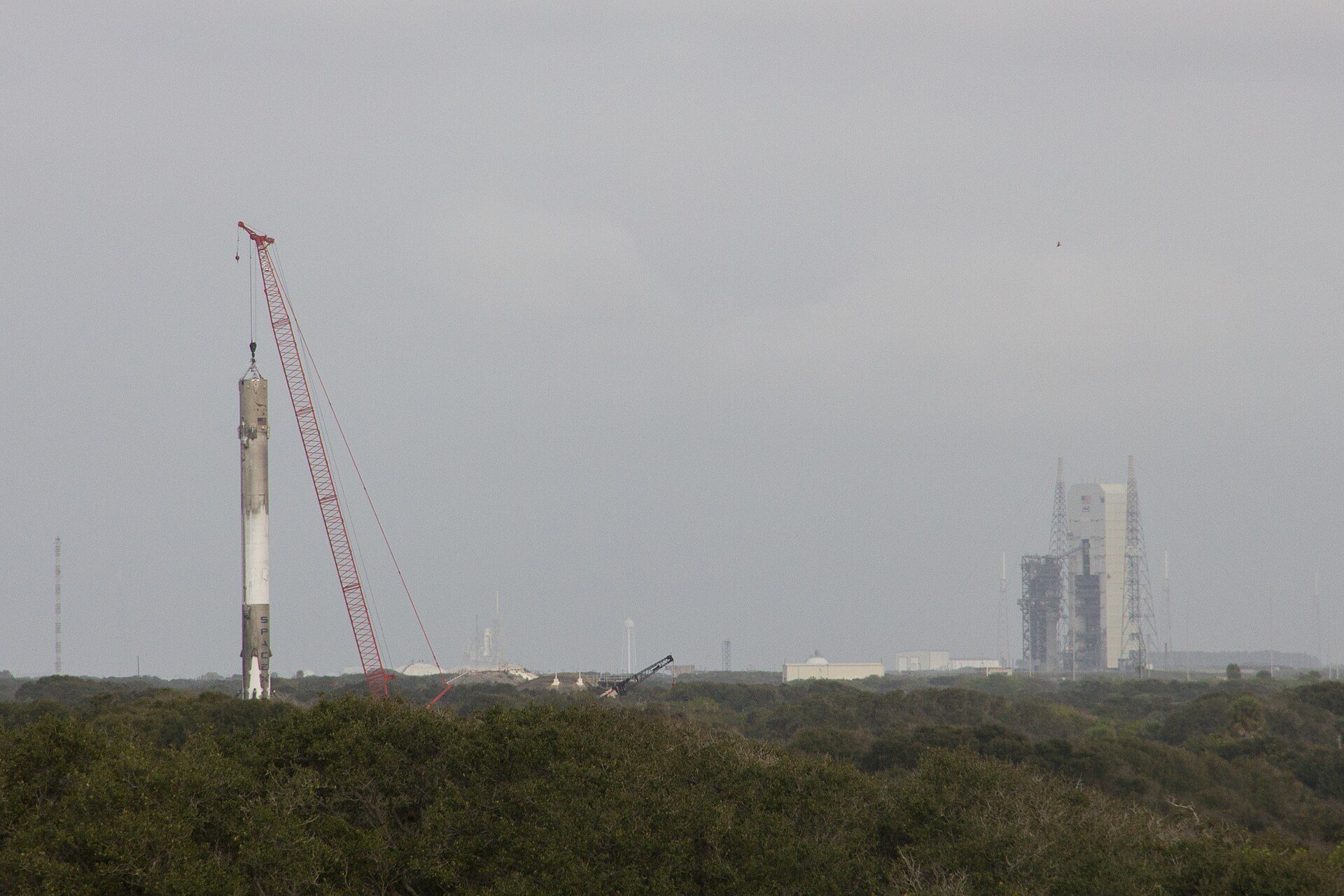
Imagine throwing away an aeroplane after every flight. For decades, that is how rockets worked: each booster was used once. On 21 December 2015, at Landing Zone 1, Cape Canaveral, a SpaceX Falcon 9 first stage became the first orbital-class booster to return and land vertically, after two earlier attempts on a drone ship had crashed. A booster that lands can fly again, and that is why launches are becoming cheaper.
4. India’s rocket story
India’s first rocket, a Nike-Apache sounding rocket, was launched on 21 November 1963 from Thumba, Kerala. A church served as the station building, and rocket parts were moved on bullock carts and bicycles.
India is now working on reusability. Pushpak, the winged vehicle of ISRO’s reusable launch vehicle technology demonstrator programme (RLV-TD), landed autonomously on a runway at about 320 km/h in the LEX-03 landing experiment on 23 June 2024 at Chitradurga, Karnataka; the next step is an orbital vehicle. ISRO’s Next Generation Launch Vehicle (NGLV), “Soorya”, will be partially reusable. The Cabinet approved it in September 2024 at a cost of ₹8,240 crore, including three development flights; it is designed to carry about 30 tonnes to low Earth orbit, with a first flight targeted around 2030.
The private sector has made history too. On 18 July 2026, Skyroot Aerospace’s Vikram-1, India’s first private orbital rocket, lifted off from Sriharikota on the mission “Aagaman” and reached orbit, delivering payloads to about 450 km. It can carry up to 350 kg to low Earth orbit and is named after Vikram Sarabhai. From bicycles to private rockets: that is India’s rocket revolution.
Legal and institutional framework
- UNGA Resolution 54/68 (6 Dec 1999): declared World Space Week, 4–10 October.
- Outer Space Treaty: in force from 10 Oct 1967; India signed in March 1967 and ratified in 1982.
- Article II: no national appropriation of outer space, the Moon or celestial bodies.
- Article IV: no nuclear weapons or other WMD in orbit or on celestial bodies.
- UNOOSA and the World Space Week Association (founded 1982): coordinate the week.
The CLAT angle
- Date pair to memorise: 4 Oct 1957 (Sputnik 1) and 10 Oct 1967 (Outer Space Treaty in force).
- A Legal Reasoning passage can apply Article II: can a country or company claim ownership of land on the Moon?
- Theme questions: 2026 Rocket Revolution; 2025 Living in Space; 2024 Space and Climate Change.
- Indian firsts: Thumba 1963 (first rocket); Vikram-1 (first private orbital rocket, 2026).
- ISRO vehicles: Pushpak (RLV-TD programme), NGLV “Soorya” (partially reusable, ₹8,240 crore).
Key facts
| Fact | Detail |
|---|---|
| World Space Week | 4–10 October every year |
| Declared by | UNGA Resolution 54/68, 6 Dec 1999 |
| 2026 theme | Rocket Revolution |
| Sputnik 1 | 4 Oct 1957; USSR; 83.6 kg |
| Outer Space Treaty | In force 10 Oct 1967 |
| First booster landing | Falcon 9, 21 Dec 2015, Cape Canaveral |
| India’s first rocket | Nike-Apache, Thumba, 21 Nov 1963 |
| Pushpak LEX-03 | 23 Jun 2024, Chitradurga |
| NGLV Soorya | Partially reusable; ₹8,240 crore |
| Vikram-1 | 18 Jul 2026, Sriharikota; first private orbital rocket |
Memory hook
“Beep to Treaty, Four to Ten.” The week opens on the beep (Sputnik, 4 Oct 1957) and closes on the treaty (Outer Space Treaty, 10 Oct 1967). For India, think Bicycle to Vikram: Thumba 1963 to Vikram-1 in 2026.
Sources
Wikipedia, “World Space Week” (citing the UN General Assembly) and SpaceNews on the week, its themes and the Association; the UNOOSA text of the Outer Space Treaty; Wikipedia, the Library of Congress and other references on Sputnik 1; SpaceNews, Space.com and the Planetary Society on the Falcon 9 landing; ISRO’s LEX-03 release and NewsOnAir on Pushpak; PIB (18 Sep 2024) on the NGLV; Space.com, Via Satellite and Wikipedia on Vikram-1; VSSC and other references on Thumba.
Free in the CLAT Gurukul app
These notes (as a PDF lesson) and the 10-question CBT are in the app under Current Affairs → 8 Oct 2026. Get the app on Google Play or open app.clatgurukul.com.
Practice Quiz — 10 CLAT-Style Questions
Click an option to reveal the answer and explanation.