CURRENT AFFAIRS | 15 OCTOBER 2026
On Sunday, 11 October 2026, Iran said that the United States’ reply to its proposal for reopening the Strait of Hormuz was “insufficient”. According to The National and Iran International, both citing Iranian state media, the secretary of Iran’s Supreme National Security Council said Washington had accepted some of Iran’s conditions, while others remained unresolved.
For a law aspirant, the key point is the US ground for rejecting one of Iran’s ideas: ships should have free passage under international law. That brings into focus one of the most testable provisions of the law of the sea: Article 38 of the United Nations Convention on the Law of the Sea (UNCLOS), 1982, which grants the right of transit passage through straits used for international navigation.
What Iran said on 11 October
According to The National (11 October 2026), the Iranian official said the United States had approached Tehran through three channels over the past two months — Pakistan, Qatar and Iraq — asking Iran to present its proposals for reopening the strait. Iran said that “about two weeks ago” it had communicated seven conditions to the United States, adding that the strait would not be opened until those conditions were met.
In Iran’s account, the reply accepted some conditions but left others open, and Washington still had to clarify issues that remained ambiguous.
One detail is especially relevant for international law. According to The National, the United States has rejected Tehran’s proposal that Iran and Oman jointly manage the waterway, “saying ships should have free passage under international law.” Oman sits on the southern side of the strait.
How the strait came to be closed
The National reported that Tehran “effectively blocked the strait by attacking ships and laying mines” after being attacked by Israel and the United States in February 2026, and that the United States responded by imposing a blockade of Iranian ports.
India’s stake became sharper on 12 October 2026. According to a Press Trust of India report carried by Business Standard, the Ministry of External Affairs (MEA) said two merchant vessels with 22 Indian crew members had come under attack in the Strait of Hormuz region. The MEA stated that “freedom of navigation and the safe, unimpeded flow of maritime commerce through international waterways, in accordance with international law, must be upheld,” and called for de-escalation through dialogue and diplomacy.
Latest: attacks rise, flows fall (14 October)
On 14 October 2026, Al Jazeera reported that Iran’s navy said it had deployed units in a new formation east of the Strait of Hormuz and across the Sea of Oman and the Arabian Sea for “real time surveillance” of maritime traffic. The report said the UK Maritime Trade Operations (UKMTO) centre had recorded 15 attacks between 6 and 14 October, and that, according to the tracking firm Kpler, only 2.9 million barrels of oil passed through the strait on 11 October, against nearly 20.8 million barrels on 8 October.
Constitutional / Legal Framework
UNCLOS, 1982 — Part III (Straits used for international navigation):
- Article 34: the passage regime does not otherwise affect the legal status of strait waters or the sovereignty of bordering States, but that sovereignty is exercised subject to Part III.
- Article 37: the transit-passage section applies to straits linking one part of the high seas or an exclusive economic zone (EEZ) with another.
- Article 38(1): in such straits, “all ships and aircraft enjoy the right of transit passage, which shall not be impeded.”
- Article 38(2): transit passage means freedom of navigation and overflight “solely for the purpose of continuous and expeditious transit”.
- Article 39: ships in transit must proceed without delay and refrain from any threat or use of force against bordering States.
- Article 44: bordering States “shall not hamper transit passage”, and “there shall be no suspension of transit passage.”
Innocent passage (Part II): Article 17 gives ships of all States the right of innocent passage through the territorial sea (up to 12 nautical miles, Article 3). Under Article 19, passage is innocent so long as it is not prejudicial to the peace, good order or security of the coastal State. Under Article 25(3), a coastal State may temporarily suspend innocent passage in specified areas for security — a power that has no equivalent for transit passage.
Transit passage versus innocent passage
The distinction is the heart of the legal debate. Innocent passage is the older, narrower right. It applies in the territorial sea, it is a right of ships (Article 17), submarines must navigate on the surface and show their flag (Article 20), and the coastal State can suspend it temporarily where that is essential for its security (Article 25(3)). Transit passage, created by UNCLOS in 1982, is wider. It covers ships and aircraft, it requires only that the transit be continuous and expeditious, and under Article 44 it cannot be suspended.
The reason is practical. Because a State may claim a territorial sea of up to 12 nautical miles (Article 3), a strait narrower than 24 nautical miles can lie entirely within the territorial seas of the States bordering it. Without a special regime, passage through such a strait would fall under the weaker innocent-passage rules. Transit passage was the compromise: bordering States kept sovereignty over the waters (Article 34), but the world kept an uninterrupted right to pass through them.
The US objection to joint Iran–Oman management echoes this logic — it claims passage as a right, not as a permission. Iran’s own legal position is complicated by its treaty status. According to the UN Division for Ocean Affairs and the Law of the Sea, Iran signed UNCLOS on 10 December 1982 but has not ratified it, while Oman ratified it on 17 August 1989 and India on 29 June 1995. The UN’s chronological list of ratifications of the Convention also carries no entry for the United States. Whether transit passage binds non-parties as customary law is a classic exam-style question.
The CLAT Angle
Expect a legal-reasoning passage that sets out UNCLOS Article 38 and Article 44 with a fact pattern: a coastal State “suspends” passage through a strait linking two parts of the high seas, citing security. Applying only the principle given, the answer is that transit passage cannot be suspended. The trap option will borrow the innocent-passage rule (temporary suspension for security) and apply it to a strait.
In GK, the likely questions are factual: which waters Hormuz connects (the Persian Gulf and the Gulf of Oman), which countries border it (Iran and Oman), the year of UNCLOS (1982), and when India ratified it (1995). Do not confuse Hormuz with Bab-el-Mandeb, which links the Red Sea and the Gulf of Aden.
Why Hormuz matters to India and the world
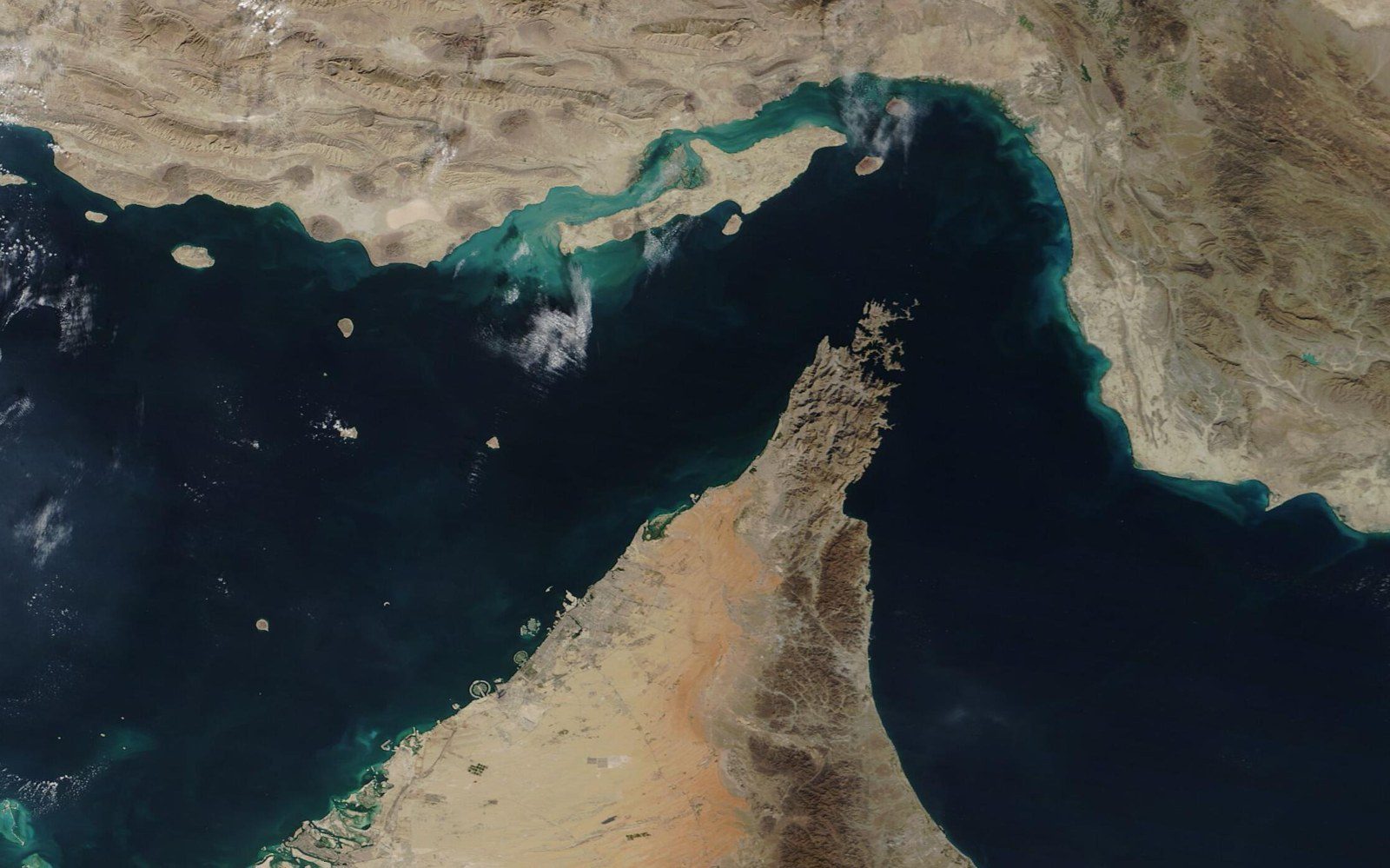
According to the US Energy Information Administration (EIA), the Strait of Hormuz lies between Oman and Iran and connects the Persian Gulf with the Gulf of Oman and the Arabian Sea. In 2024, oil flows through it averaged 20 million barrels per day, equal to about 20% of global petroleum liquids consumption. Around one-fifth of global LNG trade also transited the strait in 2024, primarily from Qatar.
The EIA adds that China, India, Japan and South Korea were the top destinations, together accounting for 69% of all Hormuz crude oil and condensate flows in 2024. That is a combined figure for four buyers, not India’s share alone.
Analysis
Two tracks are running in parallel: diplomacy through mediators and pressure at sea. Iran ties reopening to its conditions; the United States treats passage as a legal entitlement. India’s stated position is that freedom of navigation must be upheld in accordance with international law. The episode shows how a treaty rule — Article 38 — shapes a real-world dispute, even among States that have not ratified the treaty.
Watch our detailed video explainer and take its quiz: Strait of Hormuz Reopening Talks: UNCLOS and Transit Passage.
Key Facts
- 11 Oct 2026: Iran called the US reply on reopening Hormuz “insufficient” (The National, Iran International).
- Conditions: Iran said it sent seven conditions; the US accepted some, others remained unresolved.
- Channels: the US approached Iran via Pakistan, Qatar and Iraq over two months (as stated by Iran).
- Joint management: the US rejected an Iran–Oman joint-management proposal, citing free passage.
- 12 Oct 2026: MEA said two vessels with 22 Indian crew were attacked; urged freedom of navigation.
- Geography: Hormuz lies between Iran and Oman; links the Persian Gulf and the Gulf of Oman.
- Oil (EIA, 2024): 20 million b/d, about 20% of global petroleum liquids consumption.
- Asia (EIA, 2024): China, India, Japan, South Korea = combined 69% of Hormuz crude flows.
- UNCLOS Art 38: right of transit passage through international straits, “shall not be impeded”.
- UNCLOS Art 44: no suspension of transit passage; innocent passage can be suspended (Art 25(3)).
- Ratification: India 29 June 1995; Oman 17 August 1989; Iran signed 1982, not ratified.
Memory Hook / Mnemonic
“38 lets you through; 44 never shuts the door.” Article 38 grants transit passage; Article 44 says there shall be no suspension. Contrast: “Innocent can be paused, Transit cannot.” And for geography: H-O-P — Hormuz joins the Gulf of Oman to the Persian Gulf.
Practice Quiz — 10 CLAT-Style Questions
Click an option to reveal the answer and explanation.