CURRENT AFFAIRS | 09 OCTOBER 2026
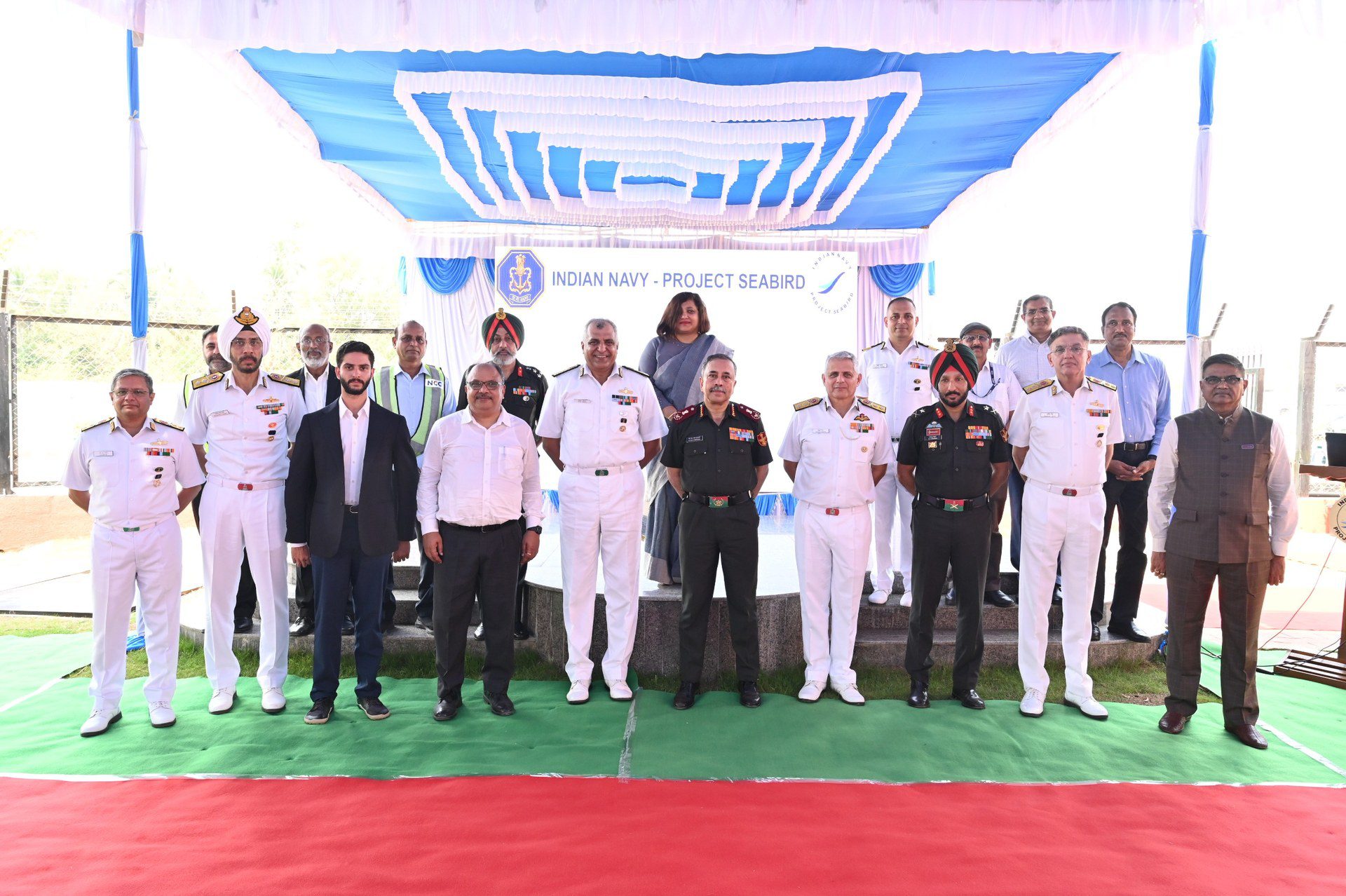
The Chief of Defence Staff (CDS), General N S Raja Subramani, who is also Secretary, Department of Military Affairs (DMA), has inaugurated new residential and utility infrastructure built under Project Seabird Phase IIA at the Naval Base, Karwar. According to a Press Information Bureau (PIB) release of the Ministry of Defence, posted on Friday, 9 October 2026, the inauguration took place on Thursday, 8 October 2026 in the presence of Vice Admiral Vivek Dahiya, Director General Seabird, and other senior officers.
The event is modest in scale — housing towers, a school and trunk utilities — but it belongs to one of the largest naval infrastructure projects India has undertaken. For a CLAT aspirant, it is a useful entry point into three linked themes: India’s maritime strategy on the western seaboard, the institutional reform that created the CDS and the DMA, and the policy language of Aatmanirbhar Bharat and green building norms that now appears in almost every defence infrastructure announcement.
What was inaugurated
The PIB release lists the facilities precisely. The residential accommodation is located at East of Manzil Creek (EOMC) and Amadalli, and consists of:
- one tower of Senior Sailors’ married accommodation comprising 60 Dwelling Units (DUs);
- one tower of 60 DUs for Naval Defence Civilians;
- in-living accommodation for 156 DSC personnel; and
- a KG (kindergarten) school.
Alongside these, the CDS opened “critical trunk utility and amenity infrastructure” — the roads, water, power and similar backbone networks that a growing base needs. The release names the builders: the residential accommodation with amenity facilities was constructed by M/s NCC Ltd, Hyderabad, and the trunk infrastructure by M/s Cemindia Projects India Ltd.
DSC here refers to the Defence Security Corps, the force that guards defence installations. Accommodation for sailors, civilians and security staff may sound routine, but a naval base is only as functional as the people it can house near the waterfront. Housing and utilities are what turn berths and dockyards into a working base.
The bigger picture: Phase IIA of Project Seabird
The release places these facilities within the ongoing Phase IIA of Project Seabird, which is intended “to support basing of ships and submarines at Karwar”. According to the Ministry, the scope of the phase includes:
- a dual-use Naval Air Station (that is, one usable for both military and civil flights);
- a full-fledged Naval Dockyard; and
- logistics facilities for ships and aircraft.
The Ministry adds that the naval base, housing approximately 10,000 uniformed and civilian personnel with families, will boost the local economy, industry and tourism and create direct and indirect jobs in the Uttara Kannada region.
Two further points in the release are worth noting. First, the project conforms to the norms of the Ministry of Environment, Forest & Climate Change (MoEF&CC) and the Indian Green Building Council (IGBC), and upon completion would be IGBC Gold rated. Second, it aligns with Aatmanirbhar Bharat, sourcing over 90% of materials and equipment domestically.
Background & Framework
Project Seabird is the codename for the development of the Indian Navy’s base at Karwar on the west coast. The base was commissioned as INS Kadamba in 2005, and has been expanded in phases since; the current work belongs to Phase IIA. The idea behind a dedicated base at Karwar was to give the Navy’s western forces a home away from congested commercial harbours, with deep water and room to grow.
Chief of Defence Staff (CDS): The post was created in 2019 as part of higher-defence reform, and became functional with the first CDS, General Bipin Rawat, assuming office on 1 January 2020. The CDS is the Permanent Chairman of the Chiefs of Staff Committee, the principal military adviser to the Defence Minister on tri-service matters, and acts as first among equals with the three Service Chiefs. The CDS does not exercise operational command over the Services.
Department of Military Affairs (DMA): A department within the Ministry of Defence, created alongside the CDS post, and headed by the CDS as its Secretary. This is why the PIB release describes General Raja Subramani as “CDS and Secretary, DMA”. The DMA’s mandate centres on jointness — integrating procurement, training, logistics and staffing across the Army, Navy and Air Force.
Why this matters: analysis
1. Maritime strategy on the western seaboard. A base that can berth both ships and submarines, and that adds its own dockyard and air station, is designed to be self-sufficient. A dockyard allows repair and refit close to where vessels operate, cutting turnaround time; an air station supports maritime surveillance and naval aviation. Read together, the elements listed in the release show a base being built for sustained operations rather than occasional use.
2. People as infrastructure. The inaugurated assets are homes, a kindergarten and utilities. Modern militaries increasingly treat the welfare and retention of trained personnel as a capability in itself. Married accommodation for senior sailors and housing for defence civilians signal that the base is moving from a construction site to a settled community of some 10,000 people with families.
3. Dual use and the local economy. The phrase “dual-use Naval Air Station” matters. Dual-use infrastructure allows defence assets to support civilian connectivity as well, which is why the Ministry links the project to economic, industrial and tourism gains for the Uttara Kannada region. This illustrates a recurring theme in public policy: defence spending justified partly by its spill-over benefits.
4. Self-reliance and sustainability as standard language. The “over 90% domestic sourcing” claim and the target of an IGBC Gold rating show how two policy goals — Aatmanirbhar Bharat and environmental compliance — are now written into project descriptions. A careful reader should note what kind of claim each is: the IGBC Gold rating is stated as something the project “would be” upon completion, i.e. a future target, not an achieved certification.
5. Jointness in practice. It is significant that a tri-service head — the CDS, an Army officer by background — inaugurated a naval project. Under the post-2019 structure, the CDS and DMA oversee matters that cut across the Services, including works and infrastructure priorities. The event is a small, visible example of the jointness the reform was meant to build.
The CLAT Angle
GK questions can be direct: Which project is associated with the Karwar naval base? (Project Seabird.) Which officer is Secretary of the Department of Military Affairs? (The CDS.) Which phase of Project Seabird is under way? (Phase IIA.) What rating does the project aim for? (IGBC Gold.)
Passage-based questions may test precision of language. If a passage states the project “would be IGBC Gold rated upon completion”, an option claiming the project “has been certified IGBC Gold” goes beyond the passage. Likewise, the 10,000 figure refers to personnel with families to be housed at the base — not new jobs created.
Logical reasoning passages could frame an argument — “defence infrastructure boosts local economies” — and ask for an assumption (that spending and employment stay in the region) or a weakener (that most materials and labour come from outside the region).
Static GK links
Indian Navy commands: The Navy has three commands — Western Naval Command (Mumbai), Eastern Naval Command (Visakhapatnam) and Southern Naval Command (Kochi). Karwar lies on the western seaboard, facing the Arabian Sea.
Indian Green Building Council (IGBC): Part of the Confederation of Indian Industry (CII), it runs green building rating programmes in India with levels such as Certified, Silver, Gold and Platinum.
Aatmanirbhar Bharat: The self-reliance initiative announced in 2020, under which defence procurement and construction have increasingly prioritised domestic sourcing.
Key Facts
- Who: General N S Raja Subramani, CDS and Secretary, DMA.
- Where / when: Naval Base, Karwar; inaugurated on 8 October 2026 (PIB release posted 9 October 2026).
- Project: Project Seabird, Phase IIA.
- Present: Vice Admiral Vivek Dahiya, Director General Seabird.
- Location of housing: East of Manzil Creek (EOMC) and Amadalli.
- Housing: 60 DUs for Senior Sailors (married) + 60 DUs for Naval Defence Civilians + in-living accommodation for 156 DSC personnel + a KG School.
- Builders: NCC Ltd, Hyderabad (residential); Cemindia Projects India Ltd (trunk infrastructure).
- Phase IIA scope: dual-use Naval Air Station, full-fledged Naval Dockyard, logistics for ships and aircraft.
- Scale: base to house approx. 10,000 uniformed and civilian personnel with families.
- Green norms: MoEF&CC and IGBC norms; IGBC Gold rating on completion.
- Self-reliance: over 90% of materials and equipment sourced domestically.
- Static: base commissioned as INS Kadamba (2005); CDS post created 2019, first CDS took office 1 January 2020.
Memory Hook / Mnemonic
“SEABIRD 60-60-156, 90 & GOLD” — two towers of 60 homes each, 156 DSC personnel, 90% made in India, IGBC Gold on completion.
Phase IIA = “A-D-L”: Air Station (dual-use), Dockyard, Logistics.
The bird that nests at Karwar is called Kadamba; the man who cut the ribbon wears two hats — CDS and Secretary, DMA.
Practice Quiz — 10 CLAT-Style Questions
Click an option to reveal the answer and explanation.