CURRENT AFFAIRS | 26 SEPTEMBER 2026
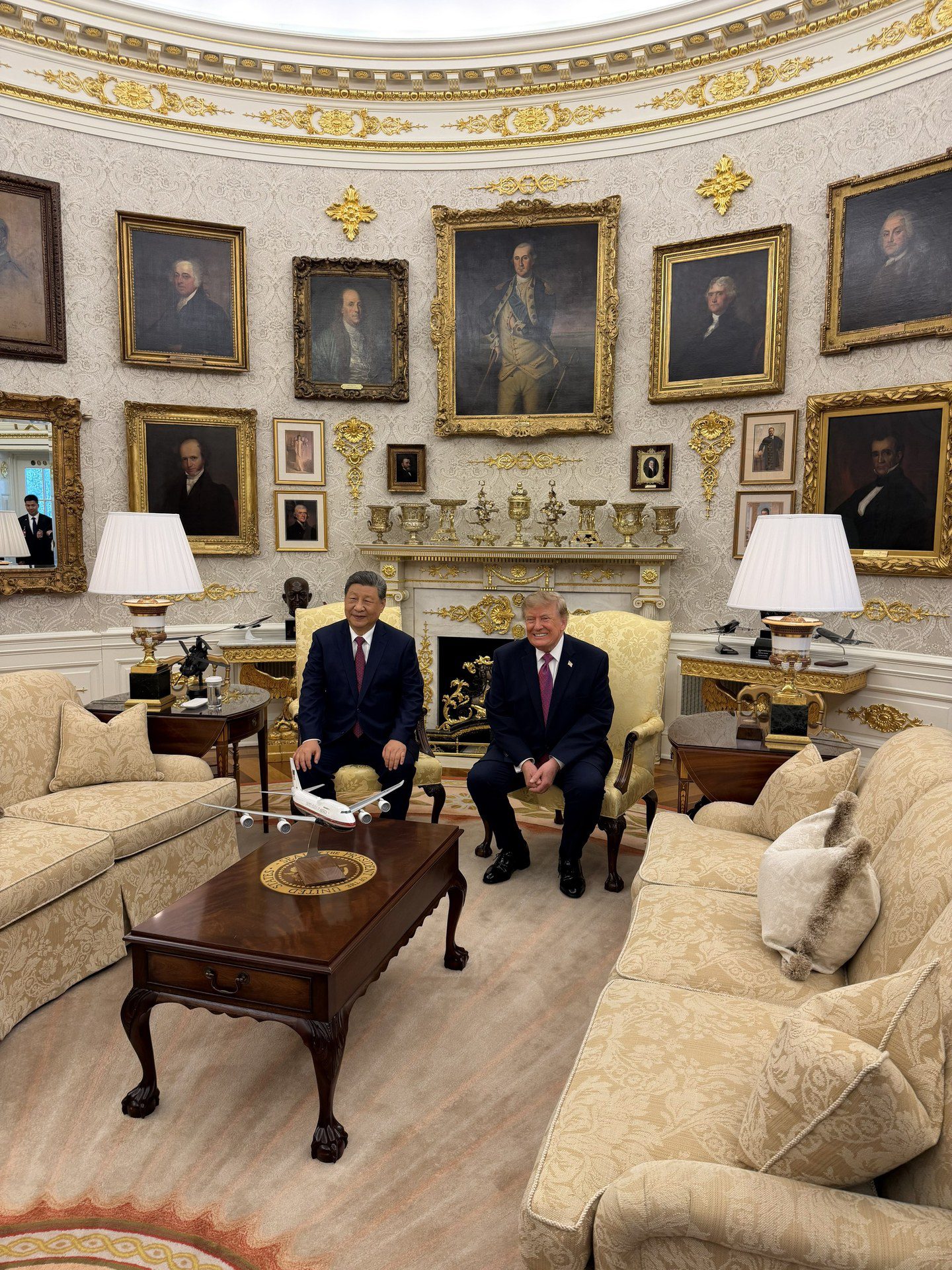
On 25 September 2026, US President Donald Trump and Chinese President Xi Jinping closed a three-day state visit by Xi to Washington with tea in the White House Red Room and a tour of the National Archives, where the two leaders viewed the US Declaration of Independence, the Constitution and the Bill of Rights. According to the Reuters report carried by The Indian Express and ThePrint, the summit “showcased personal diplomacy rather than big breakthroughs in economic relations”. Xi described the US–China relationship as having developed into a constructive one of “strategic stability on the basis of respect, fairness and reciprocity”, and said the two leaders would meet twice more before the year ends — at the APEC summit in China and the G20 summit in Miami.
The visit was Xi’s first to Washington in more than a decade. Al Jazeera reported that Trump personally received him on arrival on the evening of Wednesday, 23 September, at Joint Base Andrews — the first time a US President had welcomed a foreign leader there in 11 years. Formal talks and a state dinner in the East Room followed on Thursday, 24 September. The Indian Express editorial of 26 September noted that this was the leaders’ third meeting in less than a year. For CLAT aspirants, the summit is a compact case study in how the world’s two largest economies manage rivalry through trade truces, diplomatic language and summit sequencing.
What the summit produced — and what it did not
The headline outcome was on trade. Ahead of the formal talks, US Treasury Secretary Scott Bessent said the two sides had agreed to extend by two months the trade truce that was due to expire on 10 November, pushing it to 10 January, to give “both sides more time” to explore a larger agreement (Reuters). This truce is the arrangement reached when Trump and Xi met in Busan, South Korea, in October 2025, which paused the escalating tariff war. The Indian Express editorial pointed out that China’s suspension of its rare-earth export restrictions was also due to end in November — which is why the extension matters beyond tariffs.
Reuters reported that Beijing was meeting its commitment to buy 25 million tons of soybeans but was lagging on a pledge to buy $17 billion of other agricultural goods, and that US officials felt rare-earth deliveries were also lagging. On 25 September, US Trade Representative Jamieson Greer told CNBC that the two countries were “in a managed trade situation” and that fuller details of the limited agreements would be released the following Monday. Greer said the two sides had agreed to exempt some key goods from trade disputes, including US exports to China of agricultural products and medical devices, and imports of consumer and non-sensitive goods.
Beyond trade, the summit’s substance was thin. The Indian Express editorial summarised it through the “three Ts” that now define the relationship — trade, technology and Taiwan — and concluded that little of substance was achieved on any of them, with pageantry appearing to be the main objective.
Taiwan: the language of “prudence”
According to China’s official news agency Xinhua, as reported by Reuters, Xi pressed Trump to “handle the Taiwan question with prudence” and urged the US to oppose “Taiwan independence”. The distinction is diplomatic but significant. For decades Washington’s formulation has been that it does not support Taiwanese independence; Beijing wants the stronger word “oppose”. Reuters also noted that Xi wants the US to halt arms sales to the island, and that an arms package for Taiwan worth about $14 billion is on hold. Al Jazeera reported that Trump had earlier described military aid to Taiwan as a negotiating chip with Beijing. No change in stated US policy was announced at the summit.
Background & Framework
US–China relations rest on a set of foundational documents. The Shanghai Communiqué (1972), issued during President Nixon’s visit, recorded that the US “acknowledges” that Chinese on both sides of the Taiwan Strait maintain there is but one China. The US formally recognised the People’s Republic of China on 1 January 1979, and Congress then passed the Taiwan Relations Act, 1979, which governs unofficial US–Taiwan ties and commits the US to make available defensive arms to Taiwan. A third communiqué in 1982 addressed arms sales. Together these underpin the US “One China policy”, which differs from Beijing’s “One China principle”: the US acknowledges Beijing’s position without endorsing it. That is why a shift from “does not support” to “opposes” independence would be read as a real policy change. On the economic side, APEC (Asia-Pacific Economic Cooperation, founded 1989) has 21 member economies, and the G20 (founded 1999) groups the major economies; the US holds the G20 presidency in 2026.
Artificial intelligence: cooperation in name, divergence in substance
Both leaders identified artificial intelligence as an area for cooperation, but Reuters recorded diverging views. Trump said in a social media post that he wanted to leave AI regulation “exactly where it is” and rely on the US Department of Justice rather than impose new guardrails. Xi said that, as the leading nations on AI, China and the US must manage its growth.
The Indian Express editorial flagged precisely this as the area of greatest risk. Neither Washington nor Beijing, it argued, has much incentive to constrain a technology both see as a source of strategic power, and the history of arms control offers little reason to expect concessions. Its specific worry for India was that a US–China AI dialogue “could evolve into a framework in which the two leading powers set the rules for everyone else” — and it recommended that New Delhi prioritise cooperation with allies and indigenous capability.
The “Thucydides Trap” and the idea of managed stability
According to Reuters, Xi invoked the “Thucydides Trap” — the thesis that competition between a rising and an established power tends towards war — while saying the risk “can be overcome”. Al Jazeera quoted him as saying the relationship “should be a race of catching up with one another, not a wrestle”. The phrase comes from the ancient Greek historian Thucydides’ account of the Peloponnesian War between Athens and Sparta, and was popularised in modern international relations by the American political scientist Graham Allison.
The Indian Express editorial described the current approach as “managed stability”: a strategy that suits both sides for now, since the US is heavily reliant on China’s critical minerals and Beijing wants an open US market for its goods. But it warned that managed stability can let unresolved tensions accumulate, making a future rupture harder to contain. Other issues surfaced at the margins: US Ambassador to China David Perdue told CNBC that Trump had made clear that any Chinese help to Iran, direct or indirect, was “totally unacceptable”. Trump said only that the two had discussed Iran and “I think we’re going to do great”.
The CLAT Angle
A GK passage on this summit would most likely test precise vocabulary and sequence: the phrase “strategic stability”, the two-month truce extension (10 November to 10 January), the Busan origin of the truce, and the next two meeting venues (APEC in China, G20 in Miami). Static follow-ups are predictable: the Taiwan Relations Act (1979), the Shanghai Communiqué (1972), the difference between “One China policy” and “One China principle”, the Thucydides Trap, and APEC’s 21 economies. In Critical Reasoning, the editorial’s argument is a model structure: premise — both sides need each other (minerals, markets); conclusion — neither will tackle fundamental disputes; qualification — this stability may store up risk. Expect questions asking which statement would weaken the claim that managed stability is fragile, or which assumption underlies the fear that two powers could “set the rules for everyone else”.
Why it matters for India
India watches US–China summitry for three reasons. First, supply chains: a truce that keeps China’s rare-earth export curbs suspended affects every economy dependent on those minerals, including India’s electronics and electric-vehicle manufacturing. Second, rule-setting in technology: as the Indian Express editorial argued, a bilateral AI understanding between the two leaders could shape global norms without the participation of other major economies. Third, strategic balance in the Indo-Pacific: any softening in US language on Taiwan would be read across Asia as a signal about American commitments in the region. India’s stated preference, reflected in its approach to groupings like the Quad and its emphasis on strategic autonomy, is a multipolar order in which no bilateral pair sets the terms.
Analysis: symbolism as policy
The summit illustrates a pattern in great-power diplomacy: when substantive agreement is hard, summit sequencing itself becomes the product. Announcing two further meetings — APEC in China and the G20 in Miami — creates deadlines that keep negotiators working and markets calm. The truce extension buys time rather than settling disputes. Critics in the US Congress, as Reuters and Al Jazeera reported, objected that the lavish welcome was not matched by concessions. Supporters argued that dialogue reduces the risk of conflict. For a CLAT reader, the balanced conclusion is that the summit stabilised the relationship in the short term without resolving the three core issues of trade, technology and Taiwan.
Key Facts
- Summit concluded on 25 September 2026 with tea in the White House Red Room and a tour of the National Archives.
- Xi’s visit to Washington lasted three days; it was his first visit to Washington in more than a decade.
- Trump received Xi at Joint Base Andrews on 23 September; talks and a state dinner followed on 24 September.
- Xi’s phrase: “strategic stability on the basis of respect, fairness and reciprocity”.
- Trade truce extended by two months: from 10 November to 10 January (Scott Bessent).
- The truce dates from the Trump–Xi meeting in Busan, South Korea, in October 2025.
- China meeting its 25 million tons soybean commitment; lagging on $17 billion of other farm purchases (Reuters).
- USTR Jamieson Greer: a “managed trade situation”; exemptions for farm products, medical devices and consumer goods.
- Xi urged the US to handle Taiwan “with prudence” and oppose Taiwan independence; a ~$14 billion Taiwan arms package is on hold.
- Next meetings: APEC summit in China and G20 summit in Miami later in 2026.
- Xi invoked the Thucydides Trap, saying the risk “can be overcome”.
Memory Hook / Mnemonic
“TEA with 3 Ts” — the summit ended over TEA (Red Room + Archives) and left the three Ts — Trade, Technology, Taiwan — unresolved. Truce dates: “10 to 10” (10 November → 10 January). Next stops: “A-G” — APEC in China, then G20 in Miami. Taiwan key: US says “does not support”; Beijing wants “oppose”.
Practice Quiz — 10 CLAT-Style Questions
Click an option to reveal the answer and explanation.