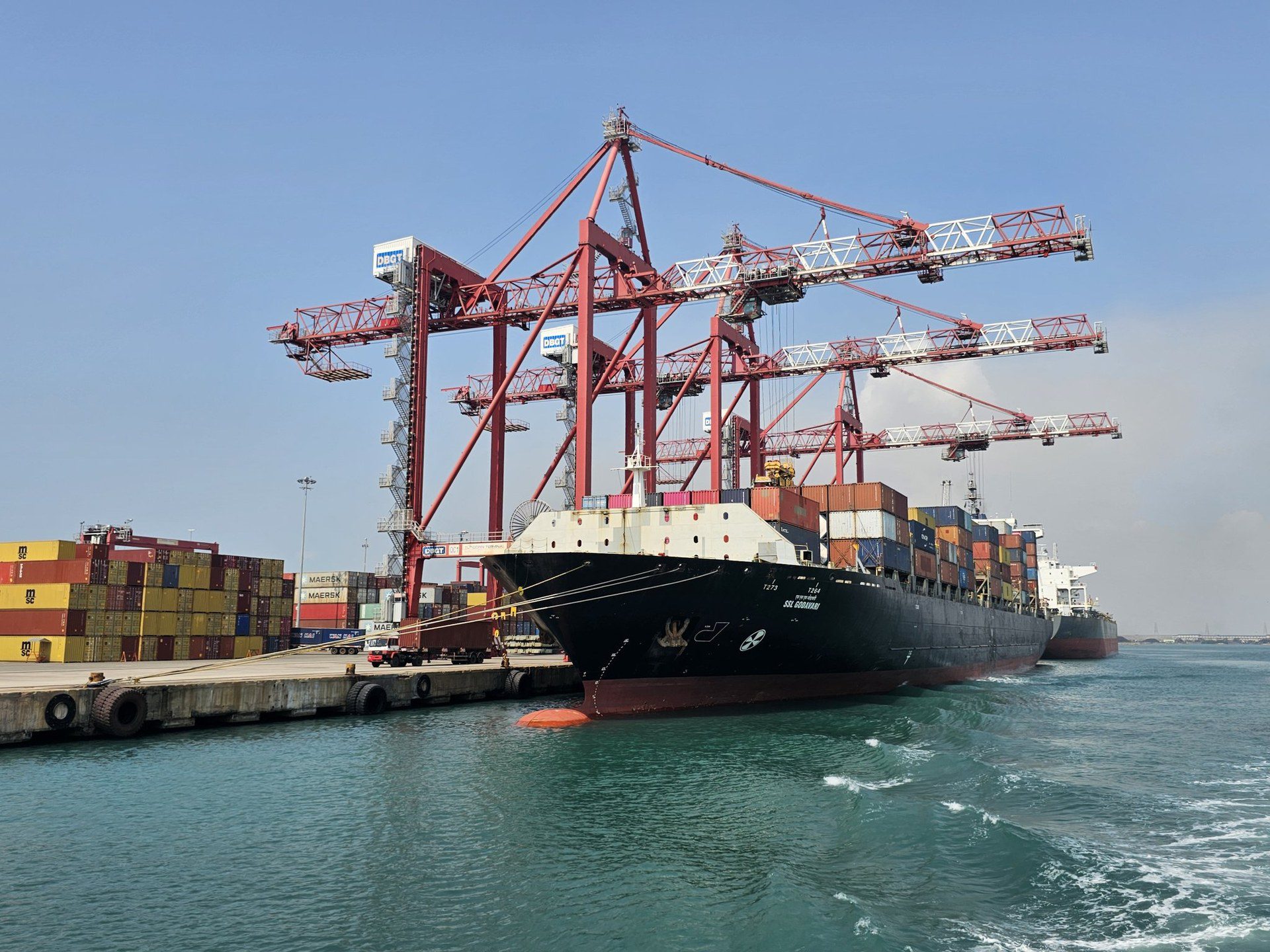
CURRENT AFFAIRS | 26 SEPTEMBER 2026
On 25 September 2026 the Supreme Court held that when a bareboat (demise) charter is validly terminated, the charter comes to an end on termination itself — the owner does not have to physically repossess the ship first. On that basis the Court vacated the arrest of the vessel M.V. Nereus Progress. A Bench of Chief Justice Surya Kant, Justice Joymalya Bagchi and Justice V. Mohana, with the judgment authored by the Chief Justice, decided Owners and Parties Interested in M.V. Nereus Progress v. Om Freight Forwarders Ltd., reported by LiveLaw as 2026 LiveLaw (SC) 991. The ruling set aside the view of the Madras High Court, which had refused to release the ship on the footing that a demise charter ordinarily continues until physical repossession.
The Court’s central sentence is short and quotable: “termination and repossession are two different things”. For CLAT, this is a textbook exercise in reading a contract and a statute together — the sort of legal-reasoning passage in which a principle is given, facts are supplied, and the candidate must decide whether the principle applies on a particular date.
The facts, in sequence
According to the LiveLaw report of the judgment, the timeline was as follows:
- Nereides Marine Services held the vessel under a demise charter on the industry-standard BIMCO BARECON 2017 form.
- After the charterer defaulted on hire, the owner issued an Anti-Technicality Notice on 6 November 2025 — a notice giving the charterer a last chance to cure the default before termination.
- The owner terminated the charter on 13 November 2025 under Clause 31 of BARECON.
- A Repossession Notice followed on 19 November 2025.
- Before the owner physically took the ship back at Tuticorin, Om Freight Forwarders Ltd. obtained an order of arrest on 4 December 2025, claiming dues arising from a separate charter arrangement with Nereides.
The question was therefore whether, on 4 December, Nereides was still the “demise charterer” of the ship. If it was, the vessel could be arrested for Nereides’ debts; if the charter had already ended on 13 November, it could not.
Constitutional / Legal Framework
The governing statute is the Admiralty (Jurisdiction and Settlement of Maritime Claims) Act, 2017. It consolidated India’s admiralty law and replaced colonial-era statutes, including the Admiralty Court Act, 1840, the Admiralty Court Act, 1861, the Colonial Courts of Admiralty Act, 1890 and the Colonial Courts of Admiralty (India) Act, 1891. Admiralty jurisdiction is exercised by the High Courts named in or notified under the Act — broadly, the High Courts of the coastal States, including the Madras High Court.
Section 4 lists the maritime claims for which a court may exercise jurisdiction. Section 5 governs the arrest of a vessel in an action in rem to secure such a claim. The Court examined Section 5(1)(b) read with Section 5(2). Broadly, Section 5(1)(b) allows a vessel to be arrested where the demise charterer at the time the claim arose is liable for it and is still the demise charterer (or has become the owner) when the arrest is effected. Section 9 separately lists the maritime liens that rank first in priority.
Under the contract, Clause 31 of BARECON 2017 governed termination on default, and Clause 32 provided that after termination the charterer holds the vessel “as gratuitous Bailee only” for the owner.
What the Supreme Court held on bareboat charter termination
The Court read Section 5(1)(b) as requiring a continuing status: the person liable must be the demise charterer both when the claim arose and when the arrest is made. On the facts, Nereides had ceased to be the demise charterer on 13 November 2025 when the owner validly terminated the charter. By 4 December 2025, the date of arrest, the statutory condition was no longer satisfied.
The High Court had reasoned that because Nereides was still physically in control of the ship, the charter continued. The Supreme Court rejected this by reading BARECON Clause 32 together with the termination clause. After termination, the charterer’s possession changes character: it is no longer possession as a charterer, but custody as a gratuitous bailee for the owner. In the Court’s words as reported, “Nereides could not have simultaneously held the Vessel both as a ‘demise charterer’ and a ‘gratuitous bailee’.”
The consequence followed directly. Since the charterer was not the demise charterer on the date of arrest, the ship could not be arrested for its debts under Section 5(1)(b), and the arrest order was vacated. The judgment does not extinguish Om Freight Forwarders’ underlying claim against Nereides; it only holds that this particular ship could not be used as security for that claim.
Understanding the key concepts
Bareboat or demise charter. In a demise charter, the owner hands over the ship itself — usually without crew — and the charterer takes full possession and control, appointing the master and crew and bearing operating costs. For the period of the charter, the charterer is treated almost as if it were the owner. That is why admiralty law allows claims against a demise charterer to be enforced against the ship. By contrast, in a time charter or voyage charter, the owner keeps possession and control through its own crew; the charterer only buys the use of the ship’s carrying capacity.
Action in rem and in personam. An action in personam is against a person. An action in rem is, in form, against the thing itself — here, the ship. Arrest of a vessel is the characteristic remedy: the ship is detained within the court’s jurisdiction so that it serves as security for the claim. Because ships move between jurisdictions and owners may be abroad, the in rem action gives claimants a practical way to obtain security.
Maritime claim versus maritime lien. A maritime claim is a category of claim for which a vessel may be arrested, subject to conditions such as those in Section 5. A maritime lien is a stronger, privileged right that attaches to the ship and generally travels with it even if ownership changes. The Act lists maritime liens separately in Section 9. Om Freight Forwarders’ claim was treated as depending on the demise-charterer route under Section 5(1)(b), which is why the date on which the charter ended became decisive.
Bailment. Indian law defines bailment in Section 148 of the Indian Contract Act, 1872 as the delivery of goods by one person to another for some purpose, on a contract that they shall be returned or otherwise disposed of when the purpose is accomplished. A gratuitous bailment is one without reward. Labelling the post-termination charterer as a gratuitous bailee captured the idea that it was merely looking after the ship for the owner until handover.
The CLAT Angle
This judgment is ideal for a principle–facts question. A likely principle: “A vessel may be arrested for a claim against its demise charterer only if that person remains the demise charterer when the arrest is effected.” Facts: charter terminated on day 1, arrest on day 20, charterer still in physical possession. Correct answer: the arrest is not sustainable, because termination — not physical repossession — ends the charter.
Watch for a trap option that says “the arrest is valid because the charterer was in possession”. The Court has drawn the line between legal status (charterer) and physical fact (possession). A second trap: treating vacation of the arrest as a finding that the creditor has no claim at all. It is not; the claim survives in personam.
The ruling also tests a general skill: reading a statute and a contract together. The statutory condition (“demise charterer when arrested”) is answered by the contract (Clause 31 terminates; Clause 32 converts possession to gratuitous bailment).
Why the ruling matters beyond this ship
Indian ports, including Tuticorin, handle a steady flow of vessels on bareboat charters, and arrest is a common remedy for suppliers, agents and freight forwarders. Commercial parties need a clear rule about when a ship stops being exposed to a charterer’s debts. A rule tied to physical repossession would make that date uncertain and would expose an owner, who has already ended the contract, to the charterer’s later liabilities for as long as the charterer delays handing back the ship. The Supreme Court’s approach ties the answer to a documented legal act — a valid termination under the contract — which is easier to prove and to predict.
The judgment also emphasises that the termination must be valid. Here, the owner followed the contractual sequence: an anti-technicality notice, then termination under Clause 31, then a repossession notice. A defective or premature termination would not have produced the same result, and future disputes will likely turn on whether that contractual procedure was followed.
Finally, the ruling reflects the broader aim of the 2017 Act: to give India a modern, self-contained admiralty code in place of nineteenth-century imperial statutes, and to align Indian practice with how shipping contracts are actually written in international trade. BIMCO forms such as BARECON are used worldwide, so a clear Indian reading of their termination clauses has value for foreign owners deciding whether to trade into Indian ports.
Key Facts
- Date of judgment: 25 September 2026.
- Bench: CJI Surya Kant (author), Justice Joymalya Bagchi, Justice V. Mohana.
- Case: Owners and Parties Interested in M.V. Nereus Progress v. Om Freight Forwarders Ltd., 2026 LiveLaw (SC) 991.
- Vessel: M.V. Nereus Progress; physical repossession was pending at Tuticorin.
- Charter form: BIMCO BARECON 2017; charterer Nereides Marine Services.
- Anti-Technicality Notice 6 Nov 2025; termination 13 Nov 2025; Repossession Notice 19 Nov 2025; arrest 4 Dec 2025.
- Provision: Section 5(1)(b) read with Section 5(2), Admiralty Act, 2017.
- Holding: valid termination ends the demise charter without physical repossession.
- Post-termination status of charterer: gratuitous bailee (BARECON Clause 32).
- Result: Madras High Court order set aside; arrest vacated.
- Bailment defined in Section 148, Indian Contract Act, 1872.
Memory Hook / Mnemonic
“Paper ends it, not the gangway.” The charter ends when the termination notice is validly served, not when the owner walks up the gangway to take the ship back.
Dates: 6 – 13 – 19 – 4 → Warn, Terminate, Repossess-notice, Arrest (“W-T-R-A: Water”). By the time of the Arrest, the charter was already over.
Practice Quiz — 10 CLAT-Style Questions
Click an option to reveal the answer and explanation.