
CURRENT AFFAIRS | 22 SEPTEMBER 2026
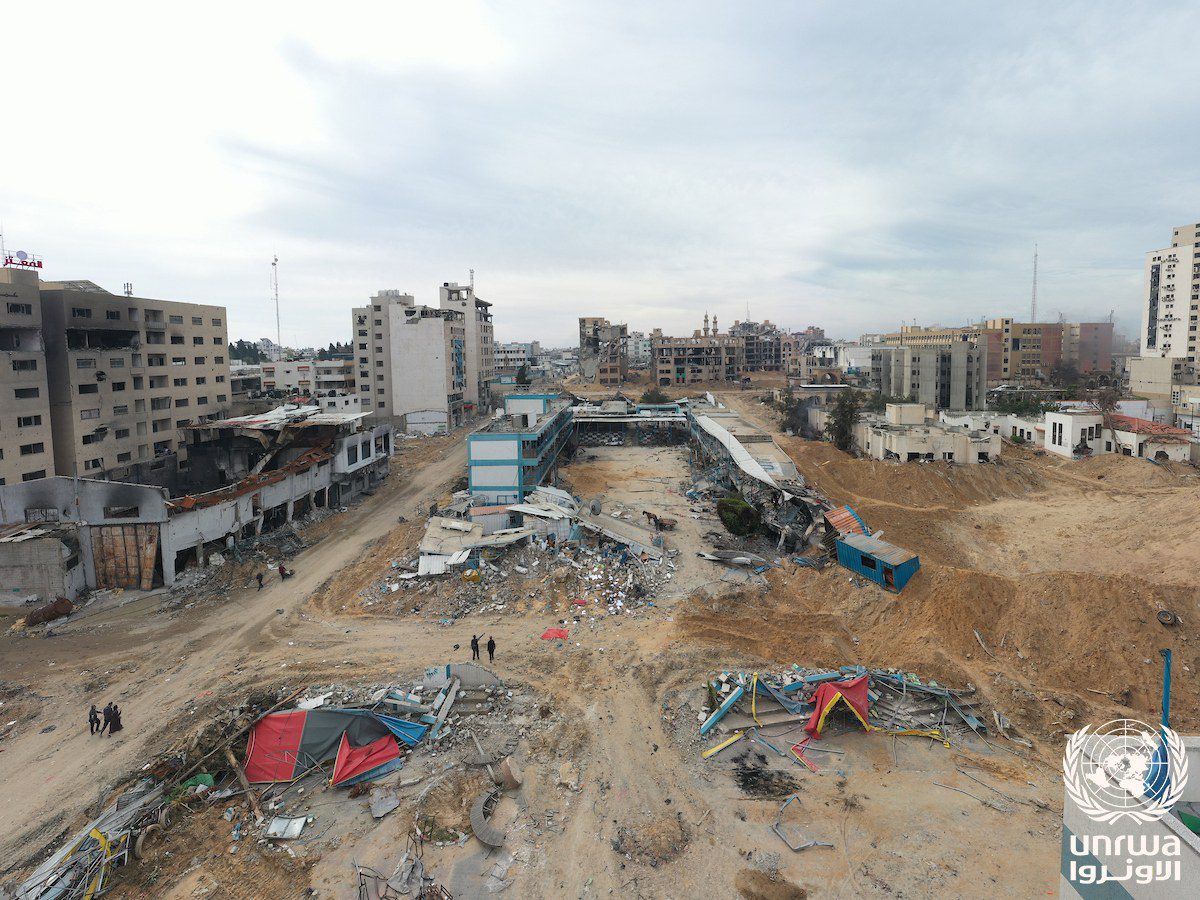
On Saturday, 19 September 2026, hundreds of thousands of children in the Gaza Strip returned to in-person teaching for the first time in nearly three years. According to a Reuters report filed from Cairo and Gaza on 21 September and carried by The Indian Express on 22 September, classes resumed in damaged or makeshift buildings and in tents, and many families could not afford uniforms, notebooks or pens. The United Nations Children’s Fund (UNICEF) says 98% of schools in Gaza were either destroyed or damaged during the war, and Gaza education officials say about 660,000 students have been deprived of in-person learning and regular participation in education.
The reopening marks the start of the 2026–27 academic year. The Ministry of Education, backed by international and local organisations, has set up dozens of temporary schools made of tents, tarpaulins, sheet metal and wood. Some stand on sandy ground; some classrooms have only mattresses and a blackboard; others are still sheltering displaced families. At least 540,000 students are expected to attend in-person classes this year in makeshift private schools, temporary learning centres and “educational points”, with UNICEF support, while online learning will continue for those who cannot attend or who left Gaza during the war. For a CLAT aspirant, the story is a compact case study in how international humanitarian law, UN agencies and the human right to education fit together — and how India’s own constitutional guarantee of education is framed.
What the numbers say
The figures in the Reuters report come from different sources, and a careful reader should keep them apart. The 98% damage figure is attributed to UNICEF. The 660,000 students deprived of in-person schooling and the 540,000 expected to attend this year are attributed to Gaza education officials. Casualty figures in the education sector — around 22,000 students and more than 770 education workers, including 532 teachers, killed — were given by Ibrahim Ramadan, director of education for East Khan Younis. Reuters also recorded that a notebook which used to cost 3 shekels now costs 15, with a stationery trader blaming import restrictions; Israel’s COGAT agency, which controls access to Gaza, did not respond to a request for comment. Reuters notes that Israeli forces remain in control of more than 60% of Gaza despite last year’s ceasefire, which halted major fighting but did not end the conflict.
The gap between 660,000 and 540,000 is itself instructive: even with the new term under way, a large share of the school-age population is not expected back in a physical classroom this year.
Constitutional / Legal Framework
International humanitarian law (IHL) governs conduct during armed conflict. The Fourth Geneva Convention of 1949 deals with the protection of civilians in time of war, and Additional Protocol I (1977), in Article 52, gives general protection to civilian objects — a category that includes schools unless they are being used for military purposes. The Rome Statute of the International Criminal Court lists, among war crimes, intentionally directing attacks against buildings dedicated to education. In the UN system, Security Council Resolution 1612 (2005) set up a monitoring and reporting mechanism on children and armed conflict built around six grave violations, one of which is attacks on schools and hospitals.
International human rights law runs alongside IHL. The UN Convention on the Rights of the Child (CRC), adopted on 20 November 1989, recognises in Article 28 the right of every child to education and requires primary education to be compulsory and available free to all; Article 38 addresses children in armed conflict. India acceded to the CRC in 1992. At home, Article 21A, inserted by the 86th Constitutional Amendment Act, 2002, makes free and compulsory education for children aged 6 to 14 a fundamental right, given effect by the Right of Children to Free and Compulsory Education Act, 2009, in force from 1 April 2010.
The UN agencies involved
UNICEF was created by the UN General Assembly on 11 December 1946 as the United Nations International Children’s Emergency Fund, originally to help children in post-war Europe and Asia. It later became a permanent part of the UN system and dropped “International” and “Emergency” from its name while keeping the familiar acronym. It is headquartered in New York and was awarded the Nobel Peace Prize in 1965.
UNRWA — the United Nations Relief and Works Agency for Palestine Refugees in the Near East — was established by General Assembly Resolution 302 (IV) of 8 December 1949 and began operations in 1950. Education has historically been its largest programme: it runs schools for Palestine refugee children in Gaza, the West Bank, Jordan, Lebanon and Syria. Many UNRWA school buildings in Gaza were turned into shelters for displaced families during the war, which is one reason reopening classrooms is not simply a matter of unlocking doors.
UNICEF’s own framing of the problem predates this week’s reopening. In a press release dated 27 January 2026, titled “Rebuilding hope”, UNICEF announced an expansion of its ‘Back to Learning’ programme to reach about 336,000 school-age children. It said then that more than 90% of schools had been damaged or destroyed and that about 60% of school-aged children lacked access to in-person learning. The programme works with the Palestinian Ministry of Education, UNRWA and other partners, and combines reading, writing and mathematics with mental-health and psychosocial support. UNICEF spokesperson James Elder described education in Gaza as “lifesaving”, because a learning centre is also a safe space in a dangerous territory.
The CLAT Angle
Current affairs: expect direct questions on the date and scale of the return (19 September 2026; “nearly three years”), the 98% figure and its source (UNICEF), and the 660,000 students deprived of in-person learning. Static GK pairs naturally: UNICEF (1946, New York, Nobel 1965), UNRWA (1949), the CRC (1989, Article 28), SDG 4 and the Geneva Conventions (1949).
Legal reasoning: a principle-fact question could state that civilian objects are protected unless used for military purposes, and then ask whether a school turned into a shelter for displaced families loses protection (it does not — sheltering civilians is not a military use). Another could test Article 21A: the right belongs to children aged 6–14 and the State must provide it “in such manner as the State may, by law, determine” — hence the RTE Act. Reading comprehension: the Reuters story is built on attributed claims; inference questions will test whether you can separate UNICEF’s data, local officials’ data and students’ testimony.
Education as a right, not a service
The legal significance of Gaza’s reopening lies in the idea that education is a right that survives conflict. The CRC does not suspend Article 28 during war; states and other duty-bearers are expected to protect it as far as possible. The UN’s 2030 Agenda (adopted in September 2015) sets Sustainable Development Goal 4: to ensure inclusive and equitable quality education and promote lifelong learning opportunities for all. Humanitarian agencies increasingly treat education as a core emergency response alongside food, water and health — because a child out of school for three years may never return, and because a school offers routine, protection and psychosocial support.
India’s constitutional journey offers a useful comparison. Education was originally placed among the Directive Principles: the original Article 45 asked the State to endeavour to provide free and compulsory education for all children up to 14 within ten years. The Supreme Court then read a right to education into the right to life under Article 21 in the early 1990s, and Parliament made it an express fundamental right through the 86th Amendment. The same amendment rewrote Article 45 to focus on early childhood care and education for children below six, and added Article 51A(k), a fundamental duty on parents and guardians to provide opportunities for education to their children aged 6–14. The progression — from aspiration, to judicial interpretation, to express right, to statute — is the same arc that international law has followed for the right to education.
Key Facts
- 19 September 2026 (Saturday): Gaza children returned to in-person teaching for the first time in nearly three years (Reuters, 21 Sep).
- 98% of Gaza’s schools destroyed or damaged — UNICEF.
- About 660,000 students deprived of in-person learning — Gaza education officials.
- At least 540,000 students expected to attend in-person classes in 2026–27, with UNICEF support.
- Temporary schools built of tents, tarpaulins, sheet metal and wood; online learning continues.
- UNICEF ‘Back to Learning’ (press release 27 Jan 2026): target of about 336,000 school-age children.
- UNICEF: created 11 December 1946; HQ New York; Nobel Peace Prize 1965.
- UNRWA: UNGA Resolution 302 (IV), 8 December 1949; operations from 1950.
- CRC 1989: Article 28 — right to education; Article 38 — children in armed conflict; India acceded 1992.
- Fourth Geneva Convention (1949): protection of civilians; Additional Protocol I (1977), Article 52 — civilian objects.
- SDG 4: inclusive and equitable quality education for all by 2030.
- Article 21A: 86th Amendment, 2002; RTE Act, 2009 (ages 6–14).
Analysis: a fragile milestone
Reuters called the reopening a “fragile milestone”, and the reasons are structural. Buildings are the most visible gap, but not the only one. Teachers have been killed or displaced; learning materials are scarce and expensive; many schools are still housing families who have nowhere else to go; and children carry the psychological weight of years of conflict. One student quoted by Reuters said he would learn “even in a tent”; another described being afraid of stray bullets and strikes on the way to school.
There is also a question of measurement. UNICEF’s January release said more than 90% of schools were damaged or destroyed; the figure cited in September is 98%. Rather than treating this as a contradiction, a careful reader would note that the two figures come from different points in time and may rest on different assessments; the direction of change is what the data consistently show. Distinguishing a genuine inconsistency from a time-series update is a critical-reasoning skill the CLAT rewards.
Finally, neither UNICEF nor UNRWA can compel a ceasefire or rebuild schools on its own; both depend on voluntary funding and on access. Yet their work on temporary learning spaces, materials and teachers is what makes a school year possible at all. For India, which relies on a statutory entitlement under the RTE Act, the comparison is a reminder that a right on paper needs institutions, funds and safety to become a classroom in fact.
Memory Hook / Mnemonic
“98 – 660 – 540 – 3 years”: 98% schools hit (UNICEF), 660,000 kept out, 540,000 coming back, after nearly 3 years.
Dates ladder — “46 – 49 – 65 – 89”: UNICEF born 1946; Geneva Conventions and UNRWA 1949; UNICEF Nobel 1965; CRC 1989 (Article 28 = education). India’s version: 86th Amendment → Article 21A → RTE 2009, ages 6–14.
Practice Quiz — 10 CLAT-Style Questions
Click an option to reveal the answer and explanation.