CURRENT AFFAIRS | 22 MAY 2026
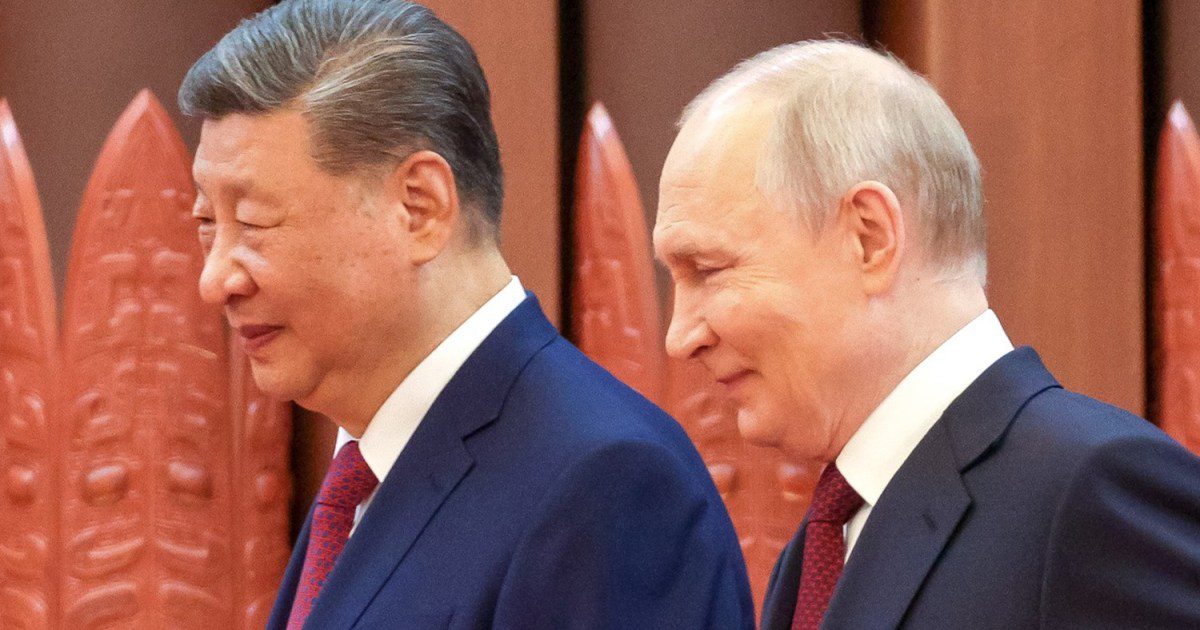
Russian President Vladimir Putin concluded a three-day visit to Beijing on 20 May 2026, signing more than 40 cooperation agreements with Chinese President Xi Jinping across energy, technology, investment, transport, space, and digital. The headline document was a joint declaration on “the formation of a multipolar world and international relations of a new type,” running close to 10,000 words. The summit landed exactly one week after US President Donald Trump’s own three-day China visit — making Beijing the diplomatic centre of gravity for two of the world’s most consequential bilateral relationships in a single month.
For India, the geopolitics are sharp. Russia is India’s largest defence supplier and a long-standing strategic partner. China is India’s largest land border challenge and second-largest trading partner. The US is India’s largest single export destination. When Russia and China move closer, and when the US-China track also shifts, Delhi’s room to manoeuvre — and to balance — narrows.
The Power of Siberia question
The summit’s central energy story was not what was signed, but what was not. Russia has been pushing the proposed Power of Siberia 2 pipeline — a 2,600-km route through Mongolia carrying gas from the Yamal fields of western Siberia to China — as the geo-economic centrepiece of post-Ukraine pivot to Asia. The pipeline would partially replace volumes lost when Russia’s gas exports to Europe collapsed after 2022.
Kremlin spokesman Dmitry Peskov said the two sides had agreed on “basic parameters of understanding” — the route and construction process — but no start date and no agreed gas price. Power of Siberia 1, by contrast, has been operational since 2019, carrying gas from East Siberian fields to Heilongjiang province in northeastern China over a 3,000-km route. Russia wants PoS-2 to lock in similar long-term volumes. China is in no rush.
Constitutional & Legal Framework
Article 51 of the Indian Constitution — Directive Principle of State Policy. The State shall endeavour to (a) promote international peace and security; (b) maintain just and honourable relations with nations; (c) foster respect for international law and treaty obligations; (d) encourage settlement of international disputes by arbitration.
UN Security Council P5 — United States, United Kingdom, France, Russia, China. Each holds veto power. Russia inherited the USSR’s seat in 1991; China’s seat shifted from the Republic of China (Taiwan) to the People’s Republic of China in 1971.
BRICS — Brazil, Russia, India, China, South Africa (formed 2009; SA joined 2010). Expanded in 2024-25 to include Egypt, Ethiopia, Iran, UAE, Indonesia.
SCO — Shanghai Cooperation Organisation. India became a full member in 2017 alongside Pakistan; Iran joined in 2023. Includes Russia, China, India, Pakistan, Kazakhstan, Kyrgyzstan, Tajikistan, Uzbekistan, Belarus, Iran.
Trade reshape: how deeply Russia has tilted East
Before the 2022 invasion of Ukraine, the European Union accounted for about 32% of Russia’s total trade — close to $228 billion. By 2025, that share with the EU had fallen to single digits. In its place, China now absorbs roughly 32% of Russia’s total trade — close to $700 billion. Two-thirds of that bilateral commerce is settled in yuan or roubles, not dollars. Russia has become, in the words of Sergei Lavrov, China’s “junior partner with senior history.”
The “no-limits partnership” was declared by Putin and Xi on 4 February 2022 — days before Russian tanks crossed into Ukraine. Four years later, the partnership is now operationally manifest: in BRICS expansion, in SCO consolidation, in yuan-rouble settlement, and in coordinated diplomatic positions on Iran, North Korea, and US sanctions architecture.
India’s strategic options
Delhi’s position is delicate. India and China reached a Line of Actual Control (LAC) framework agreement on patrolling in October 2024 — easing the four-year-long military standoff that began with the Galwan clashes in June 2020. Border management talks have resumed. Special Representatives have met. But mutual strategic suspicion runs deep.
India’s three options, as discussed in IR commentary this week, are: (a) deepen the Russia-India-China (RIC) trilateral — last convened in 2020, sidelined since — to retain Moscow as a counterweight to a runaway China; (b) accelerate Quad engagement with the US, Japan and Australia, accepting that Trump-era unpredictability is a feature not a bug; or (c) continue the “multi-alignment” of recent years — purchasing discounted Russian oil, doing G20 leadership with the West, while keeping LAC-managed bilateral channels with China open.
CLAT 2027 Angle
International relations and international organisations are reliable CLAT-current-affairs material. Expect MCQs on: (a) UNSC structure and India’s reform demand for permanent membership (G4 — India, Germany, Japan, Brazil); (b) BRICS expansion roster (the original five plus Egypt, Ethiopia, Iran, UAE, Indonesia from 2024-25); (c) SCO members and India’s induction year (2017); (d) the Russia-China “no-limits” partnership date (4 Feb 2022); and (e) Article 51 DPSP on India’s foreign-policy orientation.
Key Facts — Russia-China Numbers
| Agreements signed (Beijing 2026) | 40+ across energy, tech, transport, digital, space |
| Power of Siberia 1 | ~3,000 km; East Siberia to Heilongjiang; operational since 2019 |
| Power of Siberia 2 | ~2,600 km; Yamal to China via Mongolia; route agreed, timeline unsettled |
| Russia-China trade share (2025) | ~32% of Russia’s total; ~$700 bn |
| “No-limits partnership” | Declared 4 February 2022 (pre-Ukraine invasion) |
Mnemonic — UNSC P5: “USA-UK-France-Russia-China”
Four of the five P5 sit on one continent (Asia + Europe). Only the USA is in the Americas. India’s G4 push (with Japan, Germany, Brazil) seeks a sixth permanent seat — but every UNSC reform attempt has been blocked by one or more P5 since 1992.
Test yourself
Practice Quiz — 10 CLAT-Style Questions
Click an option to reveal the answer and explanation.
Why this matters for CLAT 2027
CLAT typically devotes 4-6 GK passages to international affairs each year. The Putin-Xi Beijing summit is the kind of story that anchors a 5-question comprehension passage covering: institutions (UNSC, BRICS, SCO), bilateral mechanisms (Russia-China “no-limits”, India-China LAC framework, India-Russia annual summit), and economic indicators (trade share, energy pipelines, currency settlement).
Three exam-ready takeaways. First, India is the only major power that is simultaneously a member of BRICS, SCO, Quad and G20 — a unique multi-aligned footprint. This is sometimes called “strategic autonomy” or “multi-alignment.” It is tested in MCQs that ask which-of-the-following-is-India-a-member-of, where the trick is including a grouping like AUKUS (which India is not in) or NATO+ (which India has not joined).
Second, the India-China LAC framework agreement of October 2024 restored patrolling rights at Depsang and Demchok in eastern Ladakh — the two friction points that had remained unresolved after the 2020-23 phased disengagement. The agreement was finalised on the sidelines of the BRICS summit in Kazan. Prime Minister Narendra Modi and President Xi Jinping held their first bilateral meeting in five years there.
Third, the legal framework of treaty obligations. India is not a party to the Energy Charter Treaty but has bilateral investment treaties (BITs) with both Russia and China — though the China BIT was terminated in 2018 and a new one is under negotiation. The Vienna Convention on the Law of Treaties (1969), to which India is a signatory but has not ratified, governs treaty interpretation and is occasionally tested in legal reasoning.
The Putin-Xi summit will not transform Indian foreign policy overnight. But it tightens the constraints under which Delhi operates. The question for the next 18 months is whether India can leverage being simultaneously in BRICS (with Russia and China), in Quad (with the US, Japan, Australia), and in SCO (with Russia, China, and Pakistan) — or whether the contradictions of being everywhere will force a choice. CLAT comprehension passages love precisely this kind of strategic tension. Read them carefully.