CURRENT AFFAIRS | 23 JULY 2026
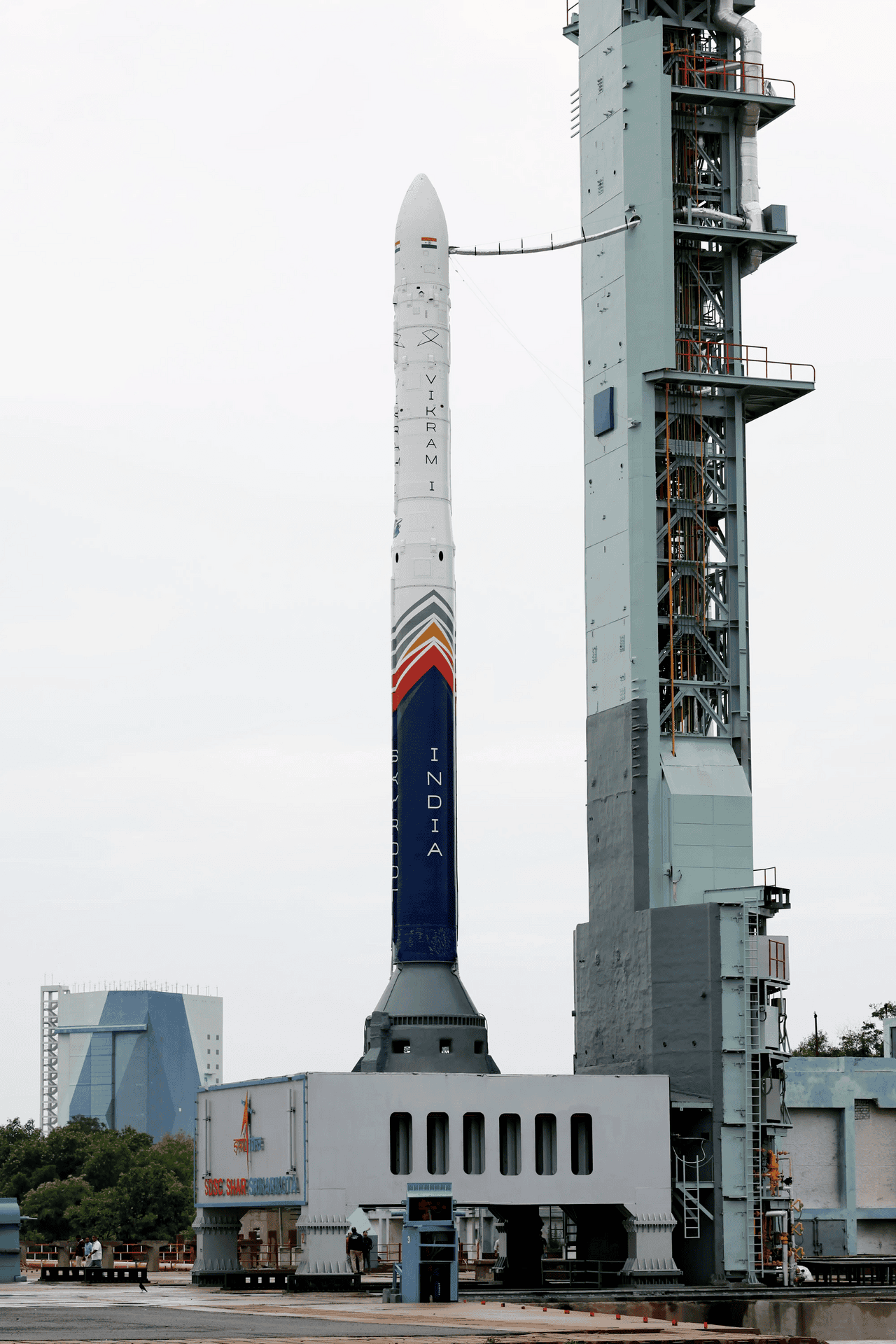
The launch of Skyroot Aerospace’s Vikram-1 marks a landmark in India’s push to open its space sector to private enterprise, demonstrating home-grown private launch capability barely half a decade after the 2020 reforms. Enabled by IN-SPACe as the authorising regulator and framed by the Indian Space Policy 2023, the mission vindicates a policy bet that private firms — not ISRO alone — can build and fly orbital-class rockets. For CLAT 2027 aspirants, the story is a rich science-and-technology GK topic that also raises questions of regulation, liability and the institutional architecture governing outer space.
| Company | Skyroot Aerospace (Hyderabad) |
| Vehicle | Vikram-1 orbital-class launch vehicle |
| Named after | Dr Vikram Sarabhai — father of India’s space programme |
| Significance | Historic leap for private launch capability in India |
| Reform year | 2020 — space sector opened to private players |
| Regulator/authoriser | IN-SPACe (under the Department of Space) |
| Policy | Indian Space Policy 2023 |
| Commercial arm of ISRO | NewSpace India Ltd (NSIL) |
A private rocket takes flight
When Skyroot Aerospace flew its Vikram-1, it did more than loft a vehicle; it validated a policy experiment. For decades, spaceflight in India was the near-exclusive preserve of ISRO, the government’s space agency. Vikram-1 — an orbital-class launcher developed by a private company — signals that Indian startups can now build and operate the most complex hardware in the aerospace world. The vehicle is named after Dr Vikram Sarabhai, the visionary widely regarded as the father of the Indian space programme, a fitting tribute for a rocket that opens a new chapter. The launch is being read as vindication of the 2020 decision to throw the sector open to private enterprise, a reform many had questioned at the time.
The 2020 reforms and why they mattered
In 2020, the government announced sweeping reforms to allow private participation across the space value chain — from building satellites and launch vehicles to providing launch and data services. The reforms recognised that ISRO’s bandwidth is finite and that a global “NewSpace” boom, led by private firms abroad, risked leaving India behind if it kept the sector closed. But opening space to private players raised an obvious problem: who ensures that a private launch is safe, licensed and compliant with India’s international commitments? The answer was a new regulator. Before the reforms, there was no single window through which a private company could seek permission to launch; after them, that gap had to be filled — and it was, by IN-SPACe.
IN-SPACe, ISRO, NSIL: who does what
The Indian Space Policy 2023 codified a clean division of labour, and understanding it is the single most exam-useful takeaway. ISRO concentrates on research, development and advanced missions — deep-space exploration, human spaceflight and cutting-edge technology. IN-SPACe — the Indian National Space Promotion and Authorisation Centre — is the single-window agency that authorises and regulates private space activity, promoting the sector while ensuring compliance. NSIL (NewSpace India Ltd) is the commercial, public-sector arm that owns ISRO-developed technology and markets it, handling commercial launches and technology transfer. Private firms like Skyroot are the new entrants that design, build and fly their own systems under IN-SPACe authorisation. In short: ISRO innovates, IN-SPACe permits and polices, NSIL commercialises, and startups execute.
The international-law dimension
Privatisation does not dissolve the state’s responsibility — it sharpens it. Under Article VI of the Outer Space Treaty of 1967, states bear international responsibility for national activities in outer space, “whether such activities are carried on by governmental agencies or by non-governmental entities.” That means India remains answerable at the international level for what Skyroot does in orbit. The Liability Convention of 1972 reinforces this by making the launching state liable for damage caused by its space objects. This is precisely why an authorising regulator like IN-SPACe is not optional but essential: the state must supervise and authorise private activity to discharge its treaty obligations. For a legal-reasoning question, the crisp principle is that international space law channels liability and responsibility to the state, so domestic regulation of private actors is the mechanism by which the state protects itself.
The caution: safeguards for ISRO
The editorial accompanying the launch flagged an important caveat: as privatisation grows, India must build institutional safeguards for ISRO. The concern is that a rush to commercialise should not hollow out the public agency that created the ecosystem, nor divert its scarce talent and infrastructure without adequate protection. A healthy model keeps ISRO focused on frontier science and strategic missions while private firms take on routine, cost-competitive launches — but that balance needs deliberate policy attention, clear rules on technology-sharing through NSIL, and a level playing field policed by IN-SPACe. This tension between promotion and protection is the sophisticated angle a well-set current-affairs question might probe.
The bigger picture
Vikram-1 is emblematic of a maturing space economy in which the government sets the rules and the private sector supplies much of the muscle. It advances the Atmanirbhar Bharat goal of self-reliant, indigenous capability and positions India to compete in the global small-satellite launch market. For the CLAT 2027 candidate, the cluster to master is compact and high-yield: Skyroot and Vikram-1; the 2020 reforms; the four-actor architecture of the Space Policy 2023; IN-SPACe as authoriser-regulator; and the Outer Space Treaty principle that makes the state responsible for private space activity. Together they turn a single launch into a full lesson on how India governs its newest frontier.
Practice Quiz — 10 CLAT-Style Questions
Click an option to reveal the answer and explanation.