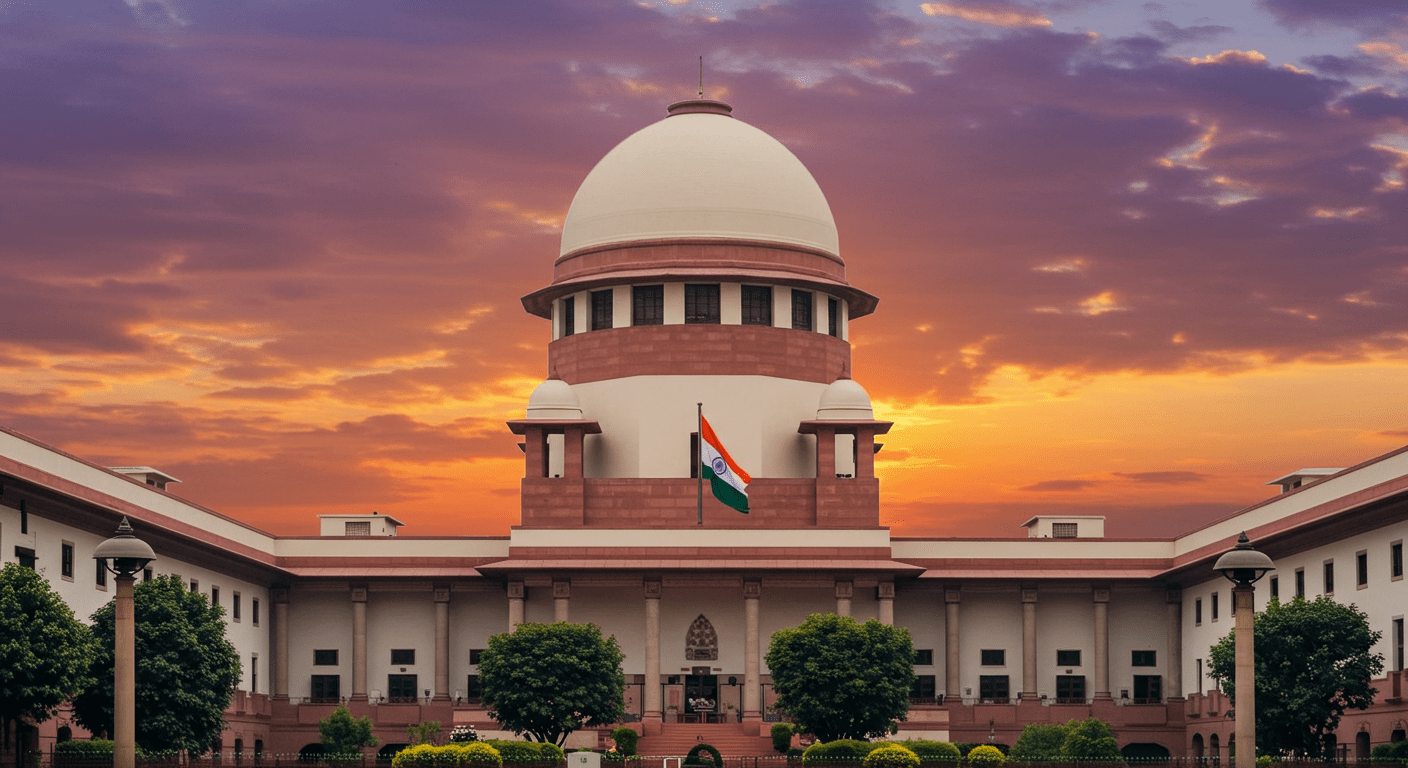
Update (22 May 2026): A Supreme Court bench of Justice JB Pardiwala and Justice R Mahadevan has questioned the Delhi High Court’s November 2025 judgment that barred law colleges from detaining students over attendance shortage. The Bench called the matter a “serious concern” for National Law Universities and asked the Bar Council of India why the order has not been appealed.
For CLAT aspirants and NLU students, this is the single most important pending case in legal education today. The outcome will reshape attendance norms for all five-year law programmes from 2026-27 onwards.
What Did the Delhi High Court Rule in November 2025?
In November 2025, a Division Bench of the Delhi High Court delivered a far-reaching judgment in a batch of writ petitions filed by Delhi University law students. The Court held that no student enrolled in a recognised law college, university or institution in India shall be detained from taking an examination or prevented from further academic pursuits solely on the ground of lack of minimum attendance.
The ruling was reported widely by Live Law, Bar and Bench, and Outlook India. The Division Bench effectively read down the BCI’s Rules of Legal Education (Rule 12, Schedule III), which require 70% minimum attendance for a student to be allowed to sit for end-semester examinations.
What Did the Supreme Court Just Say?
On 21 May 2026, the matter reached the Supreme Court via an SLP filed against the Delhi HC order by individual stakeholders. The bench of Justices Pardiwala and Mahadevan questioned why the Bar Council of India — the regulator of legal education under the Advocates Act, 1961 — had not itself moved against the Delhi HC ruling. According to Live Law, the Court observed that the Delhi HC judgment may have created “chaos” in legal education and “weakened discipline” within NLUs.
Key remarks from the Bench:
- “Students are not going to the classes… NLUs are known for their good faculty… if the students do not attend, what’s the point?”
- The Court called the situation a “serious concern” for National Law Universities across India.
- BCI’s counsel sought time to take instructions; the matter was re-listed for next week.
- The Bench made clear that even if the BCI does not appeal, the Court will independently examine the correctness of the Delhi HC’s judgment.
Why This Matters for Every Law Student in India
The five-year integrated BA LLB programme at NLUs and BCI-recognised law colleges depends on a clinical, classroom-driven model. Reading legal judgments aloud, mooting, simulated trials and faculty-led case discussions are central. Attendance, the regulator argues, is not bureaucratic box-ticking — it is the medium of legal education itself.
If the Delhi HC view stands:
- Students cannot be detained from semester exams solely on attendance grounds.
- Discipline mechanisms collapse to internal viva, marks and clinical assessment.
- NLUs face a structural rethink: how to enforce the “law as classroom” model without an attendance lever?
If the Supreme Court reverses or modifies the Delhi HC order:
- The BCI’s 70% attendance rule continues to bind every law college.
- Detained students lose a year and re-attempt the semester.
- Litigation around individual detentions falls back to writ jurisdiction on grounds of arbitrary action, not blanket exemption.
The Constitutional Question
The case sits at the intersection of three constitutional provisions:
- Article 19(1)(g): Right to practise any profession, trade or business.
- Article 14: Equality before law — regulator’s rules must not be arbitrary.
- Article 21: Right to education read into the right to life and personal liberty (post Mohini Jain and Unni Krishnan).
The Delhi HC reasoned that compelling a student to repeat a year for attendance shortfall amounts to disproportionate restriction on the right to education and the consequential right to enter the legal profession. The BCI’s response will likely invoke the doctrine of statutory authority — the BCI is empowered by Sections 7(1)(h), 7(1)(i) and 49(1)(d) of the Advocates Act, 1961 to lay down standards of legal education.
What CLAT Aspirants Should Track Over the Next 30 Days
- Next listing (May 28-30 window): The BCI counsel will file his response. Watch Bar and Bench and Live Law for the listing.
- Possible interim order: The Supreme Court may stay the Delhi HC judgment pending final hearing, which would immediately restore the 70% attendance rule for the May-June 2026 university results.
- Impact on Joining NLUs in July 2026: Incoming CLAT 2026 batches at NLUs (admissions running in May Round 4 and Round 5) start classes around July. Whichever way the SC rules, the new batches will be told the position upfront in their orientation.
- CLAT 2026 GK and Legal Reasoning relevance: Expect this case in your daily current-affairs feed and in dropper-year Legal Reasoning passages. We are covering it in our daily current affairs digest.
10-Question Quiz — Bar Council Rules and the Attendance Case
Test your understanding of the Bar Council of India, Advocates Act, and the constitutional questions at play.
Practice Quiz — 10 CLAT-Style Questions
Click an option to reveal the answer and explanation.
Frequently Asked Questions
Which Supreme Court bench is hearing the law-student attendance matter in May 2026?
The matter is being heard by a bench of Justice JB Pardiwala and Justice R Mahadevan. The bench has questioned the Delhi High Court’s November 2025 judgment and has asked the Bar Council of India to take an institutional position.
What did the Delhi High Court rule in November 2025 about law-student attendance?
A Division Bench of the Delhi High Court held that no student of a recognised law college can be barred from semester examinations or further academic progress solely on the ground that minimum attendance was not met.
Does the BCI 70 percent attendance rule still apply right now?
Yes. As of 22 May 2026 the Supreme Court has not stayed the Delhi HC order, but it has also not affirmed it. The BCI rule formally remains in force across India; the Delhi HC view is the operative position only for Delhi-based law colleges that were parties before the High Court. Until the Supreme Court rules, NLUs continue to apply the 70 percent attendance threshold.
How can a CLAT aspirant use this case in their Current Affairs and Legal Reasoning preparation?
Track Bar Council of India regulatory powers under the Advocates Act 1961, the doctrine of ultra vires, Article 19(1)(g) and the right to education jurisprudence (Mohini Jain, Unni Krishnan). This case is a high-probability Legal Reasoning passage for CLAT 2027.
Stay on Top of Legal Education News
This story will move again in the week of 25-30 May 2026 when BCI files its response. Our daily current-affairs digest captures every major hearing — subscribe via our contact form or pick up a CLAT mock test to practise the Legal Reasoning patterns built around live SC matters. For one-on-one mentoring on the new pattern, our admissions team is reachable on 7033005444.