
CURRENT AFFAIRS | 12 JUNE 2026
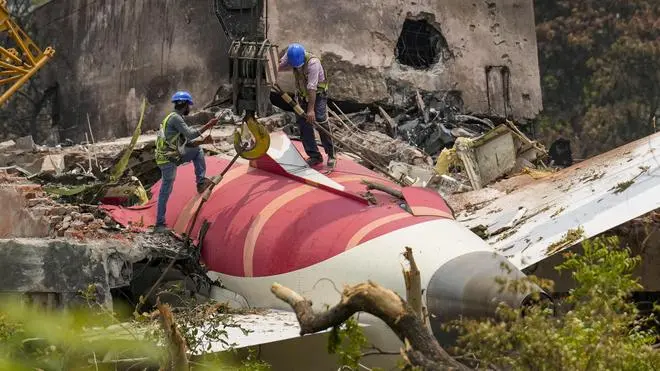
One year ago, on 12 June 2025, Air India flight AI 171 crashed shortly after take-off from Ahmedabad, becoming one of civil aviation’s most studied accidents. As the anniversary falls today, attention turns respectfully to the Aircraft Accident Investigation Bureau (AAIB) inquiry and the legal architecture that governs how such tragedies are investigated and how liability is determined.
For CLAT aspirants, the value here lies not in the loss but in the law: international investigation standards, the role of black boxes, and the conventions that frame airline liability. This post deliberately frames the story around aviation safety and legal process.
What Happened
AI 171, a Boeing 787-8 Dreamliner operating Ahmedabad-Gatwick, came down moments after lift-off on 12 June 2025. The accident claimed the lives of those on board and several on the ground, with one survivor. The episode prompted a full investigation under India’s aviation-safety machinery, and the final report is awaited.
The AAIB’s preliminary report noted that both engine fuel-control switches transitioned from ‘RUN’ to ‘CUTOFF’ seconds after lift-off, cutting fuel to the engines. Two lines of inquiry are under examination: one centred on cockpit action, and another on a possible catastrophic electrical or systems failure, a view supported by some Indian pilots and a few Boeing whistleblowers. The investigation remains ongoing and conclusions await the final report.
- Date: 12 June 2025; aircraft: Boeing 787-8 Dreamliner; route Ahmedabad-Gatwick.
- AAIB preliminary finding: both fuel-control switches moved RUN to CUTOFF.
- Two theories under study: pilot action vs systems/electrical failure.
- Final report awaited under ICAO Annex 13 timelines.
- A memorial complex and interim compensation were announced.
Constitutional / Legal / Policy Framework
Aircraft accident investigations are governed by ICAO Annex 13 (Chicago Convention framework), which sets out how investigations are conducted and expects a final report, ordinarily within 12 months. In India, the AAIB functions under the Ministry of Civil Aviation, distinct from the regulator, the DGCA. Crucially, the sole purpose of such investigations is the prevention of future accidents, not the apportioning of blame or liability.
The flight data recorder (FDR) and cockpit voice recorder (CVR) — the ‘black boxes’ — are central evidence. Airline liability and passenger compensation are governed by the Montreal Convention 1999, which India has ratified.
CLAT Angle
This topic is a goldmine of legal vocabulary CLAT loves: Annex 13, ICAO, DGCA versus AAIB, FDR/CVR, and the Montreal Convention. Examiners may test the principle that accident investigations aim at prevention, not liability — a frequent distinction in legal-reasoning passages. Knowing that the Montreal Convention governs compensation (not the investigation itself) is exactly the kind of precise mapping that earns marks.
Key Facts
| Flight | Air India AI 171 |
| Aircraft | Boeing 787-8 Dreamliner |
| Date | 12 June 2025 |
| Investigator | AAIB (Min. of Civil Aviation) |
| Investigation standard | ICAO Annex 13 |
| Liability convention | Montreal Convention 1999 |
Mnemonic / Memory Hook
Lock the law-chain with “A-A-I-B = Aviation Accidents Investigated By”. Separate the two pillars: “Annex 13 = how we investigate; Montreal 99 = how we compensate.” And remember the golden rule — “Investigate to PREVENT, not to PUNISH.”
Conclusion
A year on, the AI 171 inquiry underscores how aviation law channels grief into rigorous, prevention-focused investigation. The framework — ICAO Annex 13, the AAIB-DGCA division of roles, and the Montreal Convention on compensation — exists precisely to ensure that lessons are learned and future flights are safer. For the CLAT aspirant, the respectful and accurate takeaway is the legal architecture that turns a tragedy into a mandate for safety.
Practice Quiz — 10 CLAT-Style Questions
Click an option to reveal the answer and explanation.