

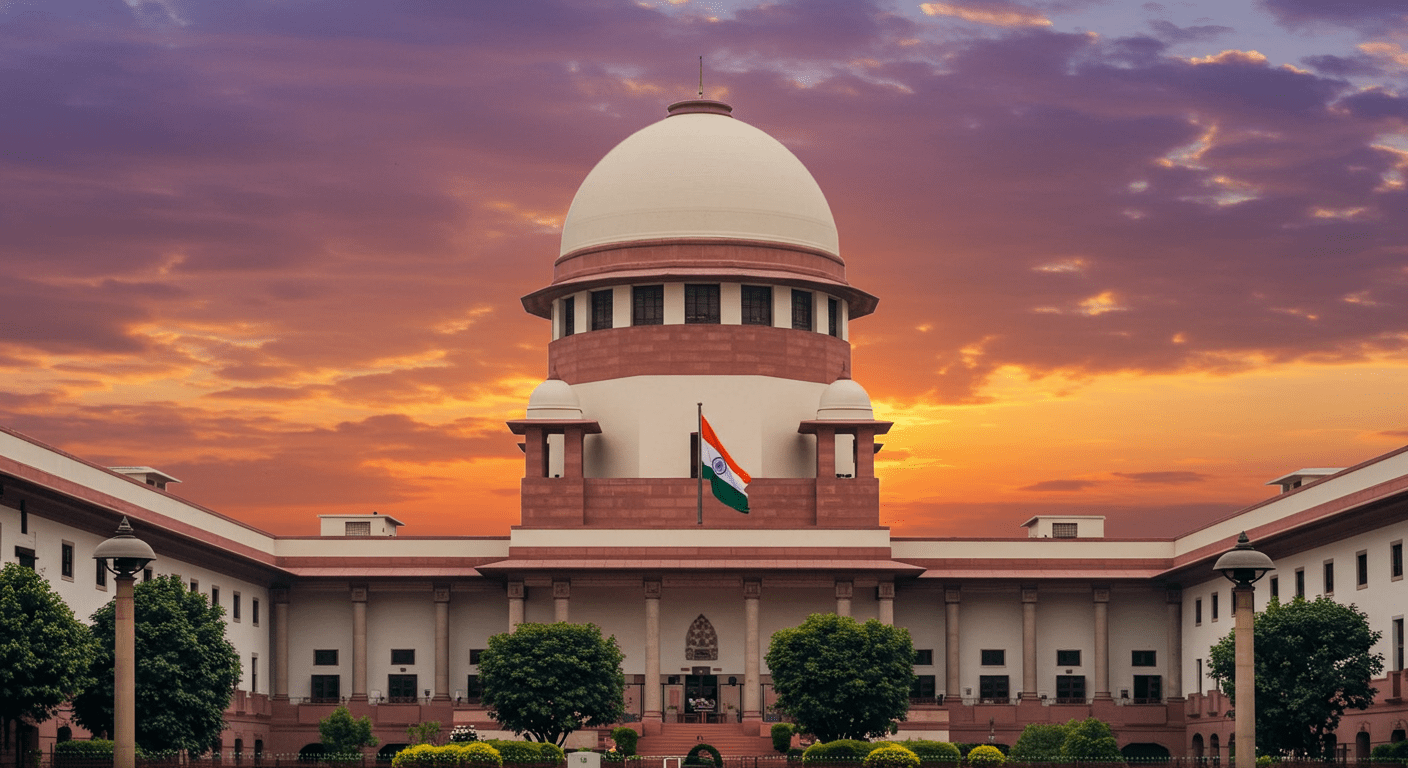
The Bar Council of India (BCI) has published a fresh notification barring 9 law colleges from admitting new students in the academic session 2026-27 and onwards. The decision follows surprise on-site inspections by a High-Level Surprise Inspection Team chaired by retired High Court judges and assisted by senior law academicians. It is the strongest enforcement signal from BCI since it ended its three-year moratorium on new law colleges earlier this year — and a quiet warning to every aspirant about to fill an LLB admission form.
The full list of 9 colleges barred from admissions in 2026-27
According to the BCI notification reported in May 2026, the following institutions have been barred:
- Sardar Patel Law College, Sriganganagar, Rajasthan
- CB Singh Law College, Akbarpur, Ambedkar Nagar, Uttar Pradesh
- Rajiv Gandhi Vidhi Mahavidyalaya, Tonk, Rajasthan
- Kautilya Law College, Mansarovar Extension, Sanganer, Jaipur, Rajasthan
- Veer Kunwar College of Law, V.K. Puram, Nagina Road, Bijnor, Uttar Pradesh
- SGN Khalsa Law PG College, Sriganganagar, Rajasthan
- Rajesh Pandey College of Law, Lohia Nagar, Iltifatganj Road, Akbarpur, Ambedkar Nagar, Uttar Pradesh
- Shri Gajendra Singh Smriti Vidhi Mahavidyalaya, Bidhuna, Auraiya, Uttar Pradesh
- Abdul Razzaq Law College
The Council has stated that “separate communications/letters shall be issued to the concerned institutions in due course, setting out the deficiencies and shortcomings found in their respective cases.” In plain English: the inspection team did find specific things wrong, and each named college will be told what they were. Until the colleges respond and the BCI is satisfied, they cannot admit students for 2026-27 or any subsequent session.
What kinds of deficiencies trigger a BCI ban?
The official notification does not yet itemise every defect. But the framework BCI uses under the Rules of Legal Education, 2008 typically focuses on:
- Faculty strength — minimum full-time, qualified faculty per programme; many of the named colleges were reportedly running with skeleton staff or paper-only appointments.
- Library infrastructure — number of titles, journal subscriptions, reading-hall capacity, e-resources.
- Physical infrastructure — classrooms, moot court hall, computer lab, accessibility.
- Student enrolment vs. sanctioned strength — over-admission, ghost students, or admissions outside the approved intake.
- Affiliation status with the parent university and statutory permissions from the State.
- Quality of academic records — attendance registers, internal assessment files, examination practices.
The BCI’s surprise-inspection method is meant to defeat colleges that prepare a Potemkin façade only for scheduled visits.
The bigger context: BCI withdrew the three-year moratorium
In March 2026, the BCI formally withdrew the three-year moratorium on new law colleges and told the Supreme Court that approvals would now resume through inspection-based assessments under the Rules of Legal Education, 2008. The May 2026 ban list is the first major enforcement action of that new regime. Two implications:
- For colleges — clearance is no longer a one-time formality. Inspections can happen anytime, and consequences are public and immediate.
- For students — a college’s “BCI approval” status can change between the day you fill the form and the day you graduate. Verify before you pay.
How this affects students preparing for CLAT, AILET, MH-CET Law, etc.
The 9 banned colleges are not National Law Universities. NLSIU Bangalore, NALSAR Hyderabad, NUJS Kolkata and the rest of the NLU family are autonomous statutory universities not in the ban list. So if your goal is an NLU through CLAT, this notification does not touch you directly.
But it should change your behaviour in three concrete ways:
1. If you are considering a private or state law college as a backup
Before paying any application fee or hostel deposit at any private/state LLB college, do this 5-minute check:
- Visit barcouncilofindia.org → look for the latest list of approved centres of legal education.
- Search the institution’s name + “BCI ban” + “BCI notice” on a news engine.
- Ask the college admissions cell, in writing (email is fine), for: (a) BCI approval letter for the current academic year, (b) sanctioned intake, (c) faculty list with qualifications.
- If the college refuses or stalls, that is the answer.
2. If you are currently enrolled at one of the named colleges
The BCI ban applies to fresh admissions from 2026-27. Students already on the rolls are not, by this notification, deregistered. But your degree’s standing depends on the parent university and BCI ongoing recognition. Speak to your academic head this week. If the deficiency is structural, consider a planned migration — many universities allow lateral transfer with the consent of both institutions and the BCI.
3. If you are an aspirant looking at smaller state law colleges
State-affiliated private colleges in Rajasthan and Uttar Pradesh — the two states accounting for the entirety of this 9-college list — should be scrutinised hardest. That is not a slur on either state; it is a pattern in this particular notification, and it tells you where the inspection pressure is currently concentrated.
What about colleges not on the ban list?
Absence from a ban list is not a positive endorsement; it just means BCI has not yet inspected and acted. The Council has signalled that more such notifications are expected as it works through its inspection schedule. Treat BCI approval as a moving variable, not a permanent badge.
A practical timeline for 2026-27 law aspirants
| If you are… | Action this month |
|---|---|
| A CLAT 2026 candidate finalising NLU admission | Focus on Round 5 acceptance + balance fee at allotted NLU (May 25 & May 30 deadlines). |
| A CLAT 2027 aspirant in Class 12 | Start mock-led prep + monitor the BCI’s evolving college-quality list as part of your “Plan B” research. |
| Considering a private/state LLB as backup | Run the 5-minute BCI verification check on every shortlisted college before applying. |
| Currently enrolled at a banned college | Meet your principal this week. Get the BCI letter in writing. Plan a lateral path if needed. |
The longer game: why this matters for the profession
India produces tens of thousands of law graduates every year, and a non-trivial slice of that pool comes from institutions that struggle on faculty, library, and infrastructure benchmarks. A BCI clean-up — even a small one like 9 colleges — is good news for the profession, for clients, and for serious aspirants whose degree value rises when sub-standard volume falls.
For aspirants reading this, the message is simple. Aim higher than the lowest-bar college that will take you. Even if CLAT and AILET feel intimidating, the ROI of grinding for a strong NLU or a top-tier private (NLSAT-Symbiosis, Jindal, NMIMS) is enormous compared to a college whose admission letter may not be honoured next year.
Real students. Real journeys.
Every year a few students join us in October after a college they’d paid two semesters at lost its BCI approval. The fix takes 9–14 months — a year usually lost. The fix could have been a 5-minute check before paying. This is exactly why we keep repeating: choose the long road on purpose. Our CLAT/AILET counsellors are happy to walk you through a college-shortlist audit before you pay any fee — call 7033005444.
Quick recap
- 9 law colleges barred from admissions in 2026-27 by BCI
- All from Rajasthan + Uttar Pradesh; based on surprise inspections by a High-Level Inspection Team
- Ban applies to fresh admissions in 2026-27 and continues until further notice
- BCI’s three-year moratorium on new colleges withdrawn in March 2026; inspection regime active
- NLUs are unaffected — focus on quality, not just availability
- Verify BCI approval before paying any application fee — every time
- Backup-college audit help: 7033005444
Test what you’ve learned
Practice Quiz — 10 CLAT-Style Questions
Click an option to reveal the answer and explanation.
Frequently asked questions
Does this BCI notification apply to current students at the banned colleges?
The notification bars fresh admissions for 2026-27 and onwards. Current students are not, by this notice alone, derecognised — but the underlying deficiencies should worry them and they must engage their college administration urgently.
Will more colleges be added to the BCI ban list?
Likely yes. BCI has withdrawn its three-year moratorium and revived inspection-based approvals. Surprise inspections continue, so more enforcement notices are reasonable to expect.
How can I confirm whether a private LLB college I plan to apply to is BCI-approved?
Visit barcouncilofindia.org for the latest approved list, ask the college for a copy of its current-year BCI approval letter, and verify in writing — never rely on a brochure or a counsellor’s word.
Are NLUs (CLAT colleges) on the ban list?
No. NLUs are autonomous statutory universities governed separately and are not part of this 9-college list.
Sources: SCC Online — BCI bans 9 law colleges (May 2026); SCC Online — BCI withdraws three-year moratorium (March 2026); LiveLaw — Law school admission landscape 2026.
Real students. Real journeys. For a free 1:1 audit of any private/state LLB college you are considering as backup, call CLAT Gurukul on 7033005444.

