
CURRENT AFFAIRS | MAY 14, 2026
The Union Cabinet, chaired by the Prime Minister, has cleared a Rs 37,500-crore push to convert India’s biggest fossil reserve into the chemical building blocks of a modern economy. The Scheme for Promotion of New Surface Coal/Lignite Gasification (SPNSFG) aims to gasify roughly 100 Million Tonnes (MT) of coal and lignite by 2030, producing synthesis gas — syngas — that can then be used to make liquefied natural gas (LNG), urea, ammonia, methanol, and other downstream chemicals India currently imports in large volumes.
The scheme will incentivise 25 projects across two categories — 12 syngas (Category-1) facilities producing the base feedstock, and 13 downstream (Category-2) facilities producing finished chemicals. The decision lands at a sensitive geopolitical moment: persistent disruption around the Strait of Hormuz has rattled global LNG and ammonia flows, leaving import-dependent economies like India searching for indigenous substitutes.
1. Entry 54, Union List — Regulation of mines and mineral development.
2. Article 73 — Union executive power extends to matters Parliament can legislate on.
3. Coal Bearing Areas (Acquisition & Development) Act, 1957 — Special Central acquisition statute for coal-bearing land (overrides LARR, 2013 by virtue of being earlier and specific).
4. Mines & Minerals (Development & Regulation) Act, 1957 — Framework statute for grant of mining leases.
5. Coal Mines (Special Provisions) Act, 2015 — Auction of coal blocks post the 2014 SC judgment in Manohar Lal Sharma v. UoI.
6. Environment (Protection) Act, 1986 — EIA notifications and emission standards apply.
7. Article 39(b) (DPSP) — Material resources of community to subserve common good.
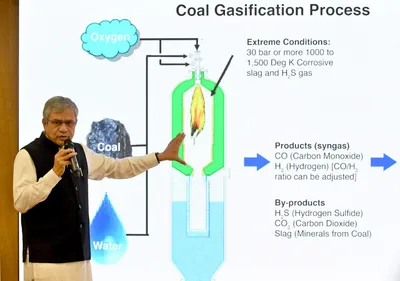
India’s coal endowment is huge but uneven. The country sits on the fourth-largest coal reserves in the world — about 389 billion tonnes, of which roughly 212 billion tonnes are proven extractable. Much of it, however, is high-ash and high-moisture — making direct combustion polluting and uneconomical. Gasification offers a workaround: the same coal is partially oxidised at high temperatures to produce syngas (mostly CO + H2), which can then be cleaned, separated, and used as a chemical feedstock — bypassing the worst of the combustion-emission problem.
1. Federal architecture — Mineral wealth vesting (Article 297 for offshore minerals; State ownership of onshore minerals per State of WB v. Union of India, 1962).
2. Coalgate judgment — Manohar Lal Sharma v. UoI (2014) — SC cancelled 214 coal block allocations as arbitrary, leading to the 2015 auction law.
3. Sustainable Development — Tension with India’s Net-Zero by 2070 pledge under the Paris Agreement (UNFCCC).
4. Trade-policy law — How import-substitution maps to the WTO non-discrimination principle.
5. Public Trust Doctrine — MC Mehta v. Kamal Nath (1997) — natural resources to be held in trust by the State.
The economic logic is straightforward: India imported roughly $185 billion worth of energy in FY25 — a fragility that turns into a crisis whenever Hormuz, the Red Sea, or the Malacca Strait flare up. Coal gasification builds energy sovereignty. The environmental logic is messier: critics argue that even gasified coal is still fossil carbon, and that scaling syngas locks India into a high-carbon pathway when the world is decarbonising. The government’s counter is that Carbon Capture, Utilisation & Storage (CCUS) can be retrofitted onto syngas units, making the pathway “cleaner coal” rather than “no coal”.
– Outlay: Rs 37,500 crore.
– Target: ~100 MT of coal/lignite gasification by 2030.
– Project count: 25 (12 syngas + 13 downstream).
– Single-project incentive cap: Rs 5,000 crore.
– Single-entity-group cap: Rs 12,000 crore.
– Expected investment: Rs 2.5-3 lakh crore.
– Job creation: ~50,000 direct + indirect.
– Approving body: Cabinet (PM-chaired CCEA).
– Nodal Ministry: Ministry of Coal.
– Strategic driver: Strait of Hormuz LNG vulnerability.
The scheme also has a political-economy angle worth noting. Eastern India’s coal-bearing states — Jharkhand, Odisha, Chhattisgarh, West Bengal, MP — host most of the future plants and will see large investment inflows, jobs, and royalty revenues. But they will also bear the local pollution burden — making the scheme a classic case study in distributive environmental justice, a hot CLAT theme.
Practice Quiz — 10 CLAT-Style Questions
Click an option to reveal the answer and explanation.