CURRENT AFFAIRS | 28 MAY 2026
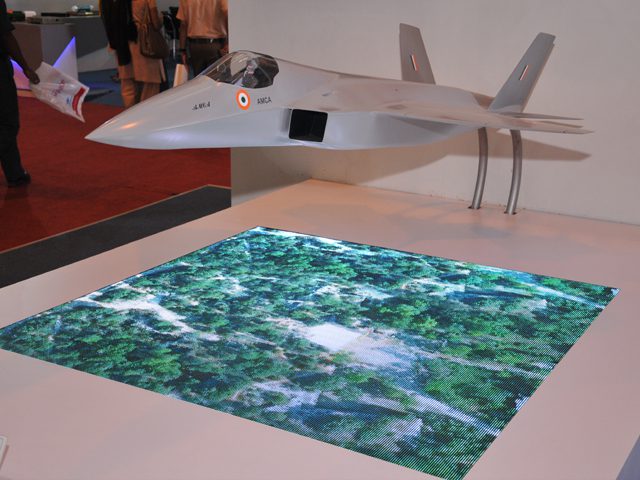
The Defence Ministry on Wednesday, 27 May 2026, issued the Request for Proposal (RFP) for the indigenous fifth-generation Advanced Medium Combat Aircraft (AMCA) to three shortlisted private consortia: Tata Advanced Systems Limited (TASL); Larsen & Toubro in consortium with Bharat Electronics Limited (BEL); and a Bharat Forge–BEML-led group. The estimated developmental outlay is approximately Rs 15,000 crore. The Aeronautical Development Agency (ADA) of DRDO will design and build five prototypes; the production aircraft will be built by the winning private OEM — a watershed moment for India’s defence manufacturing, with state-owned HAL not in the shortlist for the production lead and slated only for licence manufacturing from approximately 2035.
Constitutional & Statutory Framework
- Article 246 + Seventh Schedule, Union List Entry 1 — “Defence of India” is the exclusive domain of Parliament.
- Defence Acquisition Procedure (DAP), 2020 — places “Buy Indian-IDDM” (Indigenously Designed, Developed and Manufactured) at the top of its prioritisation hierarchy.
- Strategic Partnership (SP) Model, 2017 — enables private Indian firms to manufacture submarines, helicopters, fighters and armoured fighting vehicles in partnership with foreign OEMs.
- Defence Production & Export Promotion Policy, 2020 — targets Rs 35,000 cr defence exports by FY 2025 (target revised); aligns with Atmanirbhar Bharat.
- Cabinet Committee on Security (CCS) — chaired by PM Narendra Modi; cleared AMCA in May 2024; revised execution model approved by Defence Minister Rajnath Singh in March 2026.
- Defence Production Policy 2018 — set Rs 1.7 lakh cr aerospace turnover target by 2025.
CLAT Angle
Rich Current Affairs + Defence + Constitutional Law territory. Probable angles: (a) why Defence is Entry 1 of the Union List and not concurrent — historical reasons rooted in the 1935 Act; (b) the break in HAL’s monopoly — first major fighter platform where state-owned HAL is not the production lead; (c) strategic autonomy jurisprudence — courts have upheld government discretion in defence procurement (see Reliance Industries v UoI, 2014); (d) AMCA’s capabilities — 25-tonne twin-engine, stealth shaping, AESA radar, internal weapons bay, supercruise — comparable to F-35 / Su-57 class.
Key Facts
| RFP issued | 27 May 2026 by Defence Ministry |
| Shortlisted bidders | TASL; L&T + BEL; Bharat Forge–BEML |
| Design lead | ADA (DRDO), Bengaluru — 5 prototypes |
| Developmental cost | ~Rs 15,000 crore |
| CCS clearance | May 2024 (chaired by PM Modi) |
| Execution model | Approved by Defence Min Rajnath Singh, March 2026 |
| HAL role | Not in production-lead shortlist; licence manufacturing from ~2035 |
| Class | 25-tonne twin-engine 5th-gen stealth; F-35 / Su-57 comparable |
Mnemonic
“3 Bidders, 5 Prototypes, 25 Tonnes” — Three private consortia, five ADA prototypes, 25-tonne twin-engine class. Three letters to remember: D-A-P = DAP 2020 (Buy Indian-IDDM) — ADA design lead — Production by private OEM.
This is a structural break, not an incremental upgrade. Until now, every Indian fighter — from HF-24 Marut to Tejas — was led by HAL. AMCA is the first major combat platform where private industry holds the production reins, with HAL relegated to licence-manufacture from the second decade. The Defence Ministry has bet that competition among TASL, L&T-BEL and Bharat Forge-BEML will compress development time and yield exportable production know-how. The first AMCA flight is targeted for around 2028-29; squadron induction by the mid-2030s. For aspirants, AMCA is to fifth-generation stealth what Tejas was to fourth-generation — only this time, the manufacturing model is the bigger story than the airframe.
Practice Quiz — 10 CLAT-Style Questions
Click an option to reveal the answer and explanation.