
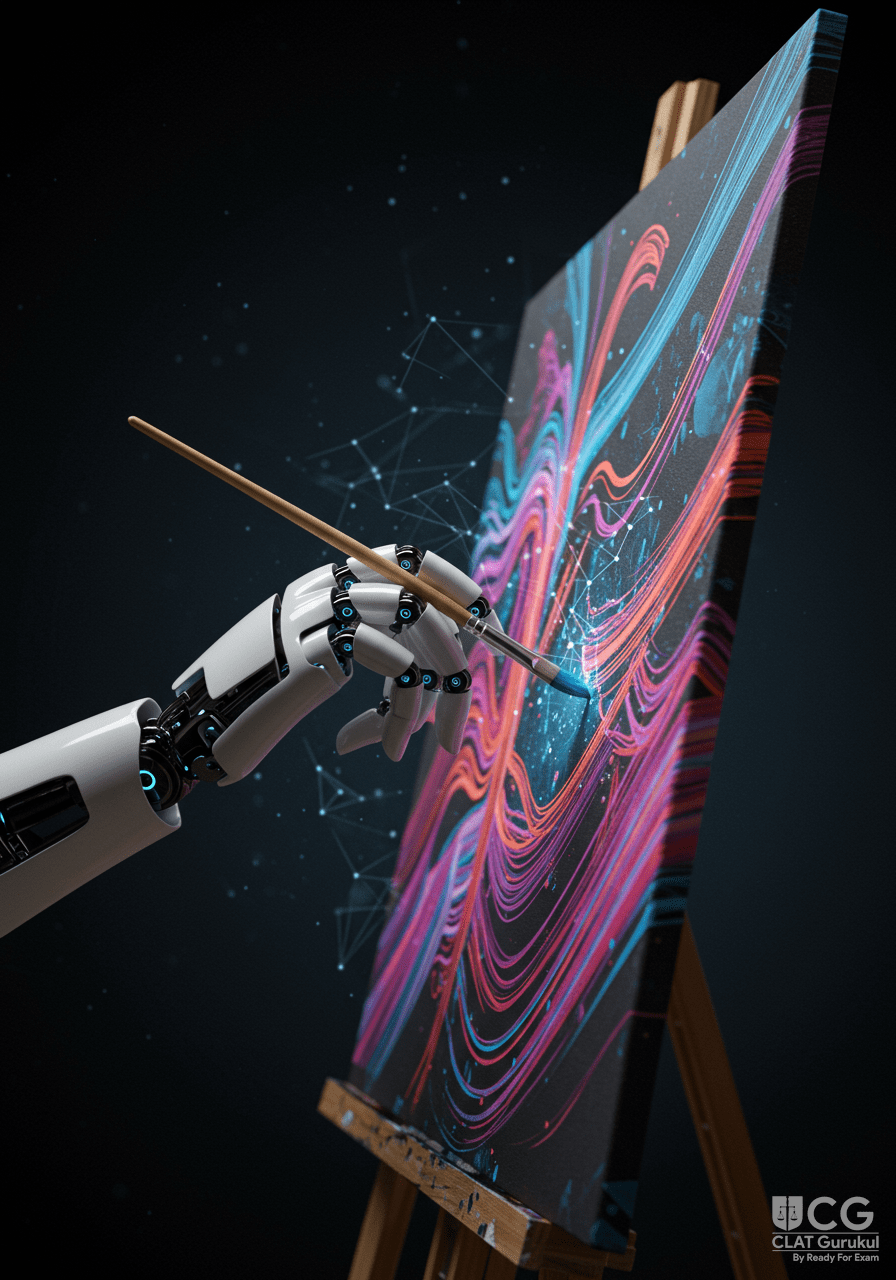
When Granta’s Commonwealth Short Story Prize Caribbean winner Jamir Nazir was flagged as 100% AI-generated by the detector Pangram — which advertises a 0.01% false-positive rate — Indian Institute of Science Bengaluru’s Danish Pruthi co-authored research showing ‘lightly polished’ human writing routinely mis-classifies as AI. The case maps directly onto India’s evolving statutory framework: Copyright Act 1957 §13 originality threshold, the DPDP Act 2023 consent regime for training data, and the IT Rules 2021 deepfake amendments — all live anchors as the Centre considers whether to mandate AI-content labelling.
Three of the five regional Granta winners faced AI-use accusations after Pangram flagged their entries. The detector’s pitch is statistical: ML models trained on paired AI + human content learn the ‘tells’ — em-dash overuse, words like ‘imperative’ and ‘delve’, bullet-pointed structure, and ‘negative parallelism’ (‘Not X, but Y’). Pruthi (assistant professor at IISc Bengaluru) cautions that even a 1-in-10,000 false-positive rate, if reliable, will mis-classify thousands of human writers globally. His recent ML-conference paper showed that ‘lightly polished’ human text — where the writer uses a language model only to edit — is routinely flagged as fully AI-generated. Equally, ‘low-entropy’ text (a list of Indian states in alphabetical order; deterministic code) is inherently hard to classify because both humans and models produce the same correct answer.
📜 Constitutional / Statutory Anchor
Copyright Act 1957 §13 — copyright subsists in original literary, dramatic, musical and artistic works; the originality test post Eastern Book Company v. DB Modak (2008) 1 SCC 1 requires a ‘modicum of creativity’ (rejecting both the UK ‘sweat of the brow’ and the US Feist threshold). DPDP Act 2023 — the consent + purpose-limitation regime applies to training data containing personal data; §4 requires lawful basis. IT (Intermediary Guidelines and Digital Media Ethics Code) Rules 2021 — 2025 deepfake amendments require synthetic media to be labelled. EU AI Act 2024 — Article 50 mandates disclosure of AI-generated content; general-purpose AI obligations under Title VIII. The originality threshold per RG Anand v. Delux Films (1978) 4 SCC 118 remains foundational for authorship disputes.
The institutional question is whether an AI-detection score is admissible as evidence of un-originality (and therefore non-copyrightability under §13). Indian courts have not yet ruled — but US courts in Thaler v. Perlmutter (US District Court, DC, 2023) held that purely AI-generated works lack the human authorship required for copyright. The Indian Copyright Office in 2023 initially registered then withdrew a registration for an AI-co-authored work, reflecting regulatory uncertainty. The DPDP Act 2023 adds a second axis: if a model is trained on personal data without lawful basis, the resulting outputs may be downstream-liable. The 2025 IT Rules deepfake amendments require labelled disclosure — a regulatory direction that AI-detection tools would, paradoxically, both enforce and undermine.
🎯 Key Facts at a Glance
- Pangram advertises a 0.01% false-positive rate (1 in 10,000); Pruthi’s IISc research disputes reliability for polished text.
- Granta Commonwealth Prize: 3 of 5 regional winners faced AI-use accusations; Caribbean winner Jamir Nazir flagged 100% AI.
- AI ‘tells’ include excessive em-dashes, words like ‘imperative’ / ‘delve’, and ‘negative parallelism’ (‘Not X, but Y’ structure).
- ‘Low-entropy text’ (lists, code, factual queries) is inherently hard to classify — both humans + models produce the same answer.
- DPDP Act 2023 — consent + purpose-limitation regime for training-data containing personal data.
- IT Rules 2021 (2025 amendments) — synthetic media must be labelled; first Indian statutory anchor for AI-content disclosure.
Globally, the regulatory directions diverge. The EU AI Act 2024 imposes Article 50 labelling on AI-generated content + general-purpose AI obligations under Title VIII; non-compliance attracts fines up to 7% of global turnover. The US has no federal AI statute; Executive Order 14110 (October 2023) directed agencies to develop content-authentication standards. The UK adopted a ‘pro-innovation’ light-touch regime. India’s IT Rules 2021 (deepfake amendments) sit between EU and US — narrower than the EU’s general labelling rule, broader than US executive-only action. The University Grants Commission’s draft AI-usage rules (2024) target academic submissions; their interface with the Copyright Act §13 originality threshold is still under consultation.
⚖️ CLAT Angle
Expect a Legal Reasoning passage on whether an AI-flagged work satisfies the §13 Copyright Act originality requirement, with principle-application questions on the Eastern Book Company v. DB Modak (2008) 1 SCC 1 ‘modicum of creativity’ test. RG Anand v. Delux Films (1978) 4 SCC 118 on idea-expression dichotomy remains foundational. A Current Affairs set may test the DPDP Act 2023 architecture, the IT Rules 2021 deepfake amendments, and the EU AI Act’s Article 50 disclosure rule. Anticipate a principle-fact pattern: ‘X used AI to lightly polish her essay; the detector flagged it 100% AI — can she claim copyright?’
What to watch next: the Centre’s draft Digital India Act (replacement for the IT Act 2000) is expected to include explicit AI-content provisions. The Indian Copyright Office’s pending policy clarification on AI-co-authored works; the UGC’s final AI-usage rules; and the first Indian judicial ruling on whether an AI-detection report is admissible as expert evidence under §45 of the Indian Evidence Act 1872.
💡 Why This Matters for CLAT 2027 Aspirants
AI + IP + DPDP is a high-probability 2027 CLAT theme. Memorise Eastern Book Company v. DB Modak ‘modicum of creativity’ test, RG Anand v. Delux Films idea-expression dichotomy, DPDP Act 2023 §4 lawful basis, IT Rules 2021 (2025 deepfake amendments), and the EU AI Act Article 50 disclosure rule. Pangram + IISc-B + Granta as factual hooks.
📝 Test Yourself — 10-Question Quiz
Take the interactive quiz below to reinforce these concepts:
Practice Quiz — 10 CLAT-Style Questions
Click an option to reveal the answer and explanation.