CURRENT AFFAIRS | JUNE 3, 2026
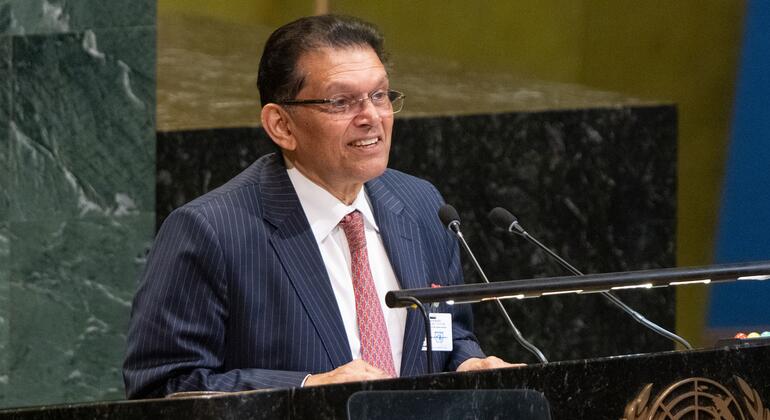
In a closely-contested election at UN Headquarters on June 2, 2026, Bangladesh Foreign Minister Khalilur Rahman was elected President of the 81st session of the United Nations General Assembly, defeating Cyprus’ Andreas Kakouris 99 to 91. It is Bangladesh’s first-ever UNGA presidency — won during the Asia-Pacific Group’s rotational turn.
Constitutional & UN-Charter Framework
- UN Charter Article 7: Lists the six principal organs of the UN.
- Article 9: UNGA composed of all UN Members.
- Articles 10-17: Functions and powers of the UNGA.
- Article 18(1): Each member has one vote (sovereign equality in voting).
- Article 21: UNGA elects its own President for each session.
- “Uniting for Peace” Resolution (1950): Empowers UNGA when UNSC is deadlocked.
Key Facts — UNGA 81st Session Election
Rotational Presidency: How It Works
The UNGA presidency rotates annually among five regional groups: African, Asia-Pacific, Eastern European, Latin American & Caribbean (GRULAC), and Western European & Others (WEOG). The 81st session falls in the Asia-Pacific turn — making Bangladesh, Cyprus and others eligible candidates from the bloc.
Powers of the UNGA President
The President presides over plenary meetings, oversees the agenda, and represents the UNGA externally. While the role is largely procedural, in moments of UNSC deadlock — invocable via the Uniting for Peace Resolution (1950) — the UNGA itself can recommend collective measures, with the President steering proceedings.
Why This Matters for CLAT 2027
- Principal organs of the UN (Art. 7) — frequently tested in GK.
- UNGA powers (Art. 10-17) — Legal Reasoning passages.
- Binding vs recommendatory nature of resolutions.
- Uniting for Peace Resolution — historical context worth memorising.
- India’s UNGA leadership history: Vijaya Lakshmi Pandit (1953) was the first woman President.
Mnemonic — UN Principal Organs
“GSE-TIC” = General Assembly · Security Council · Economic and Social Council · Trusteeship Council · International Court of Justice · SeCretariat. Six organs under Art. 7 UN Charter.
Practice Quiz — 10 CLAT-Style Questions
Click an option to reveal the answer and explanation.
Source: UN News, Indian Express, PTI (June 3, 2026).