Ethanol from Rice: When a Food Surplus Becomes a Fuel Question
India stands at an unusual crossroads in 2025-26. On one hand, it is the world’s largest producer of rice, harvesting roughly 154 million tonnes in the current crop year and exporting around 24.5 million tonnes in 2025. On the other hand, the country is chasing an ambitious clean-energy target: blending petrol with ethanol distilled from crops. The Ethanol Blending Programme (EBP) has already pushed the national fuel mix to a 20% ethanol-petrol blend — commonly called E20. Where these two facts meet, a genuinely difficult policy debate begins: should a nation with enormous rice stocks convert grain that could feed people into fuel that runs cars?
For a CLAT aspirant, this is a model current-affairs story. It braids together economics (minimum support prices and subsidies), the environment (water, methane, nitrous oxide), and public-policy reasoning (the classic food-versus-fuel trade-off). Let us unpack each strand carefully and fairly.
The MSP Machine and How Surpluses Pile Up
To understand why India has so much rice to spare, we must start with the Minimum Support Price (MSP). MSP is a price floor: the government promises to buy crops such as paddy from farmers at a pre-announced rate so that they are protected from a collapse in market prices. Procurement is carried out largely through the Food Corporation of India (FCI), the nodal agency that buys, stores and distributes foodgrains.
The trouble is that procurement in states like Punjab and Haryana has become open-ended — the FCI buys essentially whatever is offered at MSP. Over successive good harvests, this has left the FCI holding rice stocks that are, by some estimates, about five times the buffer norm. The buffer norm is the minimum quantity the government is required to keep for food security and emergencies; anything far beyond it becomes an expensive storage and management problem, with real risks of grain rotting in warehouses.
Offloading Surplus into Ethanol
Faced with mountains of rice, the government has turned to the ethanol route as a release valve. FCI rice is sold to ethanol distilleries at roughly Rs 22 per kilogram, even though the FCI’s own economic cost — the cost of buying, storing and handling that rice — is about Rs 44 per kilogram. The gap between the selling price and the true cost is, in effect, a large implicit subsidy flowing to the fuel-ethanol chain.
Here a note of caution enters the debate. Agricultural economist Ashok Gulati has argued that going a step further — mandating that a fixed share of ethanol feedstock must come from FCI rice — would be counterproductive. He likens such compulsion to “Soviet-era controls,” where planners force a particular input rather than letting relative prices and efficiency decide. The concern is that rigid mandates lock the system into using grain even when sugarcane molasses, maize or other feedstocks might make more economic and nutritional sense.
The Environmental Ledger of Paddy
Rice is not an environmentally cheap crop, and this is where the story deepens. Consider the resource intensity:
- Water: Producing one kilogram of rice can require around 4,000 litres of irrigation water. In a country with falling water tables in its major paddy belts, this is a serious sustainability question.
- Methane: Flooded paddy fields are a significant source of methane, a greenhouse gas roughly 25 times as potent as carbon dioxide over a 100-year horizon. Waterlogged soils create the oxygen-starved conditions in which methane-producing microbes thrive.
- Nitrous oxide and nitrate pollution: Over-application of urea — heavily subsidised, sold at about Rs 242 for a 45-kg bag against a subsidy of roughly 85-90% — releases nitrous oxide, a gas about 273 times as warming as carbon dioxide. Excess nitrogen also leaches into groundwater as nitrate, causing contamination linked to “blue baby syndrome” (methaemoglobinaemia), a condition that reduces the blood’s ability to carry oxygen in infants.
So when the debate asks whether we should turn rice into fuel, the honest environmental accounting must include the fact that growing that rice in the first place already carried heavy water and emissions costs. Diverting an already-produced surplus to ethanol is one question; incentivising even more water-guzzling paddy specifically to feed distilleries is quite another.
There is a further subtlety. Subsidies in Indian agriculture rarely act in isolation — they interact. A high MSP encourages farmers to grow more paddy; a deep urea subsidy makes fertiliser cheap enough to over-apply; free or near-free electricity in some states makes pumping groundwater almost costless. Each of these individually looks like a support for the farmer, but together they push the system towards a crop that is both water-intensive and emissions-heavy. Ethanol demand then adds a fourth pull. Understanding this web of interlocking incentives is what separates a superficial reading of the story from a genuine policy analysis — and it is exactly the kind of layered reasoning CLAT passages reward.
The Case in Favour: Energy Security and Decarbonisation
A balanced treatment must give the other side its due. In an interview, an executive from Toyota Kirloskar made the pro-ethanol case forcefully. Ethanol, in this view, is a domestic energy source — every litre blended is a litre of imported crude that India does not have to buy, which strengthens energy security and helps the trade balance. It is also described as the fastest and cheapest practical way to decarbonise road mobility right now, because it works with the vehicles and fuel infrastructure the country already has.
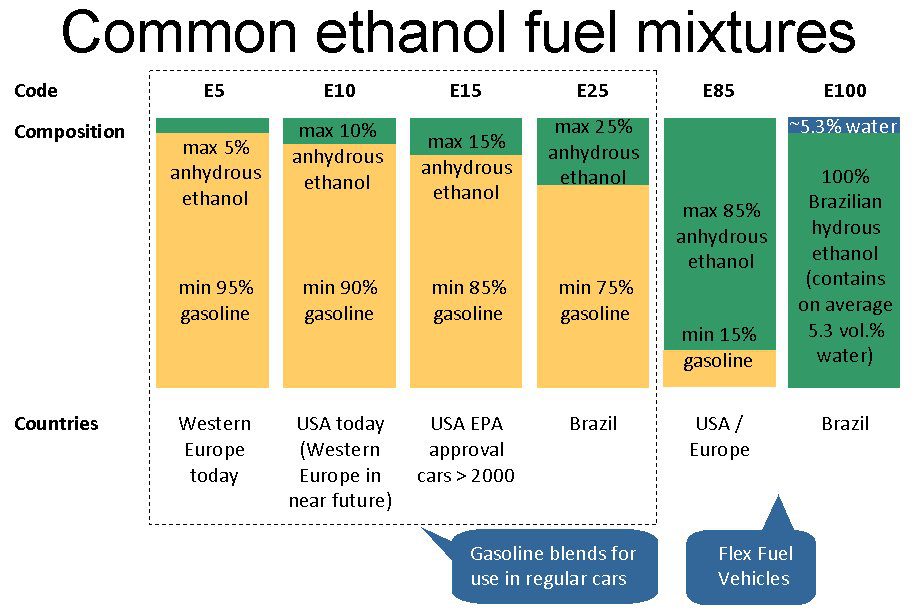
The forward direction, industry argues, is the flex-fuel vehicle (FFV) — cars engineered to run on high blends such as E85 or even E100. The honest caveat: ethanol carries less energy per litre than petrol, so higher blends can reduce fuel efficiency by roughly 3-5%. Supporters counter that this modest mileage penalty is a reasonable price for cutting oil imports and tailpipe carbon.
Weighing the Trade-Off
The heart of this issue is the classic food-versus-fuel trade-off. In principle, grain that can nourish people is being converted into fuel for vehicles. But the picture is nuanced: India is not diverting scarce grain, it is trying to responsibly dispose of a subsidy-created surplus that is otherwise costly to store and prone to spoilage. The real risk lies not in using existing surplus, but in building a permanent fuel demand that then pulls more water-intensive paddy into cultivation to keep the distilleries fed.
Good policy reasoning, therefore, distinguishes between a one-time release of surplus and a structural incentive. It also asks whether the implicit subsidy — the Rs 22 crore of value handed over for every notional slab below economic cost — is the best use of public money, or whether reforming open-ended MSP procurement and diversifying crops would address the root cause rather than the symptom.
The CLAT Angle
This topic is a treasure for CLAT because it sits at the intersection of three of the most-tested current-affairs domains and rewards reasoning over rote recall.
- Economy passages: Expect comprehension sets on MSP mechanics, buffer-stock norms, implicit versus explicit subsidies, and energy security. The examiner may hand you a passage and ask you to identify the author’s assumption or the strongest objection — for instance, why mandating FCI-rice feedstock could be “counterproductive.”
- Legal and policy reasoning: The story maps onto Directive Principles of State Policy — Article 47 (raising nutrition and public health) and Article 48 (organising agriculture on modern, scientific lines) — as well as environmental obligations flowing from Article 21 (right to life, judicially read to include a clean environment). A principle-application question could ask you to balance food security against clean-energy goals.
- Balanced argumentation: CLAT increasingly favours passages with two credible sides. Here, the environmental critique of paddy and the energy-security defence of ethanol are both legitimate. Train yourself to state each position fairly before you evaluate — that is exactly the neutral, national-interest lens the exam prizes.
Exam tip: When a passage presents a trade-off, resist picking a “side” emotionally. Instead, isolate the specific claim each option makes and test it against the passage. The correct answer is usually the one that is precisely supported, not the one that merely sounds virtuous. Master this habit on the ethanol debate and you will handle any economy-plus-environment set the exam throws at you.
Test Yourself — Daily Quiz
Practice Quiz — 10 CLAT-Style Questions
Click an option to reveal the answer and explanation.