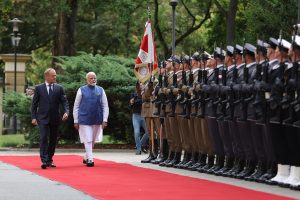
External Affairs Minister S. Jaishankar and Indonesian Foreign Minister Sugiono co-chaired the 8th India-Indonesia Joint Commission Meeting in New Delhi on 7 June 2026, fast-tracking defence, maritime-security and digital-infrastructure cooperation under the 2018 Comprehensive Strategic Partnership and laying the diplomatic groundwork for PM Modi’s Jakarta visit next month.
The JCM is the apex bilateral mechanism for India-Indonesia ties, and the 8th edition produced one of the densest agendas in recent memory: defence and security, maritime and shipping, trade, fin-tech, health, pharmaceuticals, fertilisers, critical minerals, tourism, education and culture. Jaishankar tweeted that the two sides “exchanged perspectives on regional developments, advancing our multilateral coordination and deepening India-ASEAN ties”. Sugiono framed the visit as keyed to “the Comprehensive Strategic Partnership — from trade and maritime security to digital connectivity, infrastructure, health and people-to-people ties”, and confirmed that PM Modi’s upcoming Jakarta visit will be “an important opportunity to deepen cooperation between both nations”.
📜 Constitutional / Statutory Anchor
Article 51 (DPSP) — directs the State to promote international peace and security, maintain just and honourable relations between nations, and foster respect for international law and treaty obligations. Article 73 — extends the executive power of the Union to matters with respect to which Parliament has power to make laws, including treaties. Schedule VII, List I, Entries 10, 13, 14 — foreign affairs, participation in international conferences, and entering into treaties are Union subjects. Comprehensive Strategic Partnership 2018 — concluded during PM Modi’s Jakarta visit with President Joko Widodo. Bandung Conference (April 1955) — formalised the Panchsheel five principles of peaceful coexistence.
The institutional significance of the JCM lies in how Indonesia anchors India’s Act East Policy. Launched in 1992 as the “Look East” doctrine by PM Narasimha Rao to reorient India’s economic and strategic posture after the Cold War, it was upgraded to “Act East” in 2014 under PM Modi at the East Asia Summit. Indonesia — the largest ASEAN economy, sitting astride the Malacca, Sunda and Lombok straits — is the doctrine’s lynchpin. Indonesia’s accession to the ASEAN-India Free Trade Agreement on Trade in Goods 2009 and its support for the ASEAN Outlook on the Indo-Pacific 2019 dovetail with India’s Indo-Pacific Oceans Initiative (IPOI 2019), announced by PM Modi at Bangkok’s East Asia Summit.
🎯 Key Facts at a Glance
- Forum: 8th India-Indonesia Joint Commission Meeting, New Delhi, 7 June 2026.
- Co-chairs: EAM S. Jaishankar + Indonesian FM Sugiono.
- Anchor framework: Comprehensive Strategic Partnership (2018).
- Domains covered: defence, maritime security, digital, infrastructure, fin-tech, health, critical minerals.
- Next step: PM Modi’s visit to Jakarta in July 2026.
- Historical roots: Bandung Conference 1955; Panchsheel; ASEAN-India FTA 2009.
The comparative significance is geopolitical. Indonesia is the chair-rotation power in ASEAN, a G20 member, and a candidate-member of OECD. Its agreement to advance maritime-security cooperation with India creates an Indian-Ocean-to-Pacific arc — complementary to QUAD without overlapping it. Both nations are members of the Indian Ocean Rim Association (IORA) and the East Asia Summit; both have ratified UNCLOS 1982; and both support the ASEAN Outlook on the Indo-Pacific 2019, which mirrors India’s IPOI. The Panchsheel principles articulated at Bandung in 1955 — mutual respect for territorial integrity, non-aggression, non-interference, equality and peaceful coexistence — remain the explicit normative bedrock of the bilateral.
⚖️ CLAT Angle
Expect Current Affairs questions on the year the Comprehensive Strategic Partnership was signed (2018), Look East → Act East timeline (1992 → 2014), the Bandung Conference year (1955) and its five Panchsheel principles, the IPOI’s 2019 unveiling, and the ASEAN-India FTA’s 2009 vintage. A Legal Reasoning passage may ask whether treaties signed by the Union require Parliamentary ratification — recall that under Article 253, Parliament can legislate for the implementation of any treaty, but the executive can sign treaties under Article 73 read with State of W.B. v. Kesoram Industries (2004) and Maganbhai v. UoI (1969).
The road ahead is staged. PM Modi’s Jakarta visit is expected to convert the JCM’s agreements into signed agreements — likely on defence-industrial cooperation (BrahMos export interest), critical-minerals supply chains (nickel from Indonesia for India’s EV battery push), and digital public-infrastructure transfers (DPI/UPI-style stacks). The two countries will also likely refine their multilateral coordination on the South China Sea, where both insist on UNCLOS-anchored freedom of navigation.
💡 Why This Matters for CLAT 2027 Aspirants
This story is a goldmine for static-current-affairs synthesis: pair the 1955 Bandung principles with India’s 2014 Act East upgrade and the 2019 IPOI. Memorise the QUAD vs ASEAN distinction, India’s treaty-making process under Articles 73 and 253, and the Panchsheel five-point list. Maganbhai Ishwarbhai Patel v. UoI (1969) 3 SCC 400 is the foundational case on executive treaty-power.
📝 Test Yourself — 10-Question Quiz
Take the interactive quiz below to reinforce these concepts:
Practice Quiz — 10 CLAT-Style Questions
Click an option to reveal the answer and explanation.