
What Happened
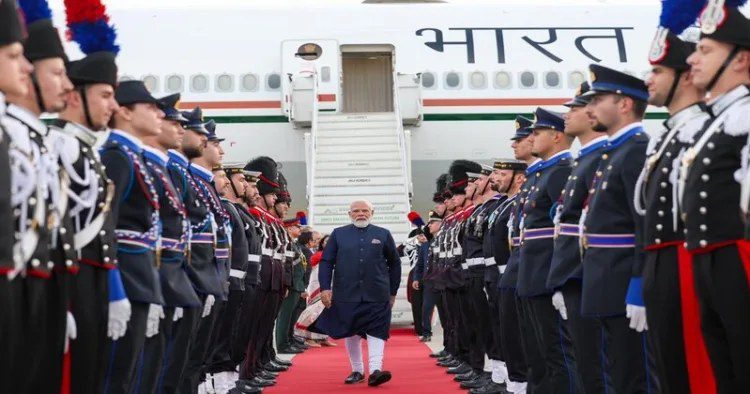
During Prime Minister Narendra Modi’s visit to Rome, India and Italy on 20 May 2026 elevated their bilateral relationship to a Special Strategic Partnership (SSP). PM Modi and Italian PM Giorgia Meloni unveiled a roadmap targeting €20 billion in bilateral trade by 2029 — nearly doubling the current €11.7 billion — anchored by the India-Middle East-Europe Economic Corridor (IMEEC), defence industrial collaboration, and joint action on Indo-Pacific stability.
The joint statement laid out cooperation across six pillars: trade and investment, defence and security, science and technology, mobility and migration, energy transition, and connectivity. A standalone defence industrial roadmap was signed for co-development of platforms, joint exercises and a Defence Industry Forum. Both leaders reaffirmed their commitment to multilateralism, UNCLOS-based maritime order, and a reformed UN Security Council with India as a permanent member.
Why It Matters
- India’s diplomatic upgrade ladder: India now has Special Strategic Partnerships with the US, France, Japan, Russia, UAE, Saudi Arabia, Australia and now Italy. Italy is the third EU member-state at this level (with France and Germany).
- IMEEC anchor: The India-Middle East-Europe Economic Corridor — launched at the G20 New Delhi Summit (2023) — runs through UAE, Saudi Arabia, Jordan, Israel and terminates in Europe through Italian Mediterranean ports. Italy is the EU end-point.
- Defence diversification: India has signalled a deliberate diversification away from single-source Russian dependency; partnerships with Italy (Leonardo, Fincantieri) add a Western European supplier to the existing French (Dassault, Naval Group) basket.
- Constitutional framework for treaties: Article 51 (Promotion of international peace and security) and Article 253 (Parliament’s power to implement treaties) form the constitutional backbone for any treaty obligations India undertakes.
Key Concepts & Provisions
- Article 51 — DPSP on international relations: Endeavour to promote international peace and security, maintain just and honourable relations, foster respect for treaty obligations and encourage arbitration to settle disputes.
- Article 253 — Legislation for treaties: Parliament has exclusive power to make any law for implementing any treaty, agreement or convention with any country, notwithstanding the federal distribution of powers in Schedule VII.
- IMEEC: A connectivity, energy and digital infrastructure corridor signed at G20 2023 New Delhi; presented as a transparent alternative to China’s Belt and Road Initiative.
- UNCLOS 1982: The UN Convention on the Law of the Sea — India ratified in 1995; Italy ratified in 1995. Both reaffirmed UNCLOS-based maritime order, an indirect message on the South China Sea.
- Trieste / Genoa hubs: Italy’s deep-water Mediterranean ports are envisaged as the EU terminus of the maritime leg of IMEEC.
- Italian Coalition government: PM Giorgia Meloni leads the Brothers of Italy (Fratelli d’Italia) — a centre-right coalition with Forza Italia and Lega.
The CLAT Connection
India-Italy is high-yield current affairs for CLAT 2027. Three angles to lock in:
- IR/Polity passage: The difference between a Strategic Partnership, an Enhanced Strategic Partnership and a Special Strategic Partnership — terminology matters in the MCQ.
- Constitutional crossover: A treaty needs neither ratification by Parliament nor State legislature consent (executive power under Article 73), but its implementation through domestic law requires Parliament’s exclusive jurisdiction under Article 253.
- Geo-economics MCQ: Memorise the IMEEC route — India → UAE → Saudi Arabia → Jordan → Israel → Greece/Italy → wider Europe. The Italian leg is critical for any IMEEC question.
Quiz data empty after normalization.