CURRENT AFFAIRS | 15 JUNE 2026
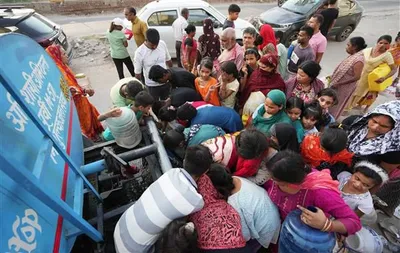
A summer of water contamination and shortages in affluent South Delhi neighbourhoods — Gulmohar Park, Hauz Khas, Sarvodaya Enclave and Green Park — has exposed the strain on India’s ageing urban water infrastructure. Delhi loses nearly 40% of supplied water as non-revenue water (leaks), with the DJB’s 16,634-km network including about 5,500 km of pipelines over 30 years old.
An Indian Express editorial by CEEW experts (Parameswaran Iyer, Arunabha Ghosh, Nitin Bassi) warns that per-capita water availability — now ~1,500 m³ — could fall below 1,200 m³ by 2050, nearing the 1,000 m³ water-stress threshold. Only about 28% of urban sewage is currently treated.
The remedy proposed is a circular water economy: treating and reusing wastewater for non-potable uses such as irrigation, industry, landscaping and construction. CEEW estimates this could unlock a market worth ₹1 lakh crore and 1,00,000 jobs by 2047. States like Uttarakhand, UP and Odisha have water-reuse policies, while Zero Liquid Discharge (ZLD) is pushed for industry.
Constitutional / Legal Framework
The right to water is read into Article 21 (right to life), reinforced by the Directive Principle Article 48A and Fundamental Duty Article 51A(g) on protecting the environment. The Supreme Court recognised access to clean water as part of the right to life in Subhash Kumar v. State of Bihar (1991). The statutory backbone is the Water (Prevention and Control of Pollution) Act, 1974, enforced alongside the National Green Tribunal (NGT).
CLAT Angle
Environment-and-rights questions love this cluster: the right to water under Article 21, sustainable development, and Subhash Kumar v. State of Bihar. Add the policy facts — the 1,000 m³ stress threshold, Zero Liquid Discharge, the Jal Jeevan Mission and the NGT — for legal-reasoning and assertion-reason items.
Key Facts
| Non-revenue water (Delhi) | ~40% lost to leaks |
| DJB network | 16,634 km; ~5,500 km over 30 yrs old |
| Per-capita water | ~1,500 m³ now; <1,200 m³ by 2050 |
| Stress threshold | 1,000 m³ per capita |
| Urban sewage treated | Only ~28% |
| Circular water potential | ₹1 lakh crore; 1,00,000 jobs by 2047 |
Mnemonic / Memory Hook
“REUSE before the well runs DRY at 1000.” The circular water economy = treat-and-REUSE wastewater; 1,000 m³ is the per-capita water-stress line; recall “ZLD = Zero Liquid Discharge” for industry and Subhash Kumar (1991) for the right to clean water.
Why this matters for CLAT 2027: The right to water under Article 21, environmental Directive Principles (48A, 51A(g)) and cases like Subhash Kumar v. State of Bihar are recurring CLAT legal-reasoning and GK themes. Pair the circular-water-economy facts with the 1,000 m³ stress threshold and the Water Act 1974 to answer CLAT 2027 environment-governance questions.
Practice Quiz — 10 CLAT-Style Questions
Click an option to reveal the answer and explanation.